
Description
The Invicta Black Prince Drophead Coupé was the most elegant and desirable version of Invicta’s short-lived but technically brilliant postwar revival—a magnificent open grand tourer that combined traditional British craftsmanship with cutting-edge mechanical innovation. Built in extremely limited numbers between 1946 and 1950, the Drophead Coupé variant embodied all the sophistication and engineering ambition of the Invicta Black Prince line, but clothed it in a graceful, hand-built convertible body that epitomised understated luxury. With its advanced chassis, semi-automatic transmission, and fine coachwork, it stood as one of the most technically accomplished and exclusive cars of its era, rivalled in spirit only by the likes of Bentley, Lagonda, and Alvis.
The Black Prince project was the vision of engineer and industrialist D. M. “Mike” Oliver, who sought to resurrect the Invicta marque after World War II as a showcase of British technical ingenuity. Determined that the new Invicta would match or surpass the pre-war reputation established by Noel Macklin’s superb Type S models, Oliver developed a car of extraordinary refinement and sophistication. The result, first unveiled in 1946, was a luxury grand tourer of the highest order—a car that combined the grace and craftsmanship of the 1930s with the most forward-thinking engineering Britain had to offer.
At the heart of the Black Prince Drophead Coupé was a 3.0-litre inline six-cylinder Meadows engine, a unit designed and built specifically for Invicta. This overhead-valve powerplant, with twin SU carburettors and a robust crankshaft, developed approximately 120 horsepower, providing smooth and flexible performance. In an era when most British saloons struggled to reach 80 mph, the Invicta could comfortably cruise at that speed for hours, with a top speed approaching 100 mph. The engine was mated to one of the car’s most remarkable features—the Brockhouse Hydro-Kinetic pre-select transmission, an early form of semi-automatic gearbox. This innovative system allowed the driver to pre-select gears using a small lever on the dashboard; the change was then made hydraulically when the clutch pedal was pressed, resulting in smooth, seamless shifts. The transmission’s fluid coupling also made the car exceptionally easy to drive, even in heavy traffic—a revelation in the late 1940s.
The chassis of the Black Prince was equally advanced. It was a rigid box-section steel structure, equipped with fully independent suspension on all four wheels—an exceedingly rare feature at the time. The front used double wishbones and coil springs, while the rear employed transverse torsion bars and trailing arms, providing a supple, composed ride. This system endowed the car with exceptional comfort and handling stability, qualities that were decades ahead of most competitors. Steering was by rack and pinion—another innovation seldom found in luxury cars of the era—and braking was handled by large, servo-assisted hydraulic drums, offering both strength and precision. The overall impression was of a car engineered for effortlessness: poised, quiet, and uncannily smooth over even the roughest roads.
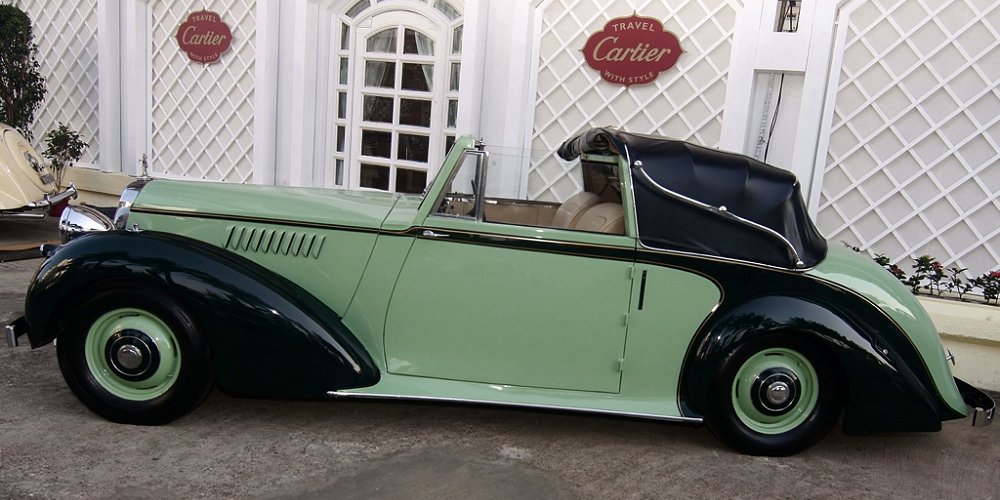
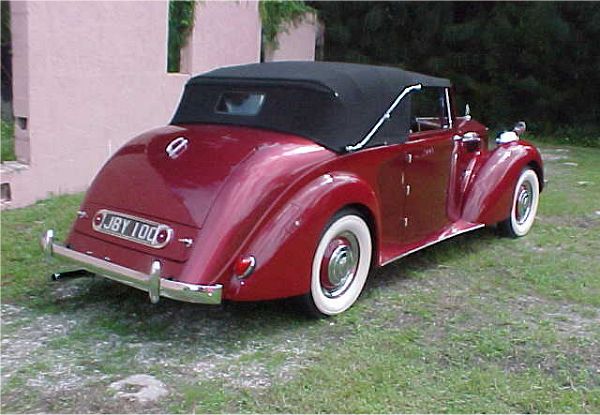
The bodywork of the Black Prince Drophead Coupé was designed and constructed by Britain’s foremost coachbuilders, with Carbodies of Coventry and Airflow Streamlines of Maidenhead among those supplying bodies. Each example was hand-built to order, ensuring that no two were identical. The Drophead Coupé design was a masterpiece of proportion and craftsmanship, combining the stately dignity of a postwar luxury car with the relaxed elegance of an open tourer. The long bonnet and sweeping front wings gave it a sense of restrained power, while the gently curved rear deck and low roofline created a fluid, harmonious silhouette. When lowered, the heavy, lined canvas hood folded neatly behind the seats, preserving the car’s graceful profile. Chrome accents were applied sparingly but tastefully—around the grille, window frames, and headlights—enhancing rather than overwhelming the car’s refined lines.
Inside, the Black Prince Drophead Coupé offered an atmosphere of serene opulence. The cabin was beautifully trimmed in traditional British luxury materials: polished walnut veneer, thick Wilton carpeting, and supple Connolly hide upholstery. The seats were broad and deeply padded, offering comfort for long journeys, while the dashboard presented an exquisite arrangement of Smiths instruments, toggle switches, and the distinctive gear-selection lever for the hydro-kinetic transmission. Every detail reflected meticulous craftsmanship—from the precision of the metal switchgear to the solidity of the doors and the quality of the stitching. Unlike many contemporaries, the Invicta’s convertible roof was superbly engineered, folding and latching with ease and providing excellent weather protection when raised.
Driving the Invicta Black Prince Drophead Coupé was a remarkably sophisticated experience for its time. The Meadows engine delivered smooth, linear power, its quiet mechanical note a testament to precision engineering. The semi-automatic transmission made progress almost seamless—one could glide through city streets or along open roads with minimal effort. The independent suspension provided a level of ride comfort that few contemporaries could match, and the car remained composed and steady even at high speeds. Steering was light yet communicative, and the servo-assisted brakes gave reassuring control. In essence, the Black Prince Drophead Coupé was the ideal postwar grand tourer: fast, silent, and supremely civilized.
Yet this perfection came at a price—both literally and figuratively. When new, the Black Prince cost around £3,500, a sum far beyond the reach of most motorists and even more expensive than a Bentley Mk VI. The car’s complex engineering also made production slow and costly, and with Britain’s postwar economy focused on austerity and export, such a luxury machine was inevitably a niche product. As a result, only around 16 to 18 Invicta Black Prince cars were ever completed, of which just a handful were Drophead Coupés. Each was a bespoke creation, ordered by a wealthy individual who valued exclusivity and technical innovation above all else.
Despite its limited commercial success, the Black Prince remains one of the most remarkable British cars of its age. It represented a vision of postwar motoring that was both ambitious and idealistic—a belief that the future of luxury automobiles lay in comfort, refinement, and engineering precision. In its time, it stood shoulder to shoulder with the very best Europe had to offer, from Delahaye and Talbot-Lago in France to the early postwar Lagondas in Britain.
Today, the Invicta Black Prince Drophead Coupé is among the rarest and most coveted British classics. Its combination of innovation, craftsmanship, and beauty makes it a jewel of the late 1940s motoring world. Collectors prize it not only for its rarity but for what it represents—a car built without compromise, in the finest tradition of bespoke British engineering.
The Black Prince Drophead Coupé was more than just a car; it was a statement of optimism and excellence in a time of rebuilding. It embodied the Invicta spirit of unyielding quality and forward-thinking design, carrying the marque’s proud motto—“Unconquered”—into the modern age. Elegant, powerful, and serenely effortless, it remains one of the finest postwar convertibles ever built, a true aristocrat among automobiles.