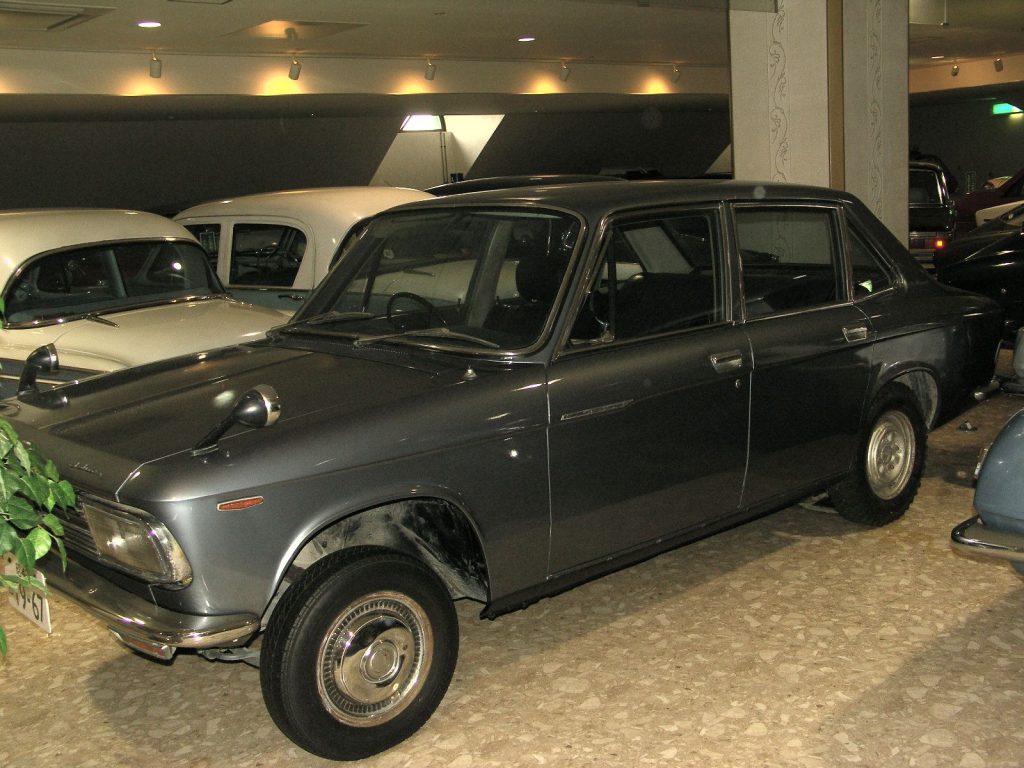
The Isuzu Florian 1600 DX was the successor to the pioneering Bellel and served as Isuzu’s mainstay mid-sized sedan throughout the late 1960s and 1970s. Introduced in 1967, the Florian marked a major step forward for Isuzu in terms of styling, refinement, and drivability. While the earlier Bellel had been known for its mechanical honesty and technical innovation, the Florian represented a more mature and cosmopolitan vision — a family car designed for comfort, reliability, and subtle sophistication. In the 1600 DX version, Isuzu offered a model that combined dependable performance with understated elegance, aimed squarely at Japan’s growing professional and middle-class markets.
The Florian’s design reflected the influence of Giorgetto Giugiaro, who had also penned the Isuzu 117 Coupé. Although the 117 would become the brand’s design icon, the Florian shared its essential proportions and stylistic restraint. Its shape was clean, rectilinear, and thoughtfully proportioned — a car of quiet confidence rather than flourish. The long, flat bonnet, upright cabin, and gently sloping rear gave it a stately presence, while fine chrome detailing along the grille, window frames, and bumpers provided a hint of formality. The car’s simplicity was deliberate, intended to convey solidity and modernity at a time when Japan was rapidly industrializing and car ownership was becoming an attainable symbol of success.
The Florian was built on a strong unibody platform with a relatively long wheelbase, giving it excellent interior space for a car of its size. The 1600 DX sat in the middle of the range — the “DX” standing for “Deluxe” — and offered a well-balanced specification that prioritized refinement over flash. The bodywork was executed with Isuzu’s characteristic precision, featuring tight panel gaps and a level of finish that reflected the company’s reputation for meticulous engineering.
Under the bonnet, the Florian 1600 DX was powered by Isuzu’s G161 engine, a 1,587 cc inline four-cylinder with an overhead camshaft — a technically advanced design for a mid-sized Japanese car of the time. Producing around 88 horsepower and 12 kg-m (87 lb-ft) of torque, it delivered smooth, flexible performance that suited both city and highway driving. The engine was paired with a four-speed manual gearbox as standard, though a three-speed automatic was available later in the model’s life. The drivetrain was rear-wheel drive, continuing the traditional layout that provided both simplicity and balance.
The G161 engine was one of the most refined powerplants of its class, noted for its quiet operation and durability. It had been derived from the same G-series family that powered the 117 Coupé and the Bellett, but in the Florian it was tuned for relaxed cruising rather than outright performance. The car could reach a top speed of approximately 150 km/h and returned fuel economy figures in the range of 11 to 13 kilometers per litre, making it both capable and economical for its era.
The suspension layout followed a conventional but well-developed pattern: independent double wishbones and coil springs at the front, and a live rear axle with leaf springs at the back. This combination gave the car a supple, composed ride, capable of absorbing rough roads with ease while maintaining good stability at higher speeds. The steering was light and accurate, and braking was handled by front discs and rear drums — a setup that provided strong and predictable stopping power.
Inside, the Florian 1600 DX reflected Isuzu’s growing attention to comfort and detail. The cabin was spacious, thanks to the car’s boxy but well-judged proportions, and could comfortably accommodate five adults. The dashboard was neatly designed, with clear round instruments set within a horizontal layout and simple, logically arranged controls. Upholstery was typically in cloth or vinyl, with patterned textures that gave the interior a refined but practical atmosphere. Chrome accents and simulated wood trim on higher trims added a touch of warmth. The DX model included standard equipment such as a heater, cigarette lighter, AM radio, and reclining front seats — modest features by today’s standards, but significant for a Japanese sedan of the late 1960s.
On the road, the Florian 1600 DX was praised for its smoothness, quietness, and composure. The engine’s flexibility allowed relaxed progress in traffic, and its free-revving nature made it pleasant to drive on open roads. The car’s ride quality was a particular strength: soft enough to absorb uneven surfaces yet firm enough to maintain stability and control. The balance between ride and handling reflected Isuzu’s careful tuning, aimed at producing a car that was comfortable, safe, and easy to live with.
While it never achieved the sales volumes of the Toyota Corona or Nissan Bluebird, the Florian built a loyal following among buyers who valued quality and engineering integrity over brand prestige. Its sturdy construction and refined mechanicals made it a favorite among government departments, taxi fleets, and private owners who expected longevity from their vehicles.
The Florian also served as a platform for a range of derivatives, including the elegant 117 Coupé and various commercial versions, as well as the later Isuzu Gemini-based sedans that would succeed it. The 1600 DX remained in production through the early 1970s, with incremental updates to trim, lighting, and mechanical components.
Today, the Isuzu Florian 1600 DX is remembered as one of the unsung achievements of Japan’s first wave of mature, world-class sedans. It lacked the flamboyance of sports cars or the ubiquity of its mass-market rivals, but it offered something equally valuable — quiet confidence, solid engineering, and a sense of craftsmanship that reflected Isuzu’s precision-driven ethos.
The Florian 1600 DX was a car of substance rather than show, built for people who appreciated quality and dependability. It represented the steady evolution of Japan’s automotive industry from imitation to individuality — a car designed not just to move people, but to do so with grace, comfort, and integrity.