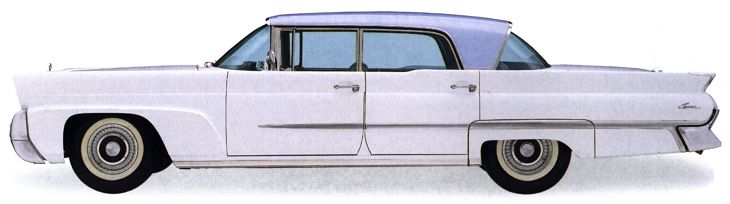
Description
The Lincoln Capri was a pivotal car in Lincoln’s history, representing the brand’s transition from traditional postwar luxury into the modern age of design, power, and engineering excellence. Introduced for the 1952 model year, the Capri replaced the Cosmopolitan and immediately established itself as a refined, forward-thinking automobile—sleeker, faster, and more sophisticated than its predecessor. It was the car that revitalized Lincoln’s reputation and set the foundation for its success in both luxury motoring and international endurance racing.
The early 1950s were a time of change for Lincoln. The company sought to move away from the heavy, conservative designs of the late 1940s and embrace a new philosophy of performance-oriented luxury. The Capri embodied this shift perfectly. It was built on a slightly shorter 123-inch wheelbase than the outgoing Cosmopolitan, giving it a more compact and agile stance, yet it retained Lincoln’s hallmark smoothness and comfort. Offered as a two-door hardtop, four-door sedan, or convertible, the Capri appealed to buyers who wanted understated elegance with modern performance.
Under its long, low hood, the Lincoln Capri featured an all-new 5.2-litre (317 cubic inch) overhead-valve V8 engine, marking Lincoln’s first departure from the older flathead design. Producing 160 horsepower and 250 lb-ft of torque, this engine transformed the car’s character, delivering brisk acceleration and effortless cruising. In 1954, output increased to 205 horsepower, and by 1955 the engine grew to 5.6 litres (341 cubic inches) with 225 horsepower, keeping the Capri competitive with Cadillac and Chrysler. Power was delivered through the smooth Hydra-Matic four-speed automatic transmission, providing seamless gear changes and making the Capri one of the most comfortable luxury cars to drive in its class.
The Capri’s engineering excellence extended beyond its powertrain. The chassis featured independent front suspension with coil springs and a solid rear axle with semi-elliptic leaf springs, tuned for both ride comfort and stability. The car’s body was constructed with exceptional rigidity, reducing vibration and improving road manners. Hydraulic drum brakes provided confident stopping power, and optional power steering and power brakes added to the car’s refinement and ease of operation. The result was a car that combined the comfort expected of a Lincoln with a degree of precision and control that was rare in full-sized American cars of the time.
Stylistically, the Capri was a clean, elegant interpretation of early 1950s design trends. The body was lower and sleeker than before, with smooth, flowing lines and subtle chrome accents that enhanced rather than dominated the car’s form. The wide horizontal grille and integrated headlamps gave the front end a modern, confident appearance, while the tapering rear fenders and modest tailfins hinted at the jet-age influences beginning to shape automotive design. The wraparound rear window, introduced in 1954, gave the cabin an airy feel and became one of the Capri’s most recognizable features.
Inside, the Lincoln Capri offered a cabin that balanced comfort, luxury, and modernity. The dashboard was symmetrical and thoughtfully arranged, featuring large, easy-to-read instruments set in a polished metal fascia. Switches and controls were placed logically within the driver’s reach, emphasizing functionality as much as style. Upholstery was available in fine leather or patterned cloth, often in striking two-tone combinations that reflected the optimistic design spirit of the era. The wide bench seats were deeply cushioned, providing true long-distance comfort, and sound insulation throughout the body ensured a quiet, serene driving environment.
The Lincoln Capri was more than a statement of luxury—it was also a demonstration of capability. To prove its durability and engineering excellence, Lincoln entered the Capri in the legendary Carrera Panamericana, a 2,000-mile endurance race across Mexico. Competing against some of the fastest and most advanced cars in the world, the Capri astonished observers by winning its class three years in a row, from 1952 to 1954. These victories showcased the car’s combination of strength, reliability, and performance under extreme conditions, earning Lincoln international respect and solidifying the Capri’s reputation as a car built to last.
The Capri’s success on the road and in competition also influenced its evolution. Lincoln refined the model each year with incremental improvements in performance, comfort, and technology. The 1955 model represented the peak of the first-generation Capri, featuring updated styling, a more powerful engine, and a more luxurious interior. In 1956, the Capri name continued as part of a redesigned Lincoln lineup that included the Premiere, but the spirit of the original—its balance of power, poise, and refinement—remained central to the brand’s identity.
Driving a Lincoln Capri was an experience defined by effortless confidence. The V8 engine provided smooth, abundant power, and the Hydra-Matic transmission made progress seamless. On open highways, the Capri cruised quietly and steadily, its suspension absorbing imperfections with ease. The steering was light but precise, and the brakes were strong and predictable. The car exuded a sense of calm authority—luxury not through excess, but through refinement and control.
Today, the Lincoln Capri is remembered as one of the most important models in the marque’s history. Collectors prize it for its elegant design, robust engineering, and direct connection to Lincoln’s racing heritage. Restored examples highlight the car’s craftsmanship and enduring appeal, while its role in the brand’s revival during the 1950s ensures its place as a milestone in American automotive history.
The Lincoln Capri was more than just a luxury automobile—it was a turning point. It represented Lincoln’s return to form, combining beauty, performance, and reliability in a way that few cars of its time could match. With its blend of quiet sophistication and proven strength, the Capri defined what a modern Lincoln should be: powerful, graceful, and built to endure.