Description
The Lincoln Capri Convertible was one of the most graceful and technically advanced American luxury cars of the early 1950s, a model that reflected Lincoln’s growing confidence in styling, performance, and engineering innovation. Introduced in 1952 as part of the new Lincoln Capri lineup, the Convertible embodied a subtle blend of power, refinement, and elegance that would carry Lincoln to prominence in both the luxury market and international motorsport. With its sleek design, powerful overhead-valve V8 engine, and sophisticated ride, the Capri Convertible represented the dawn of Lincoln’s modern era and the culmination of the brand’s postwar evolution.
The Capri replaced the outgoing Cosmopolitan as Lincoln’s flagship model and was built on a slightly shorter and more rigid 123-inch wheelbase chassis, which improved handling and reduced weight without compromising comfort. The Convertible was the most glamorous body style in the range, combining Lincoln’s contemporary design language with the freedom and prestige of open-air motoring. It was aimed at affluent buyers who wanted a car that was both luxurious and advanced, capable of offering the comfort of a traditional Lincoln while embracing the performance and styling trends that defined early 1950s America.
Power for the 1952 Lincoln Capri Convertible came from an all-new 5.2-litre (317 cubic inch) overhead-valve V8 engine—Lincoln’s first modern overhead-valve design. Producing 160 horsepower and 250 lb-ft of torque, it replaced the older flathead units used in previous models and immediately elevated Lincoln’s performance credentials. The new engine was mated to the Hydra-Matic four-speed automatic transmission, developed under license from General Motors, which provided smooth, reliable power delivery. The combination gave the Capri strong acceleration and effortless cruising ability, with a top speed of nearly 100 mph—an impressive figure for a full-sized American luxury car of the time.
The chassis and suspension of the Capri Convertible were engineered for both comfort and control. Independent front suspension with coil springs and a robust rear setup using leaf springs provided a supple, composed ride. Hydraulic drum brakes offered strong stopping power, and power steering and power brakes became available options, further enhancing ease of operation. The car’s weight distribution and lower center of gravity, thanks to its shorter frame and more compact drivetrain, gave it a planted, confident feel on the road. These qualities would later prove crucial when Lincoln entered the Capri in international endurance racing, where its engineering excellence earned it unexpected success.
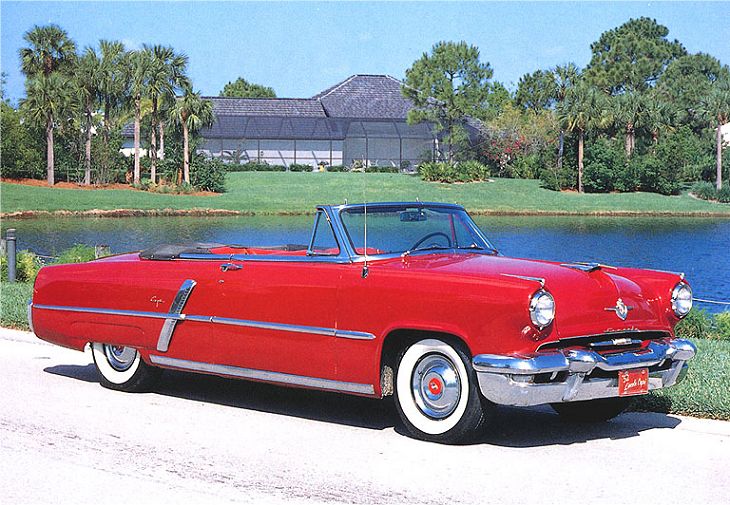
Visually, the Lincoln Capri Convertible was a study in early 1950s American style—elegant, streamlined, and distinctly modern without being ostentatious. The body was characterized by clean, flowing lines, a lower and wider stance, and minimal chrome ornamentation compared to its contemporaries. The front featured a wide horizontal grille with integrated parking lamps, flanked by rounded fenders and large circular headlamps. A modest chrome strip ran along the sides, accentuating the car’s length and visual grace. The windshield was a one-piece curved design, a hallmark of postwar aerodynamics, and the rear deck tapered gently toward the integrated tail lamps. When the power-operated convertible top was lowered, the Capri revealed an open, luxurious profile that perfectly captured the spirit of early 1950s motoring.
Inside, the Capri Convertible offered a cabin of comfort and craftsmanship befitting its luxury status. The dashboard was wide and symmetrical, featuring circular gauges set within a polished metal fascia. Controls for heating, ventilation, and the optional radio were grouped logically within easy reach, while the automatic transmission selector was mounted on the steering column. Seats were broad and deeply cushioned, trimmed in high-grade leather or patterned vinyl, often with contrasting color schemes that reflected the optimism of postwar design. Chrome detailing and subtle brightwork adorned the instrument panel, while thick carpeting and sound insulation enhanced the car’s sense of refinement.
Driving the Lincoln Capri Convertible was a remarkably sophisticated experience for its time. The V8 engine provided effortless torque, allowing smooth, steady acceleration, while the automatic transmission shifted unobtrusively. The ride was supple but well-controlled, and the cabin remained quiet even with the top down at cruising speed. The car’s steering was light and predictable, and the brakes were firm and confidence-inspiring. Few cars of the early 1950s combined such comfort with genuine high-speed capability.
In 1953 and 1954, the Lincoln Capri’s engineering excellence was demonstrated on the world stage when Lincoln entered a series of endurance races, most notably the Carrera Panamericana in Mexico—a grueling event that tested both speed and durability. The Capri Convertible’s chassis was adapted for competition, and the results were remarkable: Lincoln Capris dominated their class, winning the 1952, 1953, and 1954 events and proving that a luxury car could also be a formidable performance machine. This success not only enhanced Lincoln’s reputation for reliability and engineering prowess but also cemented the Capri’s place in motorsport history.
The Capri Convertible remained in production until 1955, with steady refinements each year. Later models gained more powerful versions of the V8 engine—up to 225 horsepower—and updated styling with larger grilles, revised trim, and the introduction of wraparound windshields. Yet the essential character of the car remained unchanged: refined, poised, and built with the quiet confidence that defined Lincoln’s postwar identity.
Today, the Lincoln Capri Convertible is remembered as one of the brand’s landmark models—an automobile that bridged the gap between classic postwar luxury and the modern performance-oriented era. Collectors admire it for its elegant proportions, advanced mechanical design, and its role in Lincoln’s international racing triumphs. Restored examples are valued not just for their rarity, but for the sense of grace and power they still convey more than seventy years later.
The Lincoln Capri Convertible was more than a stylish open car—it was a symbol of progress and prestige in the early 1950s. With its powerful new V8 engine, confident handling, and understated elegance, it represented Lincoln’s transformation into a world-class luxury manufacturer. It was the car that redefined what American sophistication could look like—sleek, capable, and effortlessly composed, whether gliding down a boulevard or thundering across the mountains of Mexico.