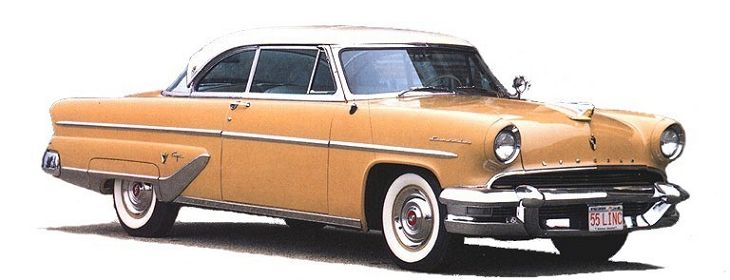
Description
The Lincoln Capri V8 was one of the defining luxury automobiles of the early 1950s, a car that demonstrated how refined power, modern design, and technical sophistication could coexist in a single, beautifully proportioned package. Introduced in 1952 as the top-tier model in Lincoln’s new postwar lineup, the Capri marked a pivotal moment for the brand. It was both a return to Lincoln’s heritage of craftsmanship and a bold step into the new era of overhead-valve V8 performance, aerodynamic styling, and international recognition.
The Capri replaced the older Cosmopolitan and immediately stood apart for its cleaner, lower lines and advanced mechanical engineering. It was offered in several body styles—including the Coupe, Sport Sedan, and Convertible—but all shared the same design language of restrained elegance and modern confidence. Beneath the smooth sheet metal lay one of Lincoln’s most important innovations: a new overhead-valve V8 engine that would redefine the marque’s reputation for performance and durability.
That engine was the 5.2-litre (317 cubic inch) Y-block V8, the first overhead-valve design in Lincoln’s history. It produced 160 horsepower and 250 lb-ft of torque in its debut year—figures that placed the Capri among the most powerful American cars of the time. The engine was built for refinement as much as strength. Its smooth, low-revving character delivered effortless acceleration, while its rugged construction, featuring deep-skirted block casting and efficient cooling, made it exceptionally durable. Power was sent to the rear wheels through a Hydra-Matic four-speed automatic transmission, licensed from General Motors, providing quiet and seamless gear changes. The combination of V8 power and automatic convenience made the Capri one of the most advanced luxury cars on the road in 1952.
The Capri’s chassis and suspension were designed to match its new engine’s capabilities. Built on a strong, box-section steel frame, it featured independent front suspension with coil springs and a solid rear axle with leaf springs—tuned to balance comfort and control. Hydraulic drum brakes provided effective stopping power, and the car’s low center of gravity gave it exceptional stability at speed. The Capri’s handling was praised by both critics and drivers, offering a smooth, predictable ride that felt confident on highways and composed on winding roads.
Stylistically, the Lincoln Capri V8 was a clear statement of postwar modernism. The body was clean and purposeful, avoiding the excessive chrome and ornamentation that had become common in early 1950s American cars. The front end was distinguished by a wide horizontal grille framed by rounded fenders and integrated headlamps, giving the car a broad, poised appearance. The roofline was low and flowing, with a graceful curve that blended seamlessly into the rear deck. The overall proportions emphasized length and stability, while subtle chrome detailing along the sides and around the windows accentuated the car’s elegant silhouette.
The interior of the Lincoln Capri reflected a similar philosophy of understated luxury. The dashboard was wide and symmetrical, with a full array of circular instruments set within a polished metal panel. Controls for heating, ventilation, and the radio were grouped logically, and the automatic transmission selector was mounted conveniently on the steering column. Upholstery options included fine broadcloth, leather, or patterned vinyl, often in two-tone color schemes that added vibrancy to the cabin. Thick carpeting, sound insulation, and careful attention to fit and finish created a calm, refined atmosphere.
Behind the wheel, the Capri V8 was a revelation. The new engine provided abundant torque, allowing the car to glide effortlessly through traffic or climb steep hills without strain. The Hydra-Matic transmission shifted smoothly, and the car cruised easily at highway speeds with a level of quietness that rivaled far more expensive European marques. The suspension soaked up imperfections in the road, and the steering—though unassisted—was light enough to make maneuvering easy while maintaining excellent feedback. It was a car built for long, unhurried journeys, exuding an air of confident composure that few contemporaries could match.
The Capri’s engineering prowess was not limited to comfort and luxury—it also proved itself in competition. In the early 1950s, Lincoln entered the Capri in the grueling Carrera Panamericana, a 2,000-mile endurance race across Mexico. Competing against purpose-built sports cars and factory-backed European teams, the Capri shocked the racing world by winning its class and finishing among the overall leaders for three consecutive years, from 1952 to 1954. The victories demonstrated the car’s remarkable durability, balance, and reliability under extreme conditions, enhancing Lincoln’s reputation worldwide.
These racing triumphs also highlighted the Capri’s dual nature: it was both a refined luxury automobile and a high-performance touring car. It could carry four passengers in comfort and elegance across a continent, yet its V8 power and sturdy chassis allowed it to endure the most punishing race routes in the world. This versatility became a defining trait of the Lincoln brand throughout the 1950s.
The Capri evolved through its production run from 1952 to 1955, gaining incremental improvements in power, comfort, and style. By 1955, engine displacement had grown to 341 cubic inches with output increased to 225 horsepower, while the introduction of power steering and power brakes made driving even easier. The exterior styling became more elaborate in later years, with wraparound windshields and additional chrome, but the essential character of the Capri remained intact—refined, balanced, and quietly authoritative.
Today, the Lincoln Capri V8 is recognized as one of the key transitional models in Lincoln’s history. It bridged the gap between the classic, formal luxury cars of the prewar and early postwar years and the bold, performance-oriented Continentals that would follow. Collectors value the Capri for its clean lines, mechanical robustness, and historical significance as the car that revitalized Lincoln’s image both at home and abroad.
The Lincoln Capri V8 stood as a statement of American progress at a time when the world was rediscovering optimism. It combined advanced engineering, graceful design, and effortless power in a way that redefined what a luxury car could be. More than seven decades later, it remains a symbol of the confidence and craftsmanship that carried Lincoln into the modern age—an enduring example of elegance expressed through motion and mastery.