Description
The Lincoln Continental Convertible was one of the most elegant and historically significant automobiles ever produced in America, embodying the very essence of open-air luxury and mid-century design sophistication. Produced intermittently from the early 1940s through the late 1960s, it was most famously reborn in 1961 as part of the all-new fourth-generation Continental series—a car that came to define American automotive design for an entire era. With its clean, unadorned lines, innovative engineering, and dignified character, the Lincoln Continental Convertible was not merely a car—it was a cultural icon.
The 1961 Continental Convertible represented a complete departure from the excesses of the late 1950s. At a time when Detroit was producing increasingly flamboyant designs with towering fins and heavy chrome, Lincoln chose a different path. Under the leadership of Elwood Engel, the design team embraced minimalism, balance, and proportion. The result was a car of rare beauty—simple, harmonious, and modern. The body was lower, narrower, and shorter than the previous generation, giving it a sense of precision and purpose that instantly set it apart from every other luxury car on the road.
The Continental Convertible shared its mechanical foundation with the Continental Sedan, built on a 123-inch wheelbase and powered by Lincoln’s smooth and robust 7.0-litre (430 cubic inch) MEL-series V8 engine. Producing around 300 horsepower and paired with a three-speed Turbo-Drive automatic transmission, the engine delivered ample performance with the refined smoothness expected of a luxury automobile. The car was capable of strong, effortless acceleration, while the massive torque ensured serene, unstrained cruising even at high speeds. Hydraulic power steering and power-assisted brakes came standard, making the Continental one of the easiest large convertibles of its time to drive.
One of the defining engineering achievements of the Lincoln Continental Convertible was its fully automatic power top mechanism. Unlike conventional convertibles, the Continental’s roof and rear decklid operated through a complex series of relays, hydraulic pumps, and motors that folded the soft top neatly into a concealed compartment beneath the rear deck. When raised, the roof sealed tightly against the windshield frame, preserving the car’s elegant lines and ensuring excellent weather protection. The decklid itself opened in reverse—hinged at the rear—to allow the top to stow cleanly inside. It was a remarkable piece of design and engineering sophistication, unmatched by any other American car of its day.
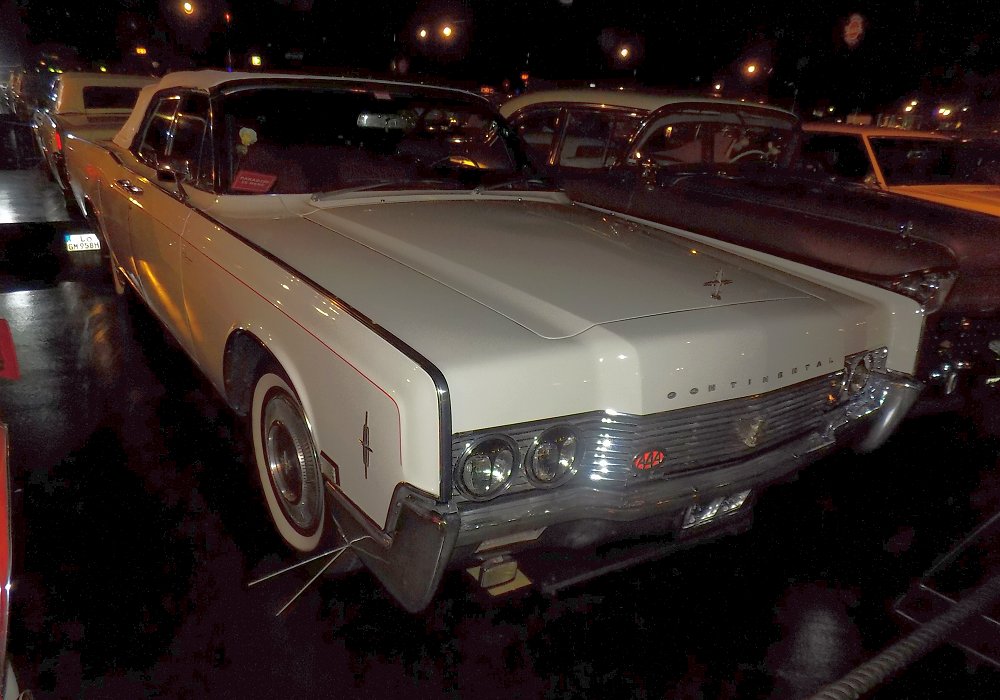
Stylistically, the Continental Convertible’s design was pure and timeless. The long, straight body sides, thin chrome accents, and perfectly proportioned overhangs created an impression of quiet strength and precision. The grille was simple and rectangular, flanked by quad headlamps integrated seamlessly into the fenders. The hood and deck surfaces were clean and unbroken, emphasizing the car’s strong horizontal lines. At the rear, full-width taillights extended across the trunk panel, enhancing the car’s sense of width and stability. The restrained use of chrome and the absence of decorative excess gave the Continental a look of understated sophistication that rivaled European marques such as Rolls-Royce and Mercedes-Benz.
The hallmark of the 1961–1967 Continental Convertible, however, was its unique rear-hinged “suicide” doors. Opening from the center, the front and rear doors met in the middle without a fixed B-pillar, allowing for graceful entry and exit—a feature borrowed from the earlier Continentals of the 1940s. It added to the car’s air of formality and exclusivity, while also serving as a practical advantage in tight spaces. The engineering precision required to maintain body rigidity and door alignment in a pillarless convertible was immense, and Lincoln’s success in achieving it remains a testament to the car’s exceptional build quality.
Inside, the Continental Convertible was every bit as refined as its exterior. The interior design followed the same minimalist philosophy—clean, symmetrical, and beautifully crafted. The dashboard featured linear instruments framed by brushed aluminum trim, with controls logically arranged and tactile in operation. Upholstery options included fine leather in a variety of tasteful colors, complemented by thick carpeting and subtle chrome highlights. The seats were broad and deeply cushioned, providing true long-distance comfort. Power windows, power seats, and automatic climate control came standard, while the cabin’s exceptional sound insulation created a serene environment, even with the top lowered.
Driving the Continental Convertible was an experience defined by quiet confidence. The car’s weight and long wheelbase gave it a composed, unhurried character on the road. The V8 engine provided smooth, steady thrust, and the ride—soft but never floaty—absorbed imperfections with authority. The car’s steering was light but precise, making it surprisingly manageable in traffic despite its size. With the top down, it offered one of the most tranquil open-air motoring experiences ever created—luxurious, isolated, and supremely comfortable.
The Continental Convertible became an American icon not only for its design but also for its cultural presence. It served as the official presidential limousine for John F. Kennedy, whose 1961 Continental Convertible (customized by Hess & Eisenhardt) remains one of the most historically significant automobiles in history. Beyond politics, the car appeared in countless films and television series, symbolizing elegance, power, and American craftsmanship.
Production of the Continental Convertible continued through 1967, after which it was discontinued due to the growing cost and complexity of manufacturing such a sophisticated open car. Fewer than 3,000 examples were built in most years, making it one of the rarest and most desirable Lincolns of its era. Its departure marked the end of an era—no four-door convertible has been produced by a major American manufacturer since.
Today, the Lincoln Continental Convertible stands as one of the most celebrated and collectible American cars of the 20th century. Its design is widely regarded as one of the finest ever executed in Detroit, blending precision, restraint, and elegance in perfect proportion. Restored examples command admiration at concours events, where their engineering, craftsmanship, and timeless beauty continue to captivate enthusiasts and designers alike.
The Lincoln Continental Convertible was more than a car—it was a symbol of modern American luxury, grace, and progress. It embodied a moment in history when design was guided by clarity rather than excess, and when engineering served art with subtle mastery. With its seamless blend of innovation and simplicity, it remains one of the most distinguished automobiles ever built—a true masterpiece of form, function, and quiet grandeur.