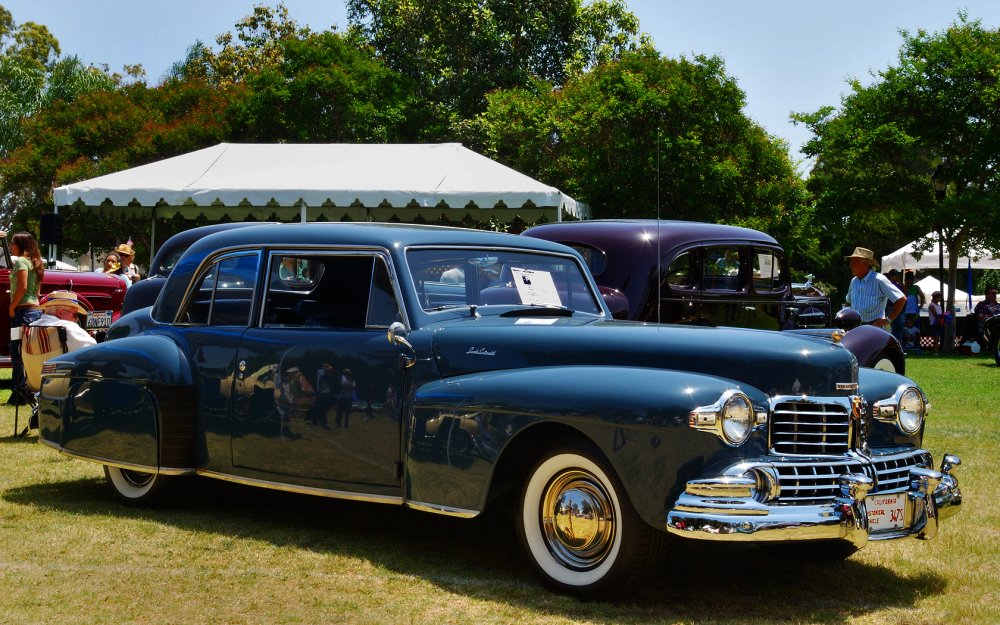
Description
The Lincoln Continental Coupe was one of the most elegant and influential American automobiles ever produced, a car that came to define the very concept of the personal luxury automobile. Born from Edsel Ford’s vision of creating a refined grand touring car with European-inspired design and American craftsmanship, the Continental Coupe combined beauty, balance, and engineering excellence in a way that few cars before or since have achieved. Introduced in 1940, it quickly became a symbol of sophistication and remains one of the most admired designs in automotive history.
The origins of the Continental trace back to 1938, when Edsel Ford, then president of Lincoln, asked designer Eugene “Bob” Gregorie to create a special, low, and sleek car for his personal use—a car with the clean, flowing lines he admired in European marques like Delahaye and Hispano-Suiza. Gregorie based his creation on the chassis of the Lincoln Zephyr but lowered the body, lengthened the hood, and eliminated unnecessary ornamentation. The result was a car of timeless proportion and elegance. When Edsel drove the prototype in Florida during the winter of 1939, it attracted immediate attention from admirers, many of whom offered to buy it on the spot. The overwhelming response led Lincoln to put the design into production as the 1940 Lincoln Continental.
At its heart, the Continental Coupe was powered by Lincoln’s 4.8-litre (292 cubic inch) V12 engine, a smooth, liquid-cooled unit producing around 120 horsepower. The engine was designed for refinement rather than high performance, delivering a quiet, steady flow of power through a three-speed manual gearbox with optional overdrive. The Continental’s V12 made it one of the few American cars of its time with twelve-cylinder smoothness, and the car’s long-stroke design produced ample low-end torque for relaxed cruising.
The chassis was adapted from the Lincoln Zephyr, featuring an advanced unit-body construction that integrated frame and body for rigidity and reduced weight. The wheelbase measured 125 inches, shorter than the Zephyr’s but perfectly suited to the car’s sleek proportions. Suspension used independent front springs with wishbones and a transverse leaf setup, while the rear employed semi-elliptic leaf springs. Hydraulic shock absorbers ensured a comfortable ride, and the four-wheel hydraulic brakes provided secure, progressive stopping power. The result was a car that combined grace with excellent handling for its class—stable at high speeds, supple over rough roads, and remarkably quiet inside.
The Continental Coupe’s design is what truly set it apart from anything else on American roads. It was a masterpiece of proportion and restraint. The long, unbroken hood line, gracefully curved fenders, and short rear deck gave the car a sense of movement even at rest. The front grille was narrow and vertically divided, framed by recessed headlamps and just enough chrome to highlight its contours. The roofline flowed smoothly into the rear fenders, creating a cohesive, almost sculptural shape. The spare wheel was mounted externally at the rear, encased in a metal housing that became known as the “Continental kit,” a signature design feature that would be echoed on later Lincoln models for decades.
The Coupe version offered a slightly more formal alternative to the Convertible, with a fixed roof and a more enclosed cabin that emphasized long-distance comfort and refinement. Despite its sleek exterior, the interior was spacious and impeccably finished. Seats were upholstered in fine leather or broadcloth, with deep cushioning and generous legroom. The dashboard was an example of Art Deco-inspired modern design, featuring symmetrical instrumentation and understated chrome detailing. Everything inside was designed for tactile satisfaction—smooth switches, soft materials, and a calm sense of luxury without excess.
Driving the Continental Coupe was an experience defined by effortlessness. The V12 engine delivered its power smoothly and quietly, while the overdrive transmission allowed relaxed high-speed touring. The steering was light for a car of its size, and the ride comfort was exceptional, with the suspension soaking up imperfections almost imperceptibly. The sound insulation and aerodynamic body design kept wind and mechanical noise to a minimum, creating an atmosphere of serene composure. It was a car that invited long journeys, encouraging its occupants to glide rather than rush.
The Continental was instantly recognized as something special upon its release. The press and public alike praised its beauty and refinement. It was soon dubbed “America’s most beautiful automobile,” and the Museum of Modern Art in New York later recognized it as a work of industrial art, including it in its 1951 “Eight Automobiles” exhibition as a design of enduring significance. The Continental’s simplicity, proportion, and elegance were a direct reflection of Edsel Ford’s personal taste—refined, cultured, and forward-looking.
Production of the first-generation Continental Coupe lasted from 1940 to 1942, and again briefly from 1946 to 1948 following World War II. Total production remained small—fewer than 2,000 prewar Coupes were built—making it one of the most exclusive Lincolns ever produced. After the war, the Continental retained its essential design, with only minor updates to the grille, trim, and interior fittings. It continued to embody understated luxury in an age when many manufacturers turned to heavier and more ornate styling.
Today, the Lincoln Continental Coupe is widely regarded as one of the most beautiful American cars ever built and one of the most important in Lincoln’s history. Collectors prize it for its design purity, rarity, and the smooth, distinctive character of its V12 powertrain. Well-preserved examples are highly sought after and often command places of honor at concours d’elegance events around the world.
The Lincoln Continental Coupe was more than a luxury car—it was a statement of design philosophy. It proved that elegance could be achieved through simplicity, that proportion mattered more than decoration, and that true sophistication lay in restraint. It embodied Edsel Ford’s vision of modern American luxury—quiet, confident, and timeless. Over eighty years later, its form remains as graceful and balanced as the day it was first sketched, a masterpiece of automotive art that continues to inspire admiration wherever it appears.