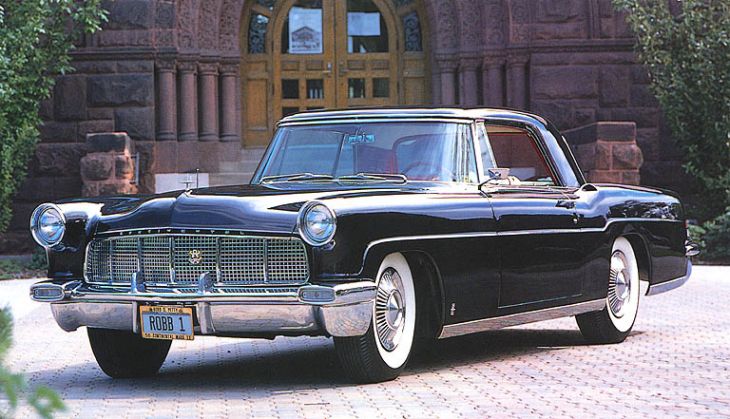
Description
The Lincoln Continental Mark II was one of the most exquisite and meticulously crafted automobiles ever produced in America, a car that embodied elegance, precision, and quiet prestige. Introduced in 1956, it was not merely another luxury model—it was a deliberate attempt to build the finest car in the world. The Mark II represented the rebirth of the Continental name, originally associated with Edsel Ford’s legendary 1940s design, and it was conceived as a bespoke grand tourer to rival the best of Europe. Every inch of the car reflected uncompromising quality, timeless design, and the pursuit of perfection that defined the vision of the Continental Division of Ford Motor Company.
The story of the Mark II began in the early 1950s, when Ford sought to reestablish itself as the leader in luxury motoring. The Continental Division was created in 1952 as a separate, semi-independent entity dedicated to producing a car of exceptional craftsmanship and exclusivity. Under the guidance of William Clay Ford and chief stylist John Reinhart, the design team envisioned a vehicle that would combine European restraint with American sophistication—a car that was elegant, understated, and built to the highest standards of fit and finish.
The result was the Continental Mark II, unveiled at the 1955 Paris Auto Show and introduced for the 1956 model year. It stood apart from every other American car of its time. While the mid-1950s automotive landscape was dominated by chrome, fins, and flamboyant styling, the Mark II was deliberately conservative. Its proportions were classical, its lines smooth and clean, and its details restrained. The long hood, short deck, and subtle curvature of the fenders created a look of timeless poise. The roofline was low and formal, with a crisp C-pillar that gave the car a dignified stance. The only flourish was the small, sculpted hump on the trunk lid—a graceful nod to the externally mounted spare wheel of the original 1940 Continental.
Beneath its elegant exterior, the Mark II was engineered to the highest standards. Power came from Lincoln’s 6.0-litre (368 cubic inch) Y-block V8 engine, producing 285 horsepower and paired with a three-speed Turbo-Drive automatic transmission. The engine was hand-assembled and individually tested to ensure perfect balance and smoothness. Power delivery was effortless, providing quiet acceleration and the ability to cruise comfortably at high speeds. The car’s body-on-frame construction was exceptionally rigid, contributing to its solid, composed ride. Independent front suspension with coil springs and a rear setup using semi-elliptic leaf springs delivered remarkable comfort and control, while power steering and power brakes were standard.
Every Mark II was built with painstaking attention to detail. The body panels were hand-fitted, sanded, and painted with multiple coats of lacquer, each polished by hand to a mirror finish. The interior was equally extraordinary. The dashboard, simple and symmetrical, featured precisely machined instruments and switches with aircraft-like precision. Upholstery was available in the finest leather hides from Scotland, hand-cut and tailored to fit each car. The seats were deep and supportive, offering long-distance comfort, while the carpeting was thick, tightly woven, and color-matched to the interior trim. Chrome accents were minimal, serving only to highlight the craftsmanship rather than to decorate.
Every feature of the Mark II was designed for understated luxury. Power windows, power seats, and automatic temperature control were standard, as were amenities like a full set of fitted luggage and a precision-tuned radio. The car’s refinement was remarkable for its time—road and engine noise were almost completely isolated, and the ride quality was both supple and controlled. At over 5,000 pounds, the Mark II felt as if it floated over the road, yet its handling was precise and stable.
The Mark II was priced accordingly. At around $10,000 in 1956—more than a Rolls-Royce Silver Cloud or a Cadillac Eldorado Biarritz—it was the most expensive production car built in America. Each example cost Ford more to produce than it sold for, as the company was less concerned with profit than with creating a symbol of excellence. The Continental Division’s philosophy was that the Mark II should represent the very best in automotive design and construction, regardless of cost.
Only about 3,000 Mark IIs were built during its two-year production run (1956–1957), and each was effectively hand-crafted. The car quickly became a favorite among America’s elite. Owners included Elvis Presley, Frank Sinatra, the Shah of Iran, and Nelson Rockefeller—people who valued its quiet sophistication and exclusivity. Unlike many of its contemporaries, the Mark II did not shout its wealth; it whispered it.
Although critically acclaimed, the Mark II was too costly to produce, and the Continental Division was eventually merged back into Lincoln after 1957. Its successor, the 1958 Mark III, was a larger, more conventional luxury car, signaling the end of the Mark II’s era of uncompromising craftsmanship. Yet the Mark II’s influence endured. Its design philosophy—graceful simplicity, perfect proportions, and quality over ornamentation—set a standard that would shape Lincoln’s identity for decades.
Today, the Lincoln Continental Mark II is revered as one of the greatest American automobiles ever made. Collectors prize it for its purity of design and its exceptional build quality, while historians regard it as a pinnacle of mid-century automotive artistry. Restored examples remain among the most admired cars at concours events, their restrained beauty and flawless detailing standing in contrast to the exuberance of their contemporaries.
The Lincoln Continental Mark II was more than a luxury car—it was a statement of principle. It represented a belief that true elegance is timeless, that craftsmanship matters more than fashion, and that the measure of excellence lies in precision rather than extravagance. In an age of excess, the Mark II stood alone as a car built not to impress the masses but to satisfy perfection itself. Its legacy endures as a masterpiece of American design, an automobile that redefined what it meant to build something extraordinary.