Description
The Lincoln Continental Mark III was a statement of power, prestige, and refinement that redefined American personal luxury when it debuted in 1968 for the 1969 model year. It was a bold return to the Continental nameplate’s tradition of elegance and craftsmanship, but now reimagined for a new era of style and performance. Designed under the direction of Lee Iacocca and styled by Ford’s design chief Eugene Bordinat, the Mark III combined the restraint of the 1956 Mark II with the assertive proportions and flair of late-1960s American design. The result was a car that became an icon of quiet authority and success—one that would influence Lincoln design for more than a decade.
The Mark III was conceived as a direct rival to the Cadillac Eldorado, which had redefined luxury coupes when it was reintroduced as a front-wheel-drive model in 1967. Ford’s response was to create a car that outclassed the Eldorado in both presence and detail while remaining true to the rear-wheel-drive, long-hood/short-deck proportions that had characterized classic Continentals. Built on the platform of the Ford Thunderbird but extensively reengineered and lengthened, the Mark III offered exclusivity and craftsmanship that clearly set it apart.
Under the hood, the Continental Mark III was powered by Lincoln’s new 7.5-litre (460 cubic inch) V8 engine—an immense, torque-rich powerplant producing 365 horsepower and 500 lb-ft of torque. Mated to Ford’s smooth three-speed C6 automatic transmission, it delivered power with effortless authority. The engine was tuned for quiet, refined performance rather than raw speed, allowing the car to surge forward with minimal effort and almost no mechanical noise. At highway speeds, the Mark III glided along serenely, with only a subdued murmur from the big V8 to remind the driver of its strength.
The chassis combined heavy-duty construction with advanced suspension geometry designed for comfort and stability. Coil springs at all four corners, along with anti-roll bars and carefully tuned shock absorbers, ensured a supple ride without excessive body movement. Power steering and power-assisted front disc brakes came standard, making the large coupe surprisingly easy to maneuver. Weighing nearly 2,200 kilograms, the Mark III carried its mass gracefully—solid, poised, and impeccably smooth.
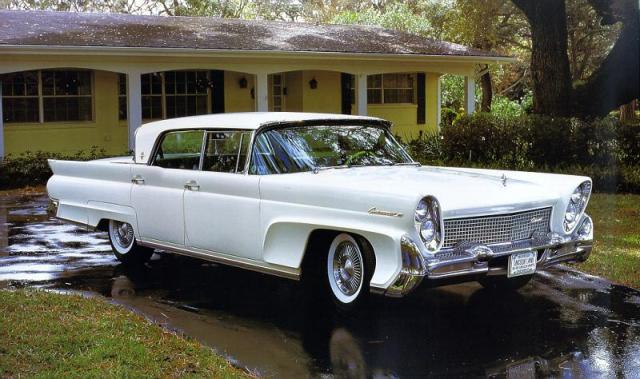
The Mark III’s styling was one of its defining features. It was long, low, and unmistakably American, yet its lines carried a sense of discipline that set it apart from the more flamboyant designs of the time. The front end was dominated by a tall, upright grille modeled after the classic Rolls-Royce shape, flanked by hidden headlamps that gave the car an air of mystery and refinement. The hood stretched endlessly toward a sharply defined front edge, while the rear deck was short and slightly raised, emphasizing the car’s powerful stance. The trademark Continental spare-wheel hump—echoing the 1956 Mark II—was sculpted into the trunk lid, serving as both a nostalgic gesture and a distinctive design signature.
Chrome trim was used sparingly but effectively, outlining the windows, wheel arches, and body creases without detracting from the purity of the form. The roofline flowed smoothly into a broad C-pillar, and most cars featured a vinyl-covered roof—a fashionable touch that enhanced the car’s sense of formality. Wire wheel covers and narrow whitewall tires completed the look, giving the Mark III an understated elegance that spoke of taste rather than excess.
Inside, the Lincoln Continental Mark III offered a level of luxury that rivaled and often exceeded that of its contemporaries. The interior was designed as a personal retreat, with deeply padded seats, soft leather upholstery, and thick carpeting that muffled road noise. The dashboard was simple yet elegant, with full instrumentation housed in square bezels and an abundance of wood-grain trim. The controls were logically arranged, and the level of equipment was extraordinary for the time: automatic climate control, power windows and seats, AM/FM stereo, and an optional eight-track tape player were all available. Each element was engineered to operate with smooth precision, reinforcing the car’s air of craftsmanship and exclusivity.
Driving the Mark III was an experience defined by quiet power and serenity. The steering was light and accurate, the ride was pillow-soft, and the V8 delivered immense, effortless thrust. The automatic transmission shifted almost imperceptibly, and the cabin remained whisper-quiet even at highway speeds. The suspension absorbed imperfections with ease, allowing the driver and passengers to glide over long distances in complete comfort. It was not a car for cornering thrills or aggressive driving—it was a car designed to make every journey feel unhurried and dignified.
The Mark III quickly became a success. Its combination of style, luxury, and refinement appealed to affluent buyers who wanted distinction without ostentation. It also reestablished Lincoln’s position at the forefront of the American luxury market, giving the brand a clear identity separate from Ford and Mercury. Each Mark III was built to high standards, and although it shared mechanical components with other Ford models, its fit, finish, and detailing were far superior. The car was expensive—priced at over $6,000—but it justified every dollar with its presence and quality.
Production continued through 1971, during which time the Mark III received only subtle refinements, such as improved trim options and minor mechanical updates. Its success laid the groundwork for the Mark IV and Mark V models of the 1970s, which continued the tradition of powerful, elegant personal luxury coupes that defined Lincoln’s identity for years to come.
Today, the Lincoln Continental Mark III is regarded as one of the most beautiful and influential American cars of its era. Collectors admire it for its balance of performance and poise, its rich interior craftsmanship, and its enduring sense of style. It remains a touchstone of late-1960s design—one of the few cars to combine strength, restraint, and luxury so seamlessly.
The Lincoln Continental Mark III was more than just a luxury car—it was a statement of refinement in an age of excess. It revived the Continental spirit with modern power and sophistication, capturing the essence of American prestige motoring at its finest. With its commanding presence, smooth V8, and impeccable design, it remains one of Lincoln’s greatest achievements—a car that defined what it meant to travel with grace, confidence, and quiet authority.