Description
The Lincoln Continental Mark V 7.5 was the final and most refined evolution of the great American personal luxury coupe era—an automobile that blended monumental presence, V8 power, and exquisite craftsmanship into one of the most distinctive cars of the late 1970s. Produced from 1977 to 1979, the Mark V represented the pinnacle of Lincoln’s traditional design philosophy: long, elegant, and commanding, with a level of comfort and quiet sophistication that few cars of its time—or any time—could match.
The Mark V was the direct successor to the Mark IV and was built on the same full-sized chassis that underpinned the Thunderbird and Continental sedans, but nearly every visible surface was unique. At over 19 feet in length and nearly 6.5 feet wide, it was among the largest coupes ever produced. Despite its size, it was carefully proportioned, its long hood and short rear deck balanced by crisp lines, a formal roofline, and subtle sculpting that conveyed dignity rather than ostentation.
Under its immense hood lay the heart of the car: Lincoln’s 7.5-litre (460 cubic inch) V8 engine, a symbol of effortless American power. In 1977, the 460 was rated at around 210 horsepower and over 350 lb-ft of torque—figures that understated its real-world strength due to new emissions-era measuring standards. The engine delivered a broad wave of torque that allowed the Mark V to move with serene ease, its acceleration smooth and silent rather than aggressive. Paired with Ford’s C6 three-speed automatic transmission, the powertrain emphasized refinement over raw speed, giving the car the sensation of infinite reserve.
The chassis was tuned for quiet composure. Lincoln engineers focused on isolation and smoothness, using coil-spring suspension at all four corners with precision-damped shock absorbers and extensive use of rubber mountings to reduce vibration. Power steering and power brakes were standard, both calibrated for ease of use and near-effortless control. The result was a car that glided over the road in near silence, impervious to surface imperfections. Its ride was soft, dignified, and entirely unhurried—a quality that defined the Lincoln driving experience of the era.
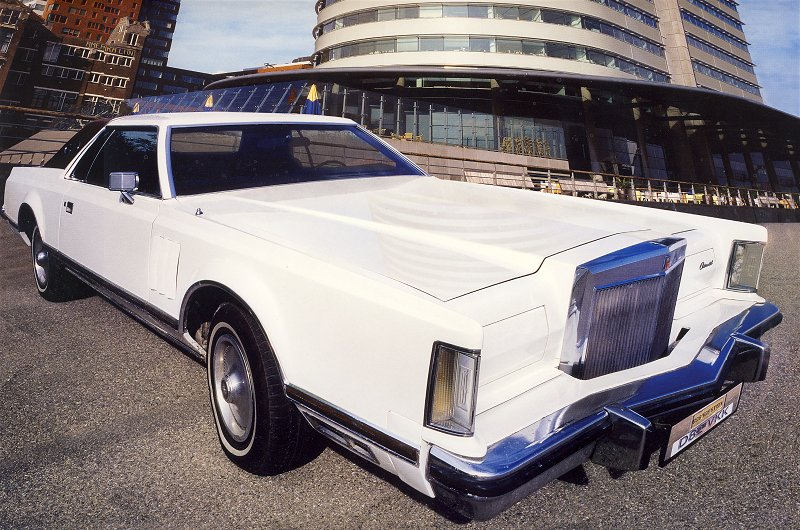
Stylistically, the Mark V carried forward the grand design themes of its predecessors while refining them into a sharper, more modern form. The front end was dominated by a tall, upright grille inspired by classic Rolls-Royce proportions, flanked by concealed headlamps that gave the car an air of quiet mystery. The hood stretched nearly six feet from the windshield to the grille, emphasizing the car’s stately proportions. Along the sides, subtle body creases and delicate chrome detailing accentuated its length, while the gently tapering rear quarters added a sense of motion and grace.
At the rear, the trademark “Continental hump” was sculpted into the trunk lid—a design cue dating back to the 1940 Continental and a signature feature of every Mark model. The taillights were integrated horizontally into the bumper, and the overall design was clean, balanced, and unmistakably Lincoln. The roofline was formal and slightly squared, available in a variety of vinyl finishes, often paired with the distinctive oval “opera windows” that had become a Mark series hallmark. Chrome, while abundant, was used with precision—polished but never gaudy.
The interior of the Mark V was a study in 1970s luxury. The cabin was enormous, hushed, and lavishly appointed, with seating for four in overstuffed, lounge-like comfort. Upholstery options included rich leather or Lincoln’s signature “Media Velour,” offered in deep, period-correct colors such as cordovan red, dark jade, and midnight blue. The dashboard was wide and symmetrical, finished in wood-grain trim with soft-touch surfaces and chromed accents. Instruments were simple and elegant, with large, legible dials set into square bezels. The steering wheel, finished in matching color tones, was light and responsive, while the gear selector operated with silky precision.
Standard features reflected Lincoln’s commitment to convenience and refinement: automatic climate control, power windows and seats, cruise control, and an AM/FM stereo with optional eight-track player were all part of the experience. Options such as power moonroofs, illuminated entry systems, and CB radios reflected the era’s fascination with technology and comfort. Every detail was designed to create a sense of serenity—the car was not simply a means of travel, but a personal sanctuary.
Driving the Lincoln Continental Mark V 7.5 was an exercise in calm authority. The massive V8 delivered its power in a deep, effortless surge, the transmission shifting almost imperceptibly. The suspension floated over imperfections, allowing passengers to glide in silence, while the thick soundproofing and weight of the car eliminated most road and wind noise. On highways, the Mark V was in its element, cruising serenely at 70 mph with the engine barely above idle. It was not a car for corners or speed—it was a car for presence, composure, and comfort unmatched in its class.
Lincoln also recognized the growing appetite for personalization among luxury buyers and offered the Mark V in a series of Designer Editions, each created in collaboration with world-famous fashion houses. The Cartier, Bill Blass, Givenchy, and Emilio Pucci editions each featured unique exterior colors, interior trims, and exclusive detailing. These special editions became some of the most desirable Mark Vs ever built, celebrated for their sophistication and exclusivity.
Production of the Mark V continued through 1979, marking the end of the true full-sized Mark series before Lincoln downsized for the 1980s. It was the last Lincoln to feature the 460 V8, as tightening fuel economy standards and emissions laws forced the company to adopt smaller engines in later models. As such, the Mark V 7.5 stands as the final expression of Lincoln’s grand tradition of big-block, rear-wheel-drive luxury coupes—an era that valued smoothness, scale, and grace above all else.
Today, the Lincoln Continental Mark V 7.5 is cherished by collectors and enthusiasts as the ultimate statement of 1970s American luxury. Its imposing design, impeccable craftsmanship, and effortless performance make it a symbol of an era when comfort and prestige were the highest priorities in automotive design.
The Lincoln Continental Mark V 7.5 was more than a car—it was a statement of success and serenity. With its commanding proportions, powerful V8, and near-silent ride, it embodied the peak of Lincoln’s traditional luxury philosophy. It remains a monument to a time when automobiles were built not just to move people, but to move them with dignity, grace, and unmistakable style.