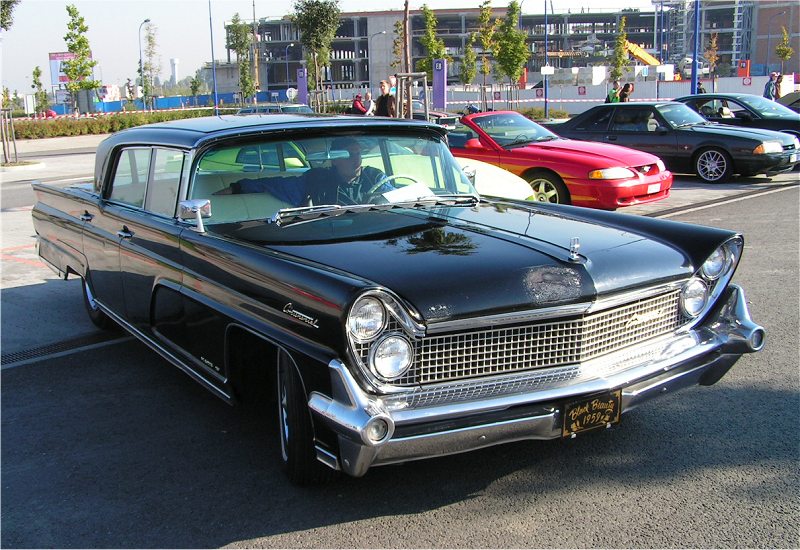
Description
The Lincoln Continental Mark IV was the epitome of 1970s American luxury—long, graceful, and unapologetically opulent. Introduced for the 1972 model year, it followed the highly successful Mark III and built upon its legacy with greater refinement, more imposing proportions, and a renewed focus on comfort and style. In an era when American automobiles celebrated excess, the Mark IV stood out not just for its size, but for its sense of elegance and authority. It was a car designed for those who valued prestige, presence, and a serene driving experience above all else.
Like its predecessor, the Mark IV was conceived as Lincoln’s flagship personal luxury coupe, competing directly with the Cadillac Eldorado. It was based on the same platform as the contemporary Ford Thunderbird but shared almost no external sheet metal. The Mark IV was larger in nearly every dimension, stretching over 19 feet in length and weighing close to 5,000 pounds. Its sheer scale gave it a commanding road presence, yet its proportions and detailing ensured it remained graceful rather than ungainly.
Power came from the massive 7.5-litre (460 cubic inch) V8 engine, a continuation of Lincoln’s smooth and torquey powerplant from the Mark III. Output in 1972 was around 365 horsepower, though subsequent emissions regulations led to a gradual reduction in rated power. Even so, the engine’s enormous torque made performance effortless. The big V8 was paired with Ford’s three-speed C6 automatic transmission, which shifted with near-silent precision. The Mark IV was never intended as a high-performance car; instead, it delivered a sense of inexhaustible strength, moving its considerable mass with the quiet assurance of a locomotive.
The chassis was engineered to deliver maximum comfort. A combination of coil springs at all four corners, hydraulic shock absorbers, and Lincoln’s signature isolation bushings ensured that almost no vibration reached the cabin. The car glided over rough surfaces with ease, its long wheelbase and immense weight helping to smooth out even the harshest imperfections. Steering was power-assisted and feather-light, requiring little effort, while power front disc brakes provided strong, predictable stopping. The result was a car that felt stately and unhurried, moving through the world with calm composure.
Stylistically, the Mark IV was a masterclass in proportion and detail. Its design retained the long-hood, short-deck profile of the Mark III but introduced softer, more sculpted contours. The front end was dominated by a tall, Rolls-Royce-inspired grille flanked by hidden headlamps—a Mark series signature that lent the car an air of mystery and sophistication. The side profile was elegantly simple, with subtle character lines and restrained chrome trim. The roofline featured a distinctive opera window—a small, oval-shaped pane set into the C-pillar—which became one of the most iconic design elements of 1970s luxury cars.
At the rear, the car’s most recognizable feature was the raised “Continental hump” on the trunk lid, a stylistic nod to the spare wheel cover of the original 1940 Continental. The rear bumper integrated smoothly with the body, framing long horizontal taillights that emphasized the car’s width. Chrome was used liberally but tastefully, outlining the wheel arches, window frames, and bumpers. Many examples featured a vinyl-covered roof, available in a wide range of colors and textures, adding to the car’s visual richness.
The interior of the Mark IV was a sanctuary of comfort and indulgence. Everything inside was designed to cocoon the driver and passengers in luxury. Deep, overstuffed seats—trimmed in leather, velour, or Lincoln’s distinctive “Media” cloth—offered lounge-like comfort. The dashboard was wide and symmetrical, with faux woodgrain accents, chrome highlights, and soft, padded surfaces. Instrumentation was simple and clear, and controls operated with smooth precision. Standard equipment included automatic climate control, power windows and locks, and an AM/FM stereo with optional eight-track player. The cabin was nearly silent at speed, thanks to extensive sound insulation and the car’s sheer mass.
Driving the Mark IV was a distinctly American experience. The big V8 delivered effortless thrust, and the automatic transmission moved through its gears with almost imperceptible smoothness. The suspension floated serenely over the road, isolating occupants from imperfections, while the power steering required only the lightest touch. On the open highway, the car seemed to glide endlessly, its quiet cabin and unruffled demeanor creating an atmosphere of unhurried confidence. This was luxury defined not by speed or agility, but by serenity.
Lincoln also recognized the growing importance of personalization and exclusivity in the luxury market, and in 1976 introduced the Designer Series—a set of special edition Mark IVs created in collaboration with leading fashion houses. Each edition—Bill Blass, Cartier, Givenchy, and Pucci—featured unique color schemes, fabrics, and trim combinations inspired by the designers’ aesthetics. These models were marketed as expressions of individuality and sophistication, further enhancing the Mark IV’s allure among affluent buyers.
Production of the Lincoln Continental Mark IV continued through 1976, with yearly refinements in detail and equipment. It was succeeded by the Mark V in 1977, which retained the same general formula but with sharper lines and even greater focus on luxury amenities. Yet it was the Mark IV that established the design language and personality that would define Lincoln’s personal luxury coupes for the next decade.
Today, the Lincoln Continental Mark IV is celebrated as one of the quintessential American luxury cars of the 1970s. Collectors value its combination of elegant styling, smooth V8 power, and uncompromising comfort. Well-preserved examples, especially Designer Series models, remain highly sought after for their craftsmanship and presence.
The Lincoln Continental Mark IV represented an era when luxury was measured not by performance or efficiency, but by ease, comfort, and visual grace. It was a car that moved through the world with quiet confidence—an unmistakable symbol of success. With its commanding proportions, refined power, and impeccable craftsmanship, it stands as one of the last great expressions of traditional American luxury, a reminder of when the open road belonged to cars that ruled it with dignity and style.