Description
The Lincoln Continental Town Coupé was the embodiment of 1970s American luxury—a car of immense presence, power, and refinement that expressed prestige through quiet confidence rather than flamboyance. Introduced in the early 1970s and continuing through the decade, the Town Coupé was the two-door companion to the Lincoln Continental Town Car sedan, offering the same level of opulent comfort and craftsmanship in a sleeker, more personal configuration. It represented the height of Lincoln’s traditional luxury before the brand transitioned into the modern age of downsized automobiles, and it remains one of the most iconic American coupes of its time.
By the early 1970s, Lincoln had fully embraced the philosophy of “quiet luxury.” The Continental range, built on one of the largest passenger-car platforms ever produced, was designed to deliver unmatched comfort and refinement. The Town Coupé, introduced alongside the sedan variant, was intended for buyers who desired the presence and prestige of a Continental but preferred the more exclusive proportions of a two-door grand touring car. At nearly 19 feet in length and over 4,900 pounds, it was one of the largest coupes ever built, yet it carried its mass with extraordinary grace and balance.
Under the long, commanding hood of the Lincoln Continental Town Coupé resided the legendary 7.5-litre (460 cubic inch) Ford V8 engine. In its early years, this massive powerplant produced around 365 horsepower and nearly 500 lb-ft of torque, though later emissions regulations in the mid-1970s reduced output on paper. Even so, real-world performance remained strong thanks to the engine’s immense torque and Lincoln’s careful tuning. The power delivery was smooth, silent, and effortless—characteristics that defined the Lincoln experience. Paired with the C6 three-speed automatic transmission, the V8 moved the Town Coupé with serene authority. Acceleration was unhurried but confident, while cruising at highway speeds was effortless and almost completely devoid of mechanical noise.
The chassis engineering of the Town Coupé prioritized comfort above all else. Its body-on-frame construction, long wheelbase, and advanced suspension design combined to create one of the softest, most isolating rides of any car of its era. Independent front suspension with coil springs and a solid rear axle with leaf springs worked together with carefully tuned shock absorbers to eliminate harshness and vibration. Power steering came standard, offering a light, fingertip touch, and the car’s power-assisted disc/drum braking system provided smooth, progressive stopping power. The overall effect was one of gliding motion—the Town Coupé did not merely travel over the road; it floated across it.
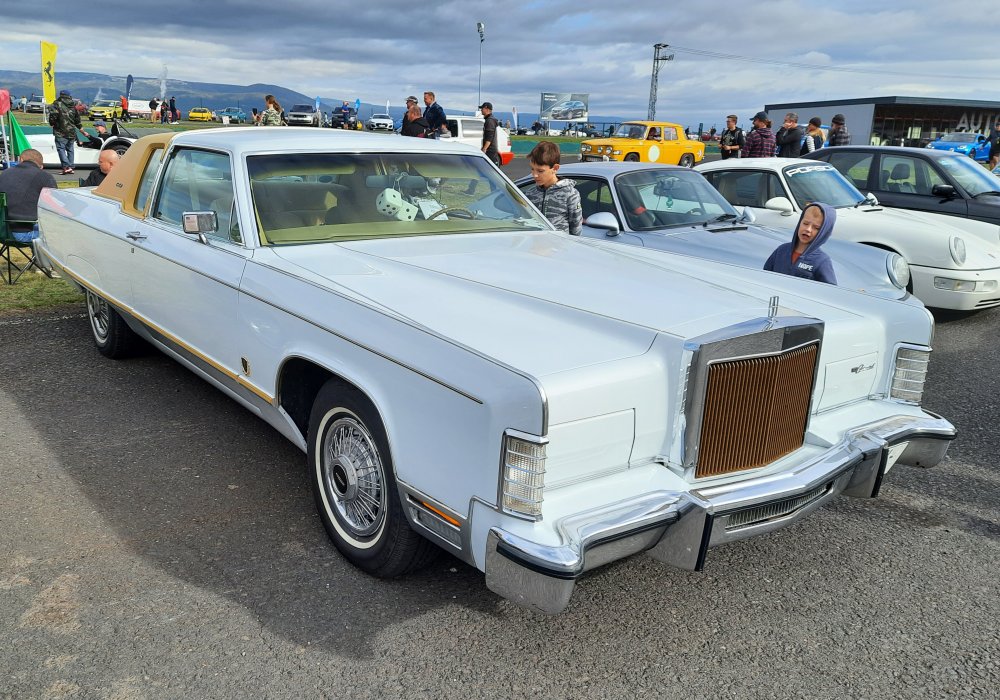
Stylistically, the Lincoln Continental Town Coupé exuded formal elegance. Its long hood, broad C-pillars, and squared-off rear deck gave it a commanding yet dignified stance. The design was marked by straight, horizontal lines and crisp surfaces that emphasized the car’s length and proportion. At the front, a tall, vertical grille inspired by the classic Mark series dominated the face, flanked by hidden headlamps that lent the car a sense of mystery and refinement. The sides were clean and unbroken, with restrained chrome trim running along the beltline and around the wheel openings. The vinyl-covered roof—often in contrasting color—added to the air of exclusivity, while the discreet opera windows set into the rear pillars became one of Lincoln’s most recognizable styling signatures of the decade.
At the rear, the car featured a full-width taillight panel integrated cleanly into the bumper line, maintaining the horizontal theme. The rear deck was expansive, with the signature “Continental hump” subtly suggested in the trunk lid—a nod to the design heritage of earlier Continentals. Every detail, from the chrome door handles to the formal hood ornament, was crafted to convey luxury through precision rather than ostentation.
Inside, the Lincoln Continental Town Coupé was a masterpiece of comfort and craftsmanship. The interior was designed to provide an experience akin to a private lounge. Seats were overstuffed, deeply contoured, and trimmed in fine materials—either soft leather or Lincoln’s signature crushed velour, available in a palette of rich, period-correct colors such as burgundy, dark jade, or midnight blue. The front seats could be power-adjusted in multiple directions, and the thick carpeting and headliner insulation created a cocoon of silence. The dashboard was expansive and symmetrical, featuring woodgrain accents, softly illuminated instrumentation, and logically arranged controls. Every switch and lever operated with the precision expected of a car in this class.
Standard equipment included automatic climate control, power windows, power door locks, a tilt steering wheel, and an AM/FM stereo with optional 8-track player. Later models introduced refinements such as automatic headlamp dimming, cruise control, and a power antenna, all aimed at making driving as effortless as possible. The rear seat, though secondary in importance, was nearly as comfortable as the front, offering generous legroom and a view through the wide rear glass that enhanced the feeling of space.
On the road, the Town Coupé delivered the quintessential Lincoln experience—unhurried, dignified, and supremely composed. The steering was light and smooth, the ride imperceptibly soft, and the cabin isolation unmatched by almost anything else on the road. The car was built for comfort rather than speed, and it excelled in providing a sense of serene detachment from the outside world. Whether gliding along city boulevards or covering long stretches of highway, the driver and passengers experienced motoring at its most effortless.
Throughout the 1970s, the Lincoln Continental Town Coupé became a symbol of success and taste. It appealed to executives, celebrities, and dignitaries who valued prestige expressed through refinement rather than flamboyance. While other luxury cars of the era experimented with radical styling or downsizing, the Town Coupé maintained its traditional proportions and stately demeanor. It represented the last great expression of the full-size, body-on-frame American luxury coupe before the energy crises and shifting consumer tastes brought an end to such grand automobiles.
Production continued through 1980, after which the Continental nameplate evolved into smaller, more efficient models. Yet the Town Coupé’s legacy endures. It remains one of the most collectible Lincolns of the period, admired for its craftsmanship, presence, and the sheer sensory pleasure of its ride.
The Lincoln Continental Town Coupé was the final great expression of traditional American luxury—an era when size, silence, and craftsmanship defined automotive excellence. With its commanding proportions, velvety power, and unmatched comfort, it represented the pinnacle of the Lincoln philosophy: that true luxury is not loud or hurried, but calm, confident, and timeless.