Description
The Lincoln Cosmopolitan Convertible was the most glamorous and exclusive model in Lincoln’s postwar lineup, a car that perfectly captured the optimism and sophistication of late-1940s America. Introduced in 1949 alongside the Cosmopolitan Sport Sedan and Coupe, it represented the height of Lincoln luxury and one of the most technically advanced convertibles of its era. Combining the smooth power of Lincoln’s new V8 engine with graceful, flowing design and impeccable craftsmanship, the Cosmopolitan Convertible was a symbol of American confidence at the dawn of the modern automotive age.
The 1949 Cosmopolitan marked a dramatic break from Lincoln’s prewar traditions. After years of building conservative, formal automobiles, Lincoln introduced a thoroughly modern car with a low, aerodynamic silhouette and advanced mechanical features. The Convertible, with its sweeping lines and open-air elegance, was the most striking of the new models. It was built on the same 125-inch wheelbase chassis as the Sport Sedan and Coupe but was hand-finished to an even higher standard, making it one of the most luxurious American convertibles available at the time.
Power came from Lincoln’s all-new 5.5-litre (337 cubic inch) flathead V8 engine, producing 152 horsepower and more than 260 lb-ft of torque. This was the largest and most powerful flathead V8 ever installed in a production car, originally derived from Ford’s heavy-duty truck engine but refined for Lincoln with smoother operation and quieter performance. Its abundant torque made driving effortless, whether cruising at highway speeds or gliding through city traffic. Early cars were fitted with a three-speed manual transmission with optional overdrive, while later examples offered Lincoln’s new Hydra-Matic automatic gearbox, sourced from General Motors, which transformed the car into one of the easiest luxury convertibles of its era to drive.
The Cosmopolitan’s chassis was solid and refined, using a robust body-on-frame design with a long wheelbase that provided both stability and generous cabin space. Independent front suspension with coil springs and wishbones ensured excellent ride comfort, while the rear used semi-elliptic leaf springs to maintain composure over uneven roads. Hydraulic drum brakes provided confident stopping power, and the steering, though unassisted, was light and precise for a car of its size. The result was a convertible that combined the power and comfort of a large luxury automobile with a surprising degree of control and balance.
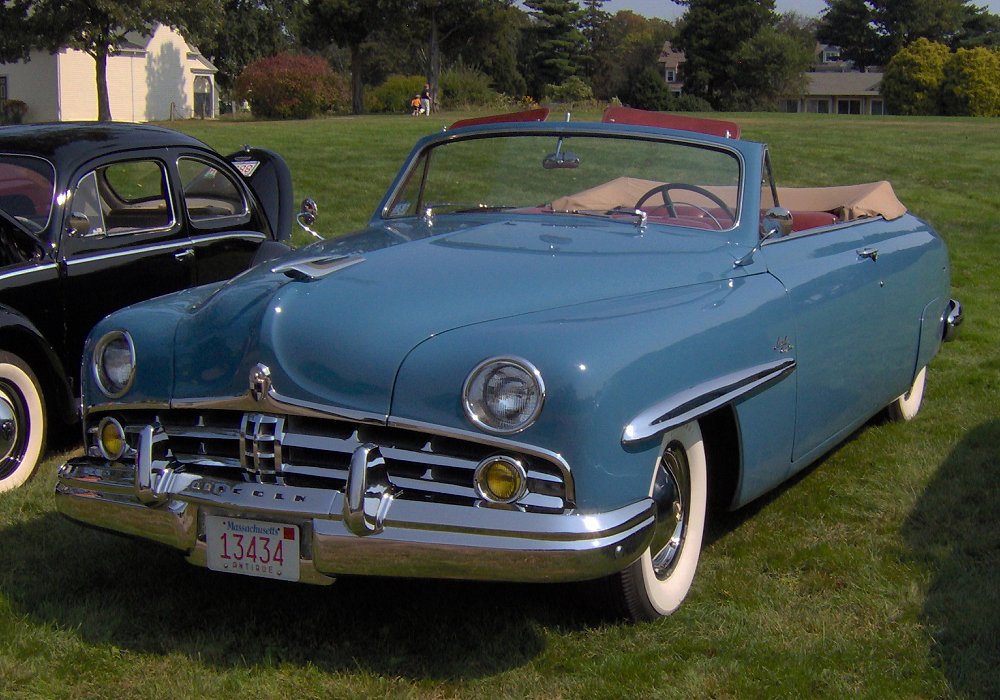
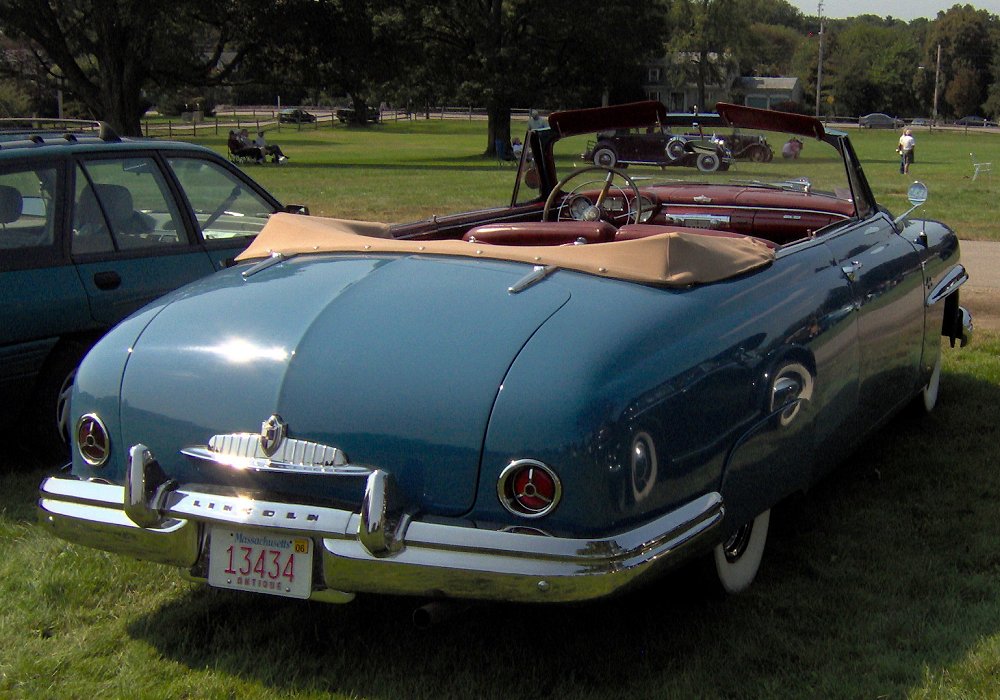
Stylistically, the Lincoln Cosmopolitan Convertible represented the essence of postwar American design. Its body was smooth, rounded, and devoid of unnecessary ornamentation—a clear departure from the heavily chromed, upright designs of the 1930s and early 1940s. The wide, horizontal grille and integrated headlamps gave the car a purposeful, modern appearance. The hood and fenders flowed seamlessly into the doors and rear quarters, creating a continuous, sculpted form that conveyed motion even at rest. The rear deck was short and clean, and the low beltline accentuated the car’s elegant proportions. With the top down, the Cosmopolitan Convertible possessed a long, low silhouette that evoked the streamlined aircraft-inspired design language of the period.
The convertible top itself was power-operated, a significant luxury feature in the late 1940s, folding neatly beneath a metal or fabric boot cover. When raised, it sealed tightly against the windshield and side windows, providing excellent weather protection and maintaining the car’s elegant profile. The windshield was a single curved pane of glass—a notable innovation at the time—further enhancing the car’s modern, aerodynamic appearance.
Inside, the Cosmopolitan Convertible offered an interior that combined comfort, luxury, and modern convenience. The seats were wide and deeply cushioned, upholstered in fine leather or high-grade broadcloth, depending on the customer’s preference. The dashboard was broad and symmetrical, finished in polished metal or painted enamel with restrained chrome detailing. Large circular gauges were arranged in a simple, elegant cluster before the driver, and controls for the radio, heater, and power windows were neatly integrated into the design. The overall effect was one of refined simplicity—sophisticated but never ostentatious.
Driving the Lincoln Cosmopolitan Convertible was a deeply satisfying experience. The V8 engine delivered its power with impressive smoothness, and the long wheelbase and well-tuned suspension gave the car a serene ride quality unmatched by most of its contemporaries. On the highway, the Cosmopolitan cruised effortlessly, the flathead V8 turning quietly beneath the hood, while the cabin remained insulated from wind and mechanical noise. The hydraulic brakes were progressive and sure-footed, and the steering, though light, provided good feedback. It was a car designed not for speed or sportiness, but for unhurried, dignified motoring in total comfort.
The Cosmopolitan range was also notable for its association with the White House. Several custom-built 1949 and 1950 Cosmopolitan Convertibles were adapted as presidential limousines for President Harry S. Truman. These cars, modified by coachbuilder Henney, featured extended wheelbases, rear seats with power lifts for public appearances, and removable roofs for parade use. Their service as official state vehicles further reinforced the Cosmopolitan’s reputation for prestige and reliability.
Production of the Lincoln Cosmopolitan Convertible continued until 1951, with only a few thousand units built across all three model years, making it one of the rarest Lincolns of its generation. Its combination of craftsmanship, style, and mechanical refinement helped reestablish Lincoln as a leader in postwar luxury motoring and set the stage for the company’s later successes in the 1950s.
Today, the Lincoln Cosmopolitan Convertible is cherished by collectors as a milestone in American automotive design. Its clean lines, smooth V8 performance, and open-air elegance embody the optimism and artistry of the postwar era. Restored examples command admiration not only for their rarity but for their timeless proportions and subtle luxury.
The Lincoln Cosmopolitan Convertible remains one of the finest expressions of Lincoln’s postwar renaissance. It was a car that captured the spirit of modern American luxury—graceful, powerful, and serene. With its quiet strength and confident design, it stands as a lasting testament to an age when automobiles were built not merely to transport, but to inspire.