Description
The Lincoln KB Limousine was the ultimate expression of American luxury and craftsmanship in the early 1930s, a car that embodied quiet prestige, mechanical refinement, and an unmistakable sense of authority. Introduced in 1932 as part of the celebrated Lincoln KB range, the Limousine version represented the pinnacle of the marque’s design and engineering under Edsel Ford’s leadership. It was a vehicle reserved for those who demanded the very finest—industrialists, ambassadors, and heads of state—people for whom a Lincoln was not merely transportation, but a statement of dignity and taste.
Built upon the same 145-inch (or optionally 147-inch) wheelbase chassis as the KB Sedan, the Limousine featured Lincoln’s magnificent 7.3-litre (448 cubic inch) V12 engine. This powerplant, designed and built in-house, was one of the most refined engines of its era. With 150 horsepower delivered at 3,400 rpm, it provided smooth, effortless power with near-silent operation. The V12’s torque allowed the car to accelerate with stately ease and maintain high cruising speeds with minimal vibration, characteristics that quickly became a Lincoln hallmark. The engine was paired with a three-speed manual gearbox equipped with synchromesh on the upper gears, allowing seamless shifts and relaxed long-distance travel.
The chassis was a masterpiece of pre-war engineering. Constructed from heavy steel channels with cross-bracing for rigidity, it offered the strength necessary to support the large and elaborately appointed limousine body. Suspension was by semi-elliptic leaf springs with hydraulic shock absorbers, providing a ride that was remarkably smooth over the rough roads of the early 1930s. The car’s large, mechanically assisted drum brakes offered reliable stopping power, and the steering, though unassisted, was light enough for precise control at low speeds. Despite its size and weight, the KB Limousine handled with surprising poise, reflecting Lincoln’s attention to balance and chassis geometry.
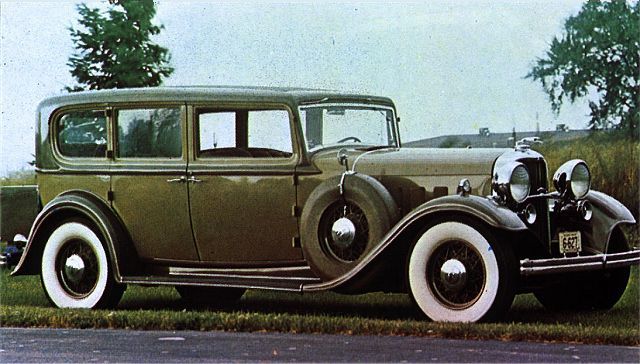
The bodywork for the KB Limousine was supplied by America’s finest coachbuilders—Brunn, Judkins, Willoughby, and LeBaron among them—each offering bespoke variations to suit individual customers. The Brunn-bodied Limousine, one of the most famous, combined clean, formal lines with subtle curvature that gave the car an air of understated elegance. A tall, upright radiator grille dominated the front, crowned by the iconic greyhound mascot and flanked by large chromed headlamps. The long bonnet, flowing fenders, and sweeping beltline created a sense of motion even when the car stood still. Twin side-mounted spare wheels, whitewall tyres, and polished chrome accents completed its imposing presence.
The Lincoln KB Limousine’s interior was its true masterpiece. Designed to provide the utmost comfort for its occupants, it featured separate compartments for passengers and chauffeur, divided by a glass partition that could be raised or lowered for privacy. The driver’s area was functional yet elegant, trimmed in high-quality leather with polished nickel controls and a large wood-rimmed steering wheel. The dashboard housed finely detailed instruments and switches, reflecting the car’s precision engineering.
In the rear compartment, luxury reached its highest form. Passengers were surrounded by fine materials—hand-polished walnut or mahogany veneers, deep pile carpeting, and seats upholstered in soft broadcloth or leather. The seating arrangement typically included a large rear bench with fold-down occasional seats for additional passengers. Details such as silk window curtains, reading lamps, ashtrays, and even an inbuilt footrest contributed to the atmosphere of quiet refinement. The car’s ride was whisper-quiet, insulated from the outside world by thick materials and meticulous craftsmanship.
On the road, the KB Limousine delivered the experience of a moving drawing room. The V12 engine produced power with near-silent smoothness, allowing the car to glide effortlessly through city streets or along country roads. The transmission shifted with ease, and the long wheelbase ensured a level of comfort and stability that few other cars of the era could match. The sense of refinement extended to every control—the light steering, the progressive brakes, and the gentle surge of torque all combined to give the impression of precision and serenity.
The Lincoln KB Limousine was as much a symbol of status as it was a feat of engineering. During the early 1930s, it served as official transportation for dignitaries and business leaders, and several examples were used by the U.S. government, reinforcing Lincoln’s position as the preferred marque for formal and ceremonial use. It competed directly with the finest offerings from Packard, Pierce-Arrow, and Cadillac’s Fleetwood-bodied V12 and V16 models, and though its production numbers were lower, its reputation for refinement and reliability was unmatched.
Like all Lincoln KB models, the Limousine was hand-built to order, ensuring that no two cars were precisely alike. Production was extremely limited—only a few hundred KB chassis were produced between 1932 and 1934, and far fewer were bodied as formal limousines. Each example represented an investment not just in a motorcar, but in a work of art, crafted to last a lifetime.
Today, the Lincoln KB Limousine is regarded as one of the great American classics of the pre-war era. Collectors prize it for its elegance, rarity, and exceptional mechanical quality. Restored examples are often seen at major concours d’elegance events, where they stand as reminders of a time when automobiles were built with the same care and artistry as fine furniture or architecture.
The Lincoln KB Limousine remains one of the most distinguished expressions of American luxury motoring. It was a car designed not to dazzle with excess, but to impress through perfection—a vehicle that combined the power and precision of Lincoln’s V12 with the quiet grace of custom coachwork. In an age of uncertainty, it stood for craftsmanship, confidence, and the enduring belief that true luxury is defined by excellence, not extravagance.