Description
The Marcos Mantis was one of the most striking, ambitious and unusual cars ever produced by Marcos. Introduced in 1968, it represented a bold attempt to push the small British manufacturer into a more modern, powerful and upscale segment of the sports-car market. Larger, wider and more dramatic than the company’s earlier plywood-monocoque GTs, the Mantis combined futurist styling with more conventional steel chassis engineering and a choice of strong, smooth six-cylinder engines. Although produced in small numbers, the Mantis became an icon of Marcos individuality — a car that refused to look or feel like anything else on the road.
The Mantis replaced the wooden monocoque construction of the classic GT with a newly designed steel backbone chassis. This approach allowed Marcos to accommodate more powerful engines, provide greater interior space and offer refinements that would have been difficult with the plywood structure. The steel frame was stiff and robust, with front and rear subframes supporting the suspension and driveline components. Even with this change, the car’s body remained a fibreglass moulding — lightweight, corrosion-proof and ideal for the flowing shapes Marcos favoured.
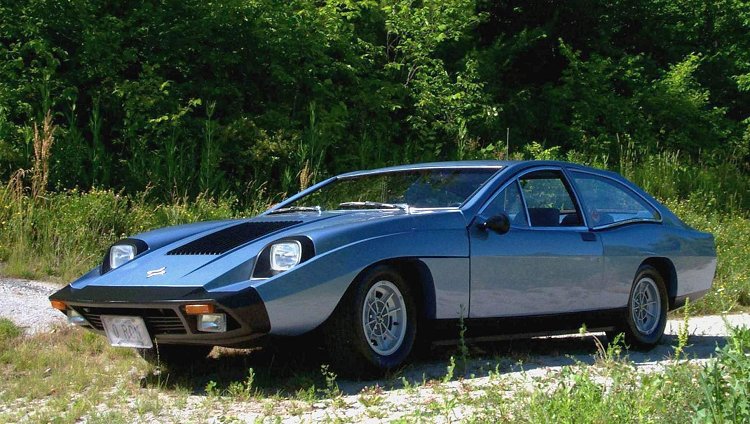
Visually, the Mantis was dramatic and futuristic for its time. Designed by Dennis Adams, the car featured a pointed, almost wedge-like nose, deep-set quad headlamps, large wheelarches, a long bonnet and an angular, sharply cut fastback tail. The profile was low and aggressive, with a wide stance that gave it real presence on the road. Unlike earlier Marcos models, the Mantis offered genuine practicality: larger doors, more interior room and better luggage capacity. It was conceived not as a minimalist sports car, but as a distinctive grand tourer capable of covering distance at speed and in comfort.
Power came from the Ford Essex 3.0-litre V6 engine, the same unit found in the Ford Capri and Zodiac but tuned to suit the Mantis’s more sporting character. Producing around 140 horsepower in standard form, the Essex V6 delivered strong mid-range torque, smooth delivery and relaxed high-speed cruising. Coupled with a kerb weight that, while higher than earlier Marcos cars, remained modest thanks to fibreglass construction, the Mantis achieved respectable performance. Top speeds in excess of 120 mph and 0–60 mph times around 8–9 seconds were typical depending on gearing and specification.
The suspension layout used double wishbones and coil springs at the front, with a coil-sprung live axle at the rear located by twin radius arms and a Panhard rod. While more conventional than the exotic setups appearing on high-end continental GTs, the Mantis’s chassis tuning gave it predictable handling, good body control and a comfortable ride for long distances. Steering was direct and communicative, though heavier than earlier Marcos models, and the car’s wide track provided reassuring stability at speed. Braking was handled by front discs and rear drums, adequate for the car’s performance but often upgraded by later owners.
Inside, the Mantis was more refined than typical 1960s Marcos fare. The cabin remained low and intimate, but it offered more space, better ventilation and more comfort. The dashboard featured a full set of Smiths instruments set into a large, wrap-around panel, and the driving position — still low and sporting — was better suited to long-distance use than the extremely reclined layout of earlier GTs. The car could be trimmed to a high standard, reflecting the company’s ambition to compete in a more premium category.
Despite its appeal, the original Marcos Mantis GT (1968–1971) was produced in very small numbers. The styling was bold, perhaps too bold for its era, and the company faced financial pressures during its production period. As a result, only a handful of original Mantis GTs were built, making it one of the rarest Marcos models.
The Mantis name resurfaced in the 1990s on a completely different model — a V8-powered, modern sports coupé — but enthusiasts still regard the late-1960s Mantis GT as a fascinating and important part of Marcos history. It represented the company’s ambition to move beyond its traditional lightweight niche and compete with larger British and European brands.
Today, the Marcos Mantis is admired for its individuality, rarity and unmistakable styling. It encapsulates the spirit of a small manufacturer prepared to take risks with design and engineering. With its combination of fibreglass construction, bold proportions, torquey V6 power and GT-oriented comfort, the original Mantis stands as one of the most charismatic and distinctive British sports cars of its era, a true expression of Marcos’s unconventional vision.