
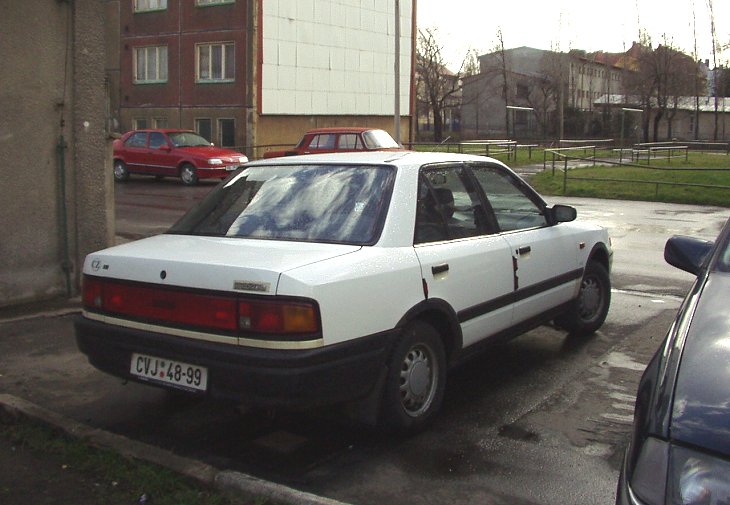
Description
The Mazda 323 1.3 was one of the core models in the early generations of the 323 family, offering a sensible balance of economy, reliability and everyday usability that helped make the nameplate one of Mazda’s most important global successes. Positioned above the smallest-engined variants but still firmly in the budget-friendly end of the range, the 1.3-litre versions were aimed at drivers who wanted a practical compact car with slightly more flexibility and refinement than the basic 1.1 models, without the added cost or fuel consumption of the larger performance engines. Across multiple generations, the 323 1.3 became a dependable favourite in markets around the world.
Power for the 1.3 models came from Mazda’s long-running B3-series engine, a 1323 cc inline-four that was renowned for its simplicity, durability and excellent fuel economy. Producing between 60 and 75 horsepower depending on generation and market tuning, the B3 delivered smooth, clean performance with low noise and minimal vibration. It was not a quick engine, but it was willing to rev and extremely reliable, making it ideal for commuting, light highway use and day-to-day driving. Paired with a four- or five-speed manual gearbox — and later a small automatic option — the 323 1.3 felt friendly and predictable in all conditions. Owners valued its low running costs, long service intervals and ease of maintenance.
The chassis varied slightly between generations, but the 323 1.3 always benefitted from Mazda’s reputation for careful suspension tuning. Early versions used a simple but effective combination of MacPherson struts in the front and a rear beam axle, while later models adopted more advanced torsion-beam or multi-link rear setups. Across decades of evolution, the 323 remained known for stable, forgiving handling and a comfortable ride. The 1.3 models were lighter than larger-engined variants, which contributed to their nimble feel and made them especially pleasant in urban environments. Steering was light, visibility excellent and refinement surprisingly good for their class.
Styling depended on the generation, but the 323 consistently presented clean, modern and unfussy lines. Whether as a hatchback, saloon or estate, the 323 1.3 always carried a practical, inoffensive look that appealed to a wide audience. Mazda avoided unnecessary ornamentation, focusing instead on sensible proportions, good aerodynamics and straightforward design. The result was a car that aged well, often looking tidier and more cohesive than many of its contemporaries.
Inside, the 323 1.3 emphasised practicality and comfort. Seats were supportive, space was cleverly maximised, and dashboards were logically laid out with durable materials. The cabins tended to be airy thanks to large windows and thin pillars, making the car easy to place in traffic. Equipment levels varied widely by market — some 1.3 models were very basic, while others offered power steering, improved audio systems, central locking or even air conditioning in later years. What remained consistent was Mazda’s commitment to build quality and a simple, user-friendly interior.
On the road, the 323 1.3 delivered exactly what buyers expected: smooth, economical and undramatic progress. The engine was happiest at moderate speeds, the gearbox light and precise, and the chassis compliant without feeling vague. It excelled at commuting, daily errands and longer journeys at sensible cruising speeds. Many owners kept their cars for hundreds of thousands of kilometres because the 323 1.3 simply worked — quietly, cheaply and reliably.
The 323 1.3 played a major role in Mazda’s success across Europe, Oceania and parts of Asia, where buyers valued its dependability and low total cost of ownership. It served as a school-run car, a commuter, a starter vehicle for young drivers, and a long-lasting companion for families who appreciated its straightforwardness.
Today, the Mazda 323 1.3 is rarely seen in pristine condition because so many were used extensively and eventually worn out. Yet among enthusiasts of honest, well-engineered classic Japanese cars, it holds a quiet appeal. Its charm lies not in performance or rarity, but in its integrity: a compact car that delivered precisely what it promised, built with intelligence, care and the practicality that defined Mazda’s best work.
As one of the backbone models of the 323 lineage, the 1.3 remains a reminder of why this nameplate became one of Mazda’s global success stories — reliable, economical, friendly to drive and built to last.