
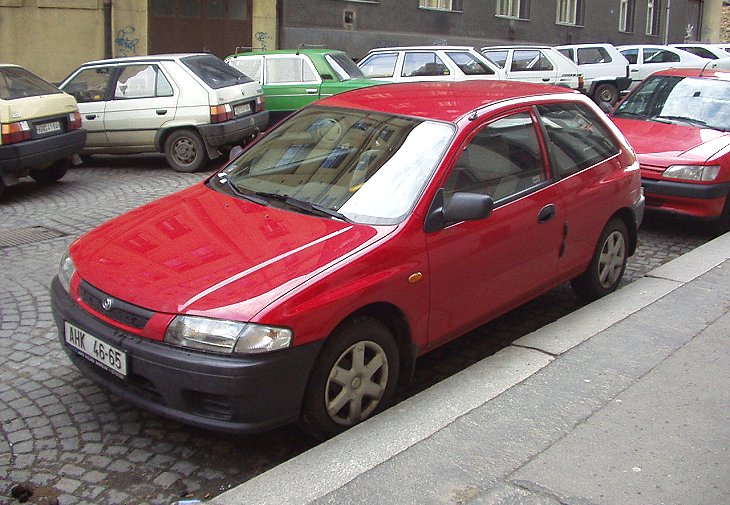
Description
The Mazda 323 1.4 was one of the steady, dependable core models in the early- and mid-generation 323 lineup, giving buyers a practical and economical alternative to the smaller 1.3 versions while remaining more affordable and lighter than the 1.6-litre cars. Across the late 1980s and early 1990s, the 1.4 filled an important role in many European markets, offering a sensible middle ground in performance, running costs and refinement. It became especially popular among commuters, small families and first-time drivers looking for a trustworthy compact car that combined Mazda’s reliability with straightforward ownership.
Under the bonnet the 323 1.4 used Mazda’s B4-series 1398 cc four-cylinder engine, part of the brand’s long-running and highly favoured B-family. With fuel injection in later versions and simple carburetion in earlier ones, the engine typically produced around 73–80 horsepower depending on generation and emissions requirements. The B4 was praised for its durability, smoothness and frugal fuel use. It delivered enough power for relaxed suburban and motorway driving while remaining notably economical in daily use. The engine paired with a five-speed manual gearbox that shifted cleanly and lightly, reinforcing the car’s easygoing character. An automatic option appeared in some markets, though most owners preferred the manual for its efficiency and responsiveness.
The 323 chassis was one of Mazda’s strengths, and even the modestly powered 1.4 benefitted from the company’s careful engineering. Depending on the generation, the 1.4 featured either a rear torsion beam or the more advanced multi-link rear suspension found on later models. In all cases the car offered impressive stability, good ride comfort and predictable handling. Mazda’s suspension tuning allowed the car to absorb rough surfaces comfortably while remaining controlled at higher speeds. The light weight of the 1.4-litre versions gave them a nimble feel, making them pleasant to drive in tight urban areas and surprisingly agile on twisting rural roads.
Styling differed slightly across generations, but the 323 1.4 always maintained a clean, modern, unpretentious design. Whether in hatchback, saloon or estate form, it carried Mazda’s familiar smooth lines, large glass areas and tidy proportions. The lack of aggressive bodywork suited the 1.4’s sensible character, and the restrained design helped the cars age gracefully. Wheel designs and exterior trim were generally simple but well executed, often colour-coded in later models to give a more contemporary appearance.
Inside, the Mazda 323 1.4 offered a comfortable, practical and well-designed cabin. The dashboard layouts were simple and ergonomic, with clear instruments and robust switchgear. Seats were supportive for long journeys, and the interior materials were chosen for durability rather than flashiness. Mazda’s packaging efficiency meant the 323 provided generous space for front occupants and useful room for passengers in the rear, even in its compact footprint. Equipment levels varied, but most 1.4-litre versions offered essentials like power steering, adjustable seats, an effective ventilation system and, in higher trims or later years, central locking or air conditioning. The hatchback versions provided excellent versatility with folding rear seats and a wide luggage opening.
On the road, the 323 1.4 delivered a quiet, smooth and reassuring driving experience. The engine’s modest output encouraged a relaxed pace, but it pulled cleanly through the rev range and handled inclines or motorway cruising with little difficulty. The gearbox reinforced the car’s friendly nature, and the steering was light but accurate. The suspension tuning gave the car a balanced feel, and its predictable cornering behaviour made it ideal for new drivers or those who simply wanted dependable, undramatic transport.
The Mazda 323 1.4 played a vital part in the success of the model internationally. It provided a well-priced, economical and mechanically durable option at a time when many competitors suffered from high running costs or inconsistent build quality. The 1.4-litre models became favourites for small families, commuting duties and long-term ownership, with many examples covering large mileages with minimal mechanical issues.
Today the 323 1.4 is less common than it once was, largely because so many were used heavily and eventually retired. Among fans of 1980s and 1990s Japanese cars, it is appreciated for its straightforward engineering, durability and the quietly satisfying behaviour of a well-balanced compact car. As an honest, practical and thoroughly dependable member of the 323 family, the 1.4 remains a reminder of Mazda’s talent for building cars that were affordable yet impressively well made.