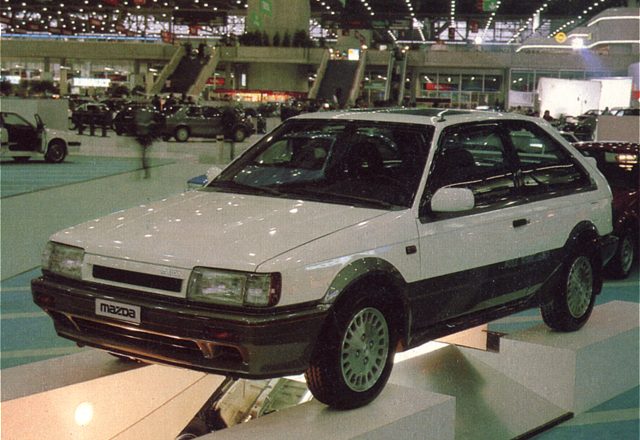
Description
The Mazda 323 GT Turbo 4WD was one of the most exciting and technically advanced variants of the BG-series 323 range, and a crucial stepping stone toward the legendary 323 GT-R. Produced in the late 1980s and early 1990s, the GT Turbo 4WD brought rally-inspired engineering into an affordable compact hatchback, giving Mazda a genuine performance model that could compete with contemporary turbocharged, four-wheel-drive rivals such as the Subaru Leone RX Turbo, Toyota Corolla GT-Four and Mitsubishi Lancer EX Turbo. Quick, rugged and packed with character, it became one of Mazda’s greatest enthusiast machines of its era.
At the core of the 323 GT Turbo 4WD was Mazda’s B6T engine, a turbocharged and fuel-injected 1597 cc DOHC four-cylinder producing around 140–150 horsepower depending on market. Compact, strong and highly tuneable, the B6T delivered muscular mid-range torque and a distinctive turbo surge that transformed the driving experience. It spooled quickly, offering responsive acceleration, and paired with a five-speed manual gearbox that made the most of the engine’s wide powerband. The B6T’s toughness later made it a favourite among tuners, but even in standard form it gave the GT Turbo 4WD performance far above that of most small hatchbacks of its time.
The drivetrain was one of the car’s defining features. Mazda equipped the GT Turbo with a full-time four-wheel-drive system using a centre differential and a viscous coupling to manage torque distribution. This layout gave the car superb traction in all conditions and allowed it to put its turbocharged power to the ground far more effectively than any front-drive counterpart. The system was engineered with rally competition in mind, offering stability on loose surfaces, confident acceleration on wet roads and strong cornering grip. It made the 323 GT Turbo 4WD feel planted, secure and notably quicker in real-world driving than many similarly powered rivals.
The chassis belonged to Mazda’s highly regarded BG platform, known for its rigidity, balance and sophistication. Fully independent suspension using MacPherson struts up front and Mazda’s clever multi-link rear layout gave the GT Turbo 4WD a combination of composure and agility unusual in its class. Firmer dampers, upgraded anti-roll bars and performance-oriented tyres sharpened its handling further. The car felt eager and responsive, with excellent body control and the reassuring stability that only a well-designed four-wheel-drive system can provide. Braking was handled by ventilated front discs and solid rears, offering solid stopping power for a compact performance car of the early 1990s.
Styling gave the GT Turbo 4WD a distinctive and purposeful presence. It retained the clean, rounded lines of the BG 323, but added deeper bumpers, side skirts, bonnet vents or scoops for turbo cooling, a subtle rear spoiler and unique alloy wheels. These details gave it a restrained but unmistakably sporting character, signalling its performance credentials without excessive aggression. It looked like a compact hatchback with serious intent — a car designed to work hard, drive fast and tackle all weather conditions without fuss.
The interior continued Mazda’s theme of functional, driver-centred design. Supportive sports seats, a leather-rimmed steering wheel on many versions, clear round instruments including a turbo boost gauge and simple but durable materials created an atmosphere of focused purpose. The cabin felt solid and confidence-inspiring, with good visibility and straightforward ergonomics. Equipment levels were typically generous for the time, reflecting the GT Turbo’s position near the top of the 323 range, and the hatchback layout preserved everyday practicality despite the car’s performance focus.
On the road, the 323 GT Turbo 4WD delivered the kind of driving excitement usually reserved for much more expensive cars. The turbocharged engine pulled hard from low revs and surged eagerly through the mid-range, while the 4WD system ensured clean, confident acceleration even in challenging conditions. The suspension tuning offered a firm but compliant ride, and the car remained composed and communicative through fast corners. It was equally at home carving through mountain roads, commuting in the wet or charging down a gravel backroad — a genuinely versatile performance machine with real depth.
The GT Turbo 4WD also laid the groundwork for Mazda’s later motorsport-homologation hero, the 323 GT-R. Much of the engineering that made the GT Turbo 4WD successful became the foundation for the GT-R’s world-class rally credentials, and enthusiasts often view the GT Turbo as the model that bridged the gap between mainstream compact cars and Mazda’s ambitious four-wheel-drive rally programme.
Today, the Mazda 323 GT Turbo 4WD is a sought-after classic among enthusiasts of early 1990s turbocharged performance hatchbacks. Its combination of rugged engineering, eager turbo power, sophisticated 4WD technology and practical hatchback versatility gives it enduring appeal. Rare, capable and brimming with character, it stands as one of Mazda’s finest drivers’ cars of its era — a compact turbocharged warrior that captured the spirit of 1990s rally-influenced performance.