
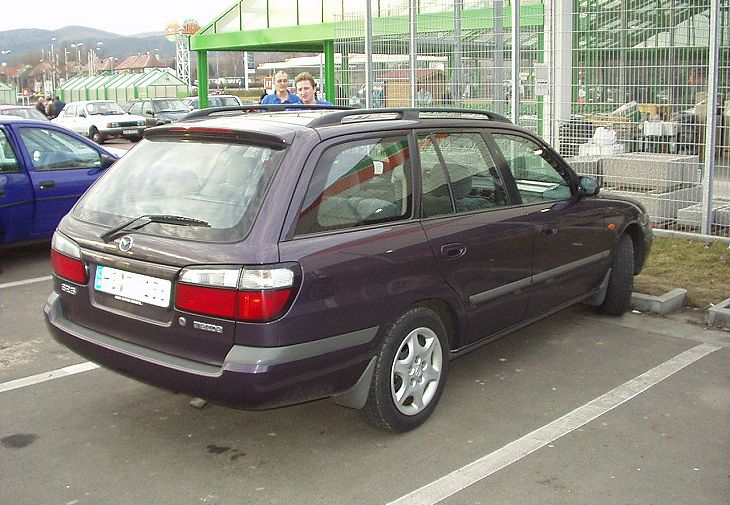
Description
The Mazda 626 Wagon 1.9 was the practical, mid-range workhorse of the late GC (1982–1987) and early GD (1987–1992) generations, offering the useful increase in torque of Mazda’s 1.9-litre engine within the spacious and versatile estate body. Positioned between the economical 1.6 models and the more powerful 2.0-litre versions, the 1.9-litre Wagon became a popular choice for families, small businesses and rural drivers who needed dependable cargo capacity without high running costs. Its blend of space, durability and modest but flexible performance made it one of the more quietly capable models in the 626 lineup.
Power came from Mazda’s B-series 1.9-litre overhead-cam four-cylinder engine, producing around 90 horsepower depending on market and emissions equipment. The 1.9 offered a noticeable improvement over the 1.6 in day-to-day usability, pulling more confidently at low and mid-range speeds and making the heavy estate body easier to drive when fully loaded. It was designed for long life, with simple construction, smooth operation and light maintenance requirements. The engine paired with a five-speed manual gearbox that shifted cleanly and gently, perfectly suited to the Wagon’s practical, easy-going nature. Some markets offered a three-speed automatic in the GC generation or a four-speed automatic in the GD, emphasising comfort over performance.
The chassis gave the 626 Wagon 1.9 much of its strength. The GC-generation estate used MacPherson struts at the front and a coil-sprung, well-located rear axle, tuned to provide stability even with significant weight in the cargo area. Ride quality was one of the model’s standout features, with the suspension absorbing rough surfaces and long journeys with ease. In the later GD generation, the Wagon benefitted from Mazda’s fully independent layout, with a MacPherson-strut front end and the advanced Twin-Trapezoidal Link rear suspension. This gave the GD Wagon unusually good composure and comfort for an estate car of the late 1980s, even when carrying heavier loads. Steering was light and predictable, and the car delivered the calm, secure feel that made the 626 such a popular midsize choice.
Styling followed Mazda’s characteristic understated approach. GC Wagons carried clean, angular early-1980s lines, with large side windows, rectangular headlamps and a long, practical roofline that gave excellent visibility. The GD Wagons adopted smoother, more aerodynamic shapes with rounded edges, slimmer bumpers and a more modern profile. In both generations the Wagon 1.9 avoided sporty embellishments, instead presenting a neat, timeless look appropriate for a family or utility vehicle. Colour-coded bumpers and simple wheel designs appeared on higher trims, while lower-spec models favoured durability and simplicity.
Inside, the 626 Wagon 1.9 offered generous space, excellent visibility and a robust, logically arranged cabin. Front seats were wide and supportive, designed for comfort during long hours behind the wheel, and the dashboard layout was clear and practical. The rear load area was one of the Wagon’s defining strengths: long, flat, easily accessible and capable of swallowing luggage, tools, furniture or weekly shopping with ease. Folding rear seats expanded the space further, giving the estate van-like practicality when needed. Depending on trim level, equipment included power steering, an effective heater/ventilation system, central locking, electric windows, upgraded interior fabrics and, in some markets, air conditioning. The materials were chosen for durability, befitting a car designed for heavy and versatile use.
On the road, the Mazda 626 Wagon 1.9 delivered steady, predictable and reassuring performance. The 1.9-litre engine provided enough torque to cope with mixed driving and moderate load carrying, the suspension kept the car poised and comfortable even on rough surfaces, and the long wheelbase added to its stability. Cruising ability was one of its quiet strengths; the Wagon settled into a relaxed rhythm at motorway speeds, offering a surprisingly refined experience for a practical estate of the time. It was not designed for acceleration or dynamic sharpness, but it excelled in endurance, comfort and low running costs — qualities highly valued by families and working drivers alike.
The 626 Wagon 1.9 played an important role in Mazda’s lineup during the 1980s by offering a practical, affordable estate with real-world capability and excellent reliability. It bridged the gap between compact hatchbacks and larger, more expensive estates, giving buyers a durable midsize option that could handle both daily life and heavier-duty tasks.
Today the Wagon 1.9 is rare, as many examples lived hard working lives and accumulated high mileage before being retired. Among enthusiasts of Japanese practical classics it remains appreciated for its honest engineering, versatility and the dependable character that defined Mazda during this era. It stands as one of the quietly unsung but deeply useful members of the 626 family.