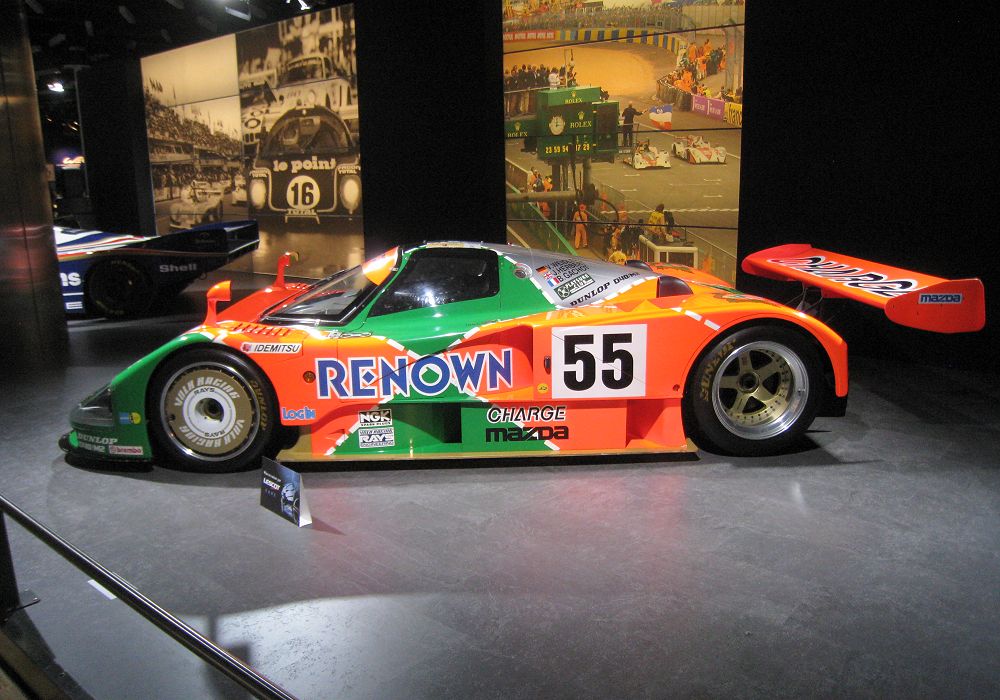
Description
The Mazda 787B was the culmination of Mazda’s rotary-powered racing programme and the car that delivered one of the most significant victories in motorsport history: outright victory at the 1991 24 Hours of Le Mans. It was the first Japanese car to win the race, the only rotary-powered car to win, and the last non-piston engine ever permitted to compete at that level after regulations changed the following year. The 787B represented the peak of Mazda’s rotary engineering, combining advanced aerodynamics, exceptional endurance reliability and the remarkable four-rotor 26B engine that became legendary for its sound and performance.
The heart of the 787B was the naturally aspirated 2.6-litre 26B rotary engine, using four rotors arranged in sequence. With peripheral porting, ceramic apex seals and continuously variable intake runners, it produced around 700 horsepower in race trim while delivering extraordinary smoothness and responsiveness. The engine was astonishingly light compared to piston rivals and was able to maintain high rpm for long periods without vibrational stress. One of its defining characteristics was its spine-tingling exhaust note, a high-pitched mechanical scream that became one of motorsport’s most distinctive and beloved sounds. Its efficiency, reliability and unique power delivery made it ideally suited to endurance racing.
The chassis of the 787B was an evolution of Mazda’s earlier 767 and 767B Group C prototypes, refined extensively in partnership with Mooncraft. It used a lightweight carbon-kevlar monocoque that provided stiffness without excessive weight, allowing Mazda to take full advantage of the compact rotary powertrain. Suspension was via double wishbones front and rear with pushrod-actuated dampers, giving the car superb stability through long high-speed corners. Extensive development work went into balancing aerodynamic drag reduction with downforce, resulting in a car that was fast on the straights yet stable in technical sections. The 787B’s low mass, excellent balance and responsive handling made it unusually easy for drivers to manage during long stints.
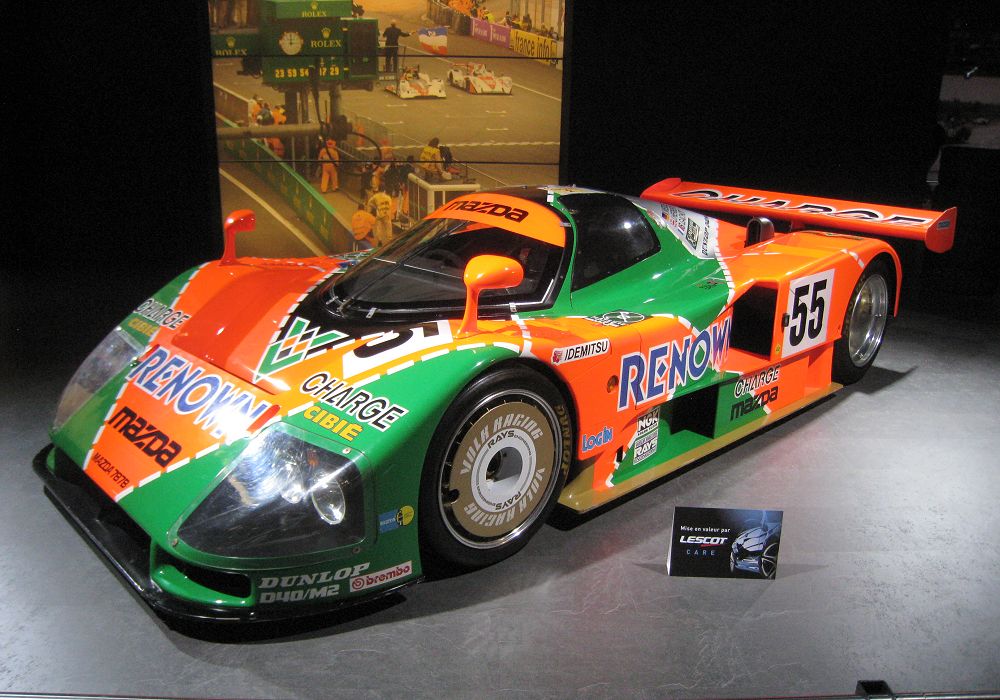
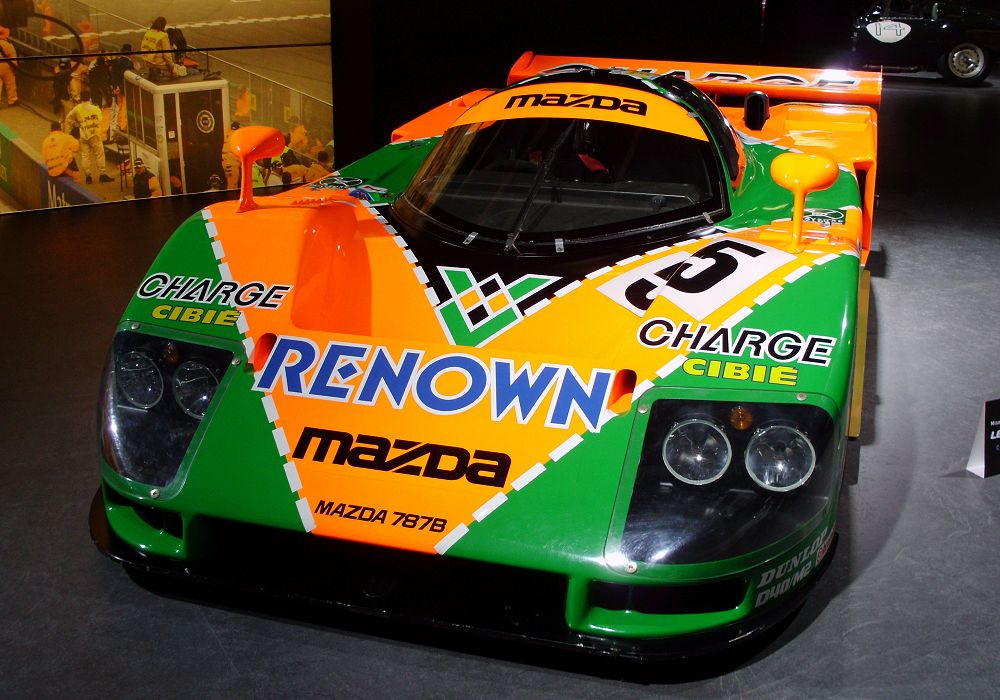
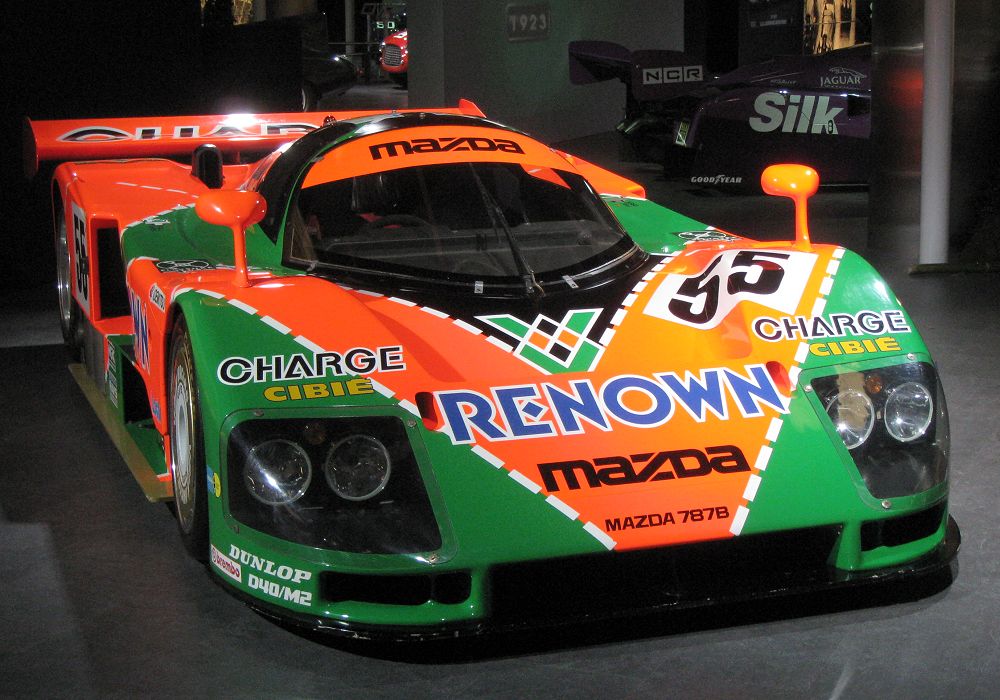
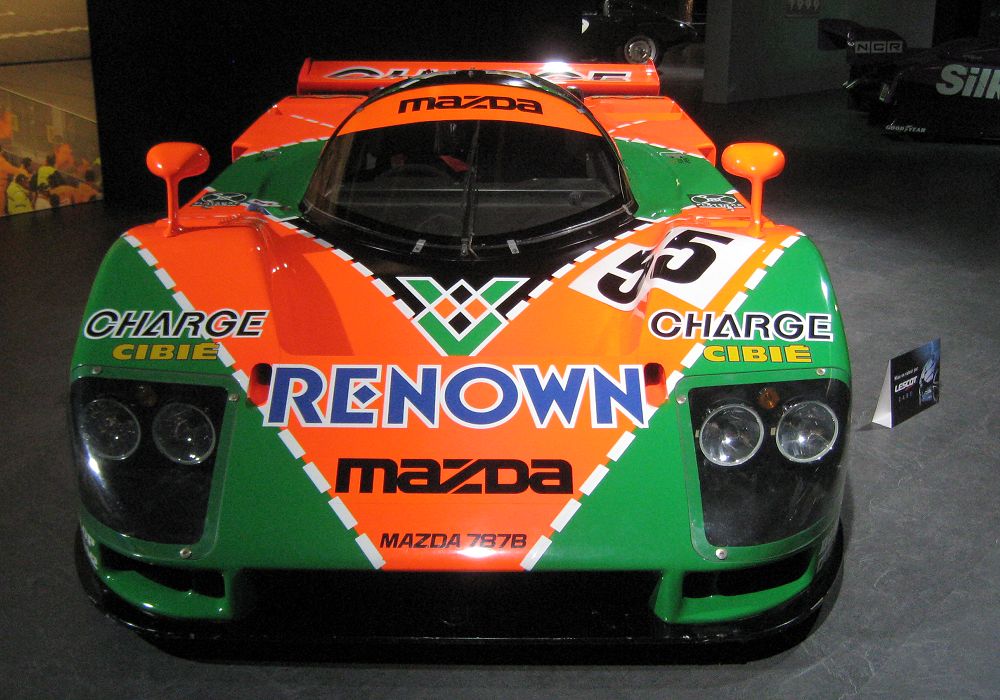
Styling followed Group C functional principles, with a long, low body and large rear wing designed to generate stable downforce at extreme speeds. The car’s bodywork integrated deep channels for airflow management and large side ducts to cool the rotary engine and brakes. Its livery became instantly iconic: bright orange and green in the colours of Mazda’s sponsor Renown/Charge, arranged in a bold diamond pattern. This distinctive look, combined with the car’s unique sound, made the 787B a visual and sensory standout even in an era filled with radical prototypes.
Inside, the car was a pure endurance-racing machine. The cockpit was designed around clarity and practicality, with essential gauges and controls focused on engine temperature, fuel consumption and gearbox status. Driver changes were a core part of Le Mans strategy, so Mazda ensured the interior allowed quick transitions and comfortable long stints. The rotary’s smooth power delivery meant reduced vibration inside the cockpit, helping reduce driver fatigue — an advantage during the physically demanding 24-hour race.
On the track, the 787B’s performance was defined by its balance, reliability and the rotary engine’s ability to sustain high speeds without mechanical strain. Drivers praised its stability under braking, its predictable behaviour through high-speed corners and its strong acceleration out of slow sections. During the 1991 24 Hours of Le Mans, car number 55 — driven by Johnny Herbert, Volker Weidler and Bertrand Gachot — ran faultlessly. While many faster piston-engined competitors suffered mechanical issues, the 787B maintained a relentless pace with near-perfect consistency. It completed 362 laps without a single unscheduled stop, its engine reportedly capable of continuing for another full day without major servicing. Herbert’s final stint, driving flat-out to secure the win, became one of the race’s most memorable efforts.
The victory had historic implications. It was the first time a car from Japan had taken overall victory at Le Mans, and the achievement proved the rotary engine’s capability on the world stage. However, regulatory changes for the following season restricted non-piston engines, making Mazda’s win both a breakthrough and a farewell. The 787B was retired at its peak, never returning to defend its title, which only elevated its mythic status.
Today the Mazda 787B is revered as one of the most significant endurance racers ever built. Its Le Mans win, its engineering innovation and its unforgettable sound have made it a legend far beyond Mazda’s own legacy. Restored examples occasionally appear at historic motorsport events, where the scream of the 26B rotary continues to captivate spectators. As a symbol of ambition, ingenuity and perseverance, the 787B stands not only as Mazda’s greatest racing achievement but as one of the defining icons of the entire Group C era.