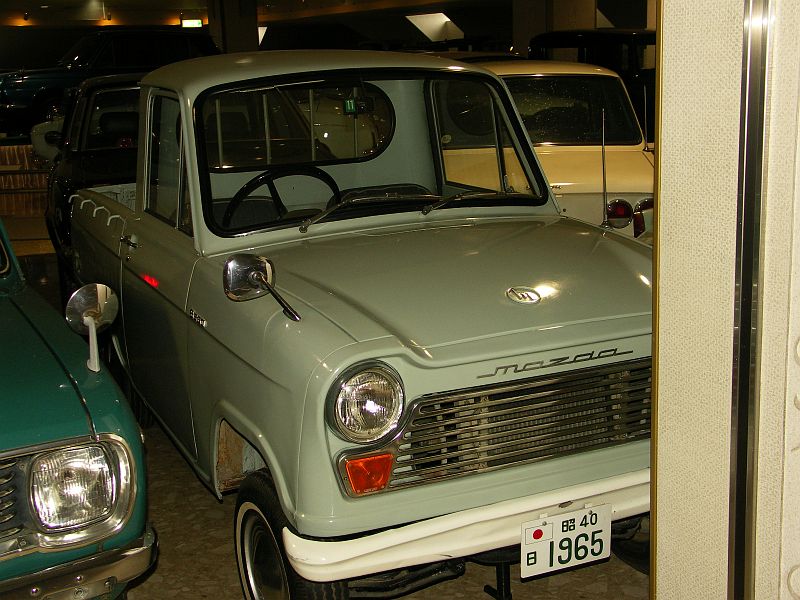
Description
The Mazda B360 Pickup was one of Mazda’s earliest four-wheeled commercial vehicles and an important step in the company’s transition from three-wheeled trucks to a modern light-commercial lineup. Introduced in the early 1960s, the B360 Pickup was designed to meet Japan’s booming demand for compact, economical utility vehicles that could handle daily deliveries, small-business duties and light freight. Practical, affordable and extremely efficient, it became a familiar sight in towns and cities during Japan’s post-war economic expansion.
The B360 Pickup was powered by a 356 cc air-cooled inline-two engine engineered to comply with kei-class regulations of the period. Producing roughly 13–16 horsepower depending on the year, the small two-cylinder unit was simple, durable and very economical. It drove the rear wheels through a four-speed manual gearbox, giving the pickup steady, predictable performance in urban conditions. While not fast, it provided enough power to move modest payloads through narrow streets, precisely the environment for which it was designed.
Mazda built the B360 Pickup on a lightweight monocoque structure — an advanced approach for a low-cost commercial vehicle. This gave the little truck good rigidity and kept overall weight low, improving both fuel economy and load-carrying efficiency. Suspension used independent wishbones with coil springs at the front and a leaf-sprung live axle at the rear. This combination provided a surprisingly compliant ride while still supporting the pickup bed’s work-oriented payload capacity.
Styling was simple, clean and functional. The front end featured a modest grille flanked by round headlamps, giving the truck a friendly appearance that echoed the design language of Mazda’s early passenger models. The proportions were compact and purposeful: a short bonnet, a two-seat cab, and a small but practical rear cargo bed designed to carry produce, parcels, tools or light equipment. The overall look was utilitarian, but the design was tidy and well balanced.
Inside, the B360 Pickup provided a straightforward, hard-wearing cabin for two occupants. Vinyl seats, simple instrumentation and durable plastics defined the interior. Controls were arranged clearly, visibility was good, and the upright driving position made the vehicle easy to handle in tight spaces. It was not designed for comfort or long-distance driving, but for short, efficient daily use — a role it performed extremely well.
On the road, the B360 Pickup delivered calm, manageable performance. Its light weight allowed the small engine to move the truck with reasonable eagerness around town, while its tight turning radius and compact footprint made it ideal for crowded Japanese streets and markets. Ride quality was better than many contemporaries thanks to Mazda’s increasingly refined suspension tuning. Fuel economy was exceptional, one of the key reasons for its popularity.
The B360 Pickup was an important part of Mazda’s early commercial strategy, complementing the B360 Van and providing a more versatile open-bed alternative. Together, these models helped Mazda build credibility in the light-commercial sector before the arrival of the more advanced Porter and later Bongo series. The B360 also represented a pivotal shift toward four-wheeled vehicles, as Mazda gradually moved away from its earlier three-wheelers and expanded into full automobile production.
Surviving examples of the Mazda B360 Pickup are extremely rare today. As working vehicles, most were used hard and discarded once worn out. Those that remain are prized by collectors of early Japanese utility vehicles for their historical significance, simplicity and charm. As one of Mazda’s foundational light trucks, the B360 Pickup stands as an important milestone in the company’s evolution — a small, honest workhorse that contributed to Mazda’s rise as a major automotive manufacturer.