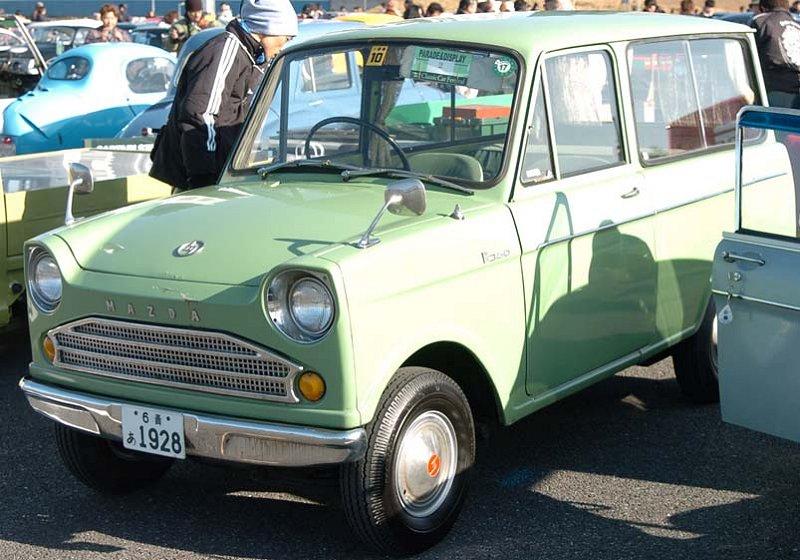
Description
The Mazda B360 Van was one of Mazda’s early small commercial vehicles, introduced in the early 1960s as part of the company’s expanding lineup of compact, affordable and efficient utility models. Positioned above Mazda’s three-wheeled trucks and alongside its first four-wheeled passenger cars, the B360 Van was designed to serve small businesses, shopkeepers and delivery operators during a period of rapid economic growth in post-war Japan. Practical, economical and easy to maintain, it quickly became a staple vehicle for light commercial use.
The B360 Van was powered by a 356 cc air-cooled inline-two engine — a simple, durable and economical unit engineered to comply with Japan’s kei-class regulations of the time. Producing around 13–16 horsepower depending on the production year, the engine offered reliable performance for local deliveries and short-distance travel. Power was routed through a four-speed manual gearbox, giving the little van enough flexibility for city driving despite its modest displacement.
The chassis layout prioritised durability and practicality. The B360 used a lightweight monocoque body — an ambitious construction method for a low-cost commercial vehicle — that contributed to both rigidity and low running weight. Suspension typically consisted of independent front wishbones with coil springs and a leaf-sprung live axle at the rear, tuned to handle varying loads without compromising stability. Despite its small size, the B360 Van was capable of carrying a useful payload, making it ideal for businesses requiring frequent short-haul transport.
Styling of the B360 Van was simple, functional and clean. It featured a compact, boxy silhouette with a short front overhang, large side panels for company branding and a rear cargo area accessible through a simple lift-gate or double doors depending on the version. The front fascia was cheerful and modern for its time, with round headlamps and a small grille. Its minimal ornamentation reflected its utilitarian purpose, but the proportions were well balanced and gave it a friendly, approachable appearance.
Inside, the cabin offered basic but practical accommodations for two occupants. Vinyl-trimmed bench seating, simple instrumentation and durable materials made it easy to clean and maintain — essential for a working vehicle. The steering layout and visibility were designed for urban use, and the compact dimensions made manoeuvring effortless in tight city environments. Behind the seats, the cargo area was flat, spacious for its size and designed to accommodate boxes, tools, produce or small freight items.
On the road, the B360 Van provided steady, predictable performance. Its lightweight construction meant that even the small two-cylinder engine could propel it adequately in dense urban traffic. The ride quality was surprisingly compliant for a vehicle of its class, and the handling was nimble thanks to its short wheelbase and compact dimensions. Fuel economy was excellent, which made the B360 especially appealing during a period when Japan’s transportation infrastructure and small-business economy were expanding rapidly.
The B360 Van played an important role in Mazda’s early commercial-vehicle strategy. It helped bridge the gap between Mazda’s earlier three-wheelers and the more advanced four-wheeled trucks and vans that would follow. The model contributed to Mazda’s reputation for building dependable, economical small vehicles and laid the foundation for later light-commercial offerings, including the popular Mazda Porter series and the long-running Bongo vans and trucks.
Today, surviving examples of the Mazda B360 Van are extremely rare, as commercial vehicles of this type typically saw hard use and few were preserved. Enthusiasts of early Japanese microvans and kei-commercial classics value the B360 for its simplicity, charm and historical significance. As one of Mazda’s foundational light-commercial vehicles, it represents an important chapter in the company’s growth into a full-range automotive manufacturer.