Description
The Mazda Carol 600 was an important transitional model in Mazda’s early passenger-car lineup, bridging the gap between the tiny kei-class Carol 360 and Mazda’s emerging range of larger, more mainstream family cars. Introduced in the mid-1960s, the Carol 600 retained the charm, compactness and mechanical ingenuity of the original Carol but expanded its engine capacity and overall usability to appeal to buyers who wanted something slightly more powerful and more versatile than a kei car, yet still affordable and easy to drive.
Although visually similar to the Carol 360, the Carol 600 belonged to a different regulatory class due to its larger engine. This placed it outside Japan’s kei-car rules, meaning it was targeted at customers willing to pay slightly higher taxes and insurance premiums in exchange for more performance and a greater degree of long-distance comfort.
The Carol 600 was powered by a 586 cc water-cooled inline-four engine, an enlarged version of the sophisticated small four-cylinder introduced in the earlier 360. This engine produced around 20–23 horsepower depending on the exact variant, and although modest by modern standards, it offered significantly improved torque and mid-range flexibility compared with the kei-class version. The four-cylinder layout gave the car a smooth, quiet and refined character that stood out among competitors still using two-stroke or twin-cylinder engines. Power was delivered through a four-speed manual gearbox that made the Carol 600 lively and engaging to drive at low speeds.
The chassis retained Mazda’s monocoque construction and independent suspension at all four wheels. Torsion bars were used at the front, while rear suspension typically employed semi-elliptic leaf springs mounted transversely — a compact and unusual solution that allowed Mazda to maximise cabin space and maintain comfort within the car’s small footprint. Handling was predictable and nimble, and the increased power made the Carol 600 easier to drive on faster suburban roads.
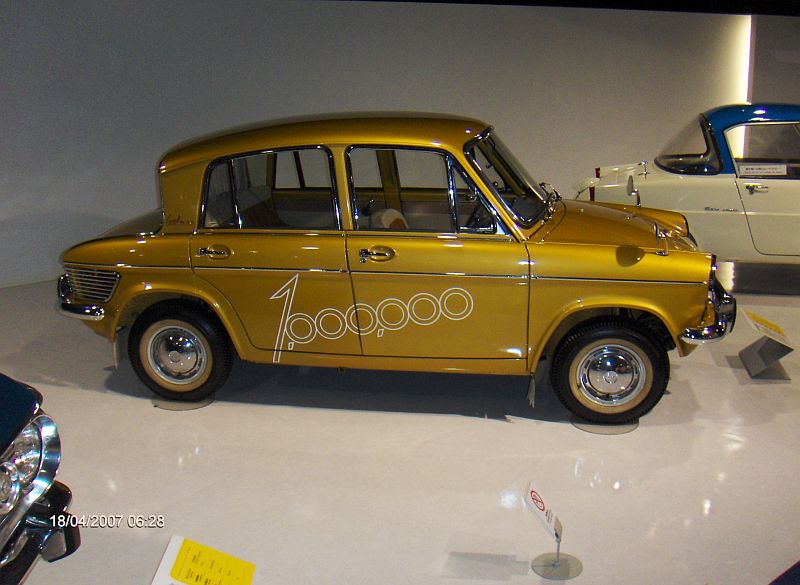
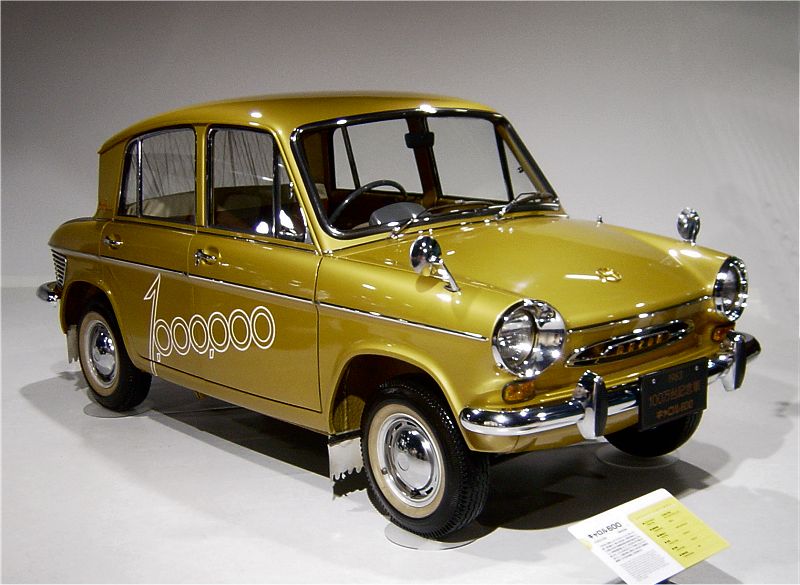
Styling largely mirrored the Carol 360, with its upright stance, rounded contours and compact, friendly proportions. The Carol 600’s slightly larger engine and revised mechanical layout did not dramatically change its exterior appearance, but the model was marketed as a step-up choice, offering more versatility for families and commuters who needed extra performance without sacrificing efficiency or ease of use.
The interior preserved the simplicity of the earlier Carol but was noticeably more comfortable for everyday use. Seating accommodated four occupants, though realistically with more comfort for two adults and two children. Noise levels were lower thanks to the smoother, water-cooled engine, and the cabin materials and finishing reflected Mazda’s improving manufacturing standards. The dashboard was simple, robust and clearly laid out, emphasising practicality and ease of operation.
On the road, the Carol 600 delivered pleasant, steady performance. It was still a small, lightweight car, but the additional power made a meaningful difference in real-world driving. Acceleration was better, hill-climbing improved, and the car could maintain higher speeds without excessive mechanical strain. Ride comfort remained one of the Carol series’ strengths, thanks to Mazda’s efforts to fine-tune suspension geometry and damping for Japanese road conditions.
The Carol 600 did not achieve the same iconic status as the kei-class 360, partly because it sat in a less distinct category and partly because it was soon overshadowed by Mazda’s rapidly advancing lineup — particularly the Familia (323) and later the Porter, Luce and rotary-powered models. Nevertheless, it represented an important evolutionary step, demonstrating Mazda’s ability to scale its engineering solutions and build credible small cars outside the kei-class.
Today, the Mazda Carol 600 is extremely rare. Because it existed in small numbers, had a brief production life and did not benefit from kei-car incentives, fewer examples survived into the modern era. For enthusiasts of early Japanese microcars and Mazda history, however, the Carol 600 is a fascinating and important model — a bridge between Mazda’s tiny 360s and the broader global portfolio that would soon define the brand.