Description
The Mazda Cosmo Sport L10B was the evolved, more powerful and more refined second series of Mazda’s pioneering rotary-powered sports car. Introduced in 1968, one year after the launch of the original L10A, the L10B represented Mazda’s effort to turn its advanced but limited-production halo model into a more capable grand-touring machine. While retaining the same futuristic styling and lightweight engineering that made the Cosmo Sport so distinctive, the L10B offered stronger performance, improved high-speed stability and a more flexible driving experience, making it the definitive version of the Cosmo line.
Power came from the upgraded 0813 twin-rotor rotary engine, still displacing 982 cc but now producing around 128 horsepower thanks to revised port timing, higher rotational capacity and improved breathing. The engine remained remarkably smooth and free of vibration, with the characteristic turbine-like sound that defined Mazda’s early rotary units. In place of the Series I car’s four-speed gearbox, the L10B adopted a close-ratio five-speed transmission, giving it more relaxed cruising ability and better acceleration flexibility. Despite its modest displacement, the L10B’s rotary engine delivered performance comparable to much larger piston engines of the period, especially at higher revs where the rotors spun freely and eagerly.
The chassis of the L10B retained Mazda’s backbone frame design, but important changes were made to improve stability and road manners. The wheelbase was extended by around 38 mm compared with the earlier L10A, giving the car a slightly more settled, planted feel at motorway speeds. Suspension remained identical in layout — unequal-length wishbones at the front and a De Dion rear axle — but revisions to spring and damper tuning complemented the longer wheelbase. The result was a car that maintained the agility and lightness of the original while gaining the composure needed for long-distance touring. Front disc brakes were standard, enhancing stopping performance and safety.
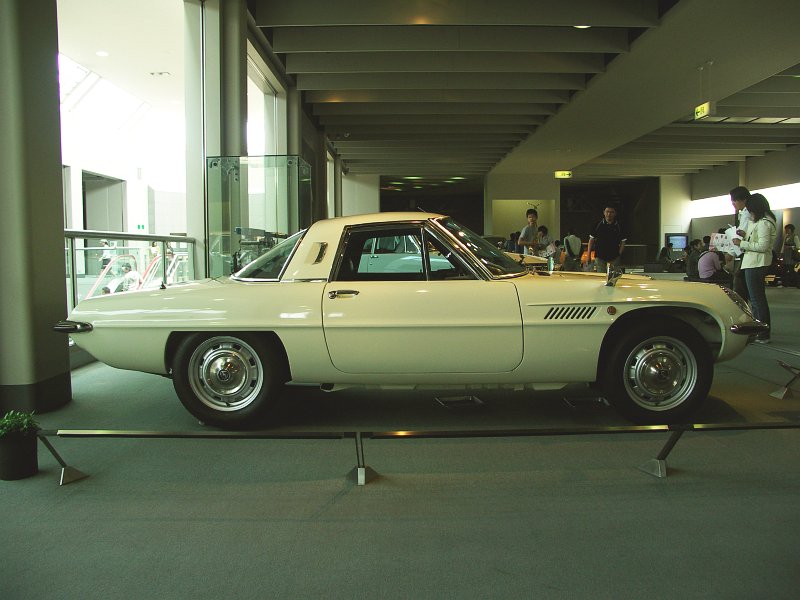
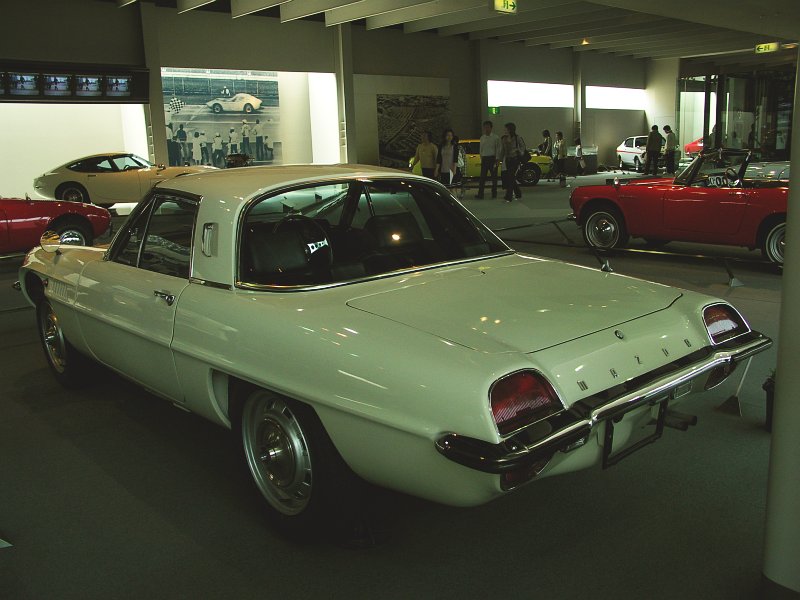
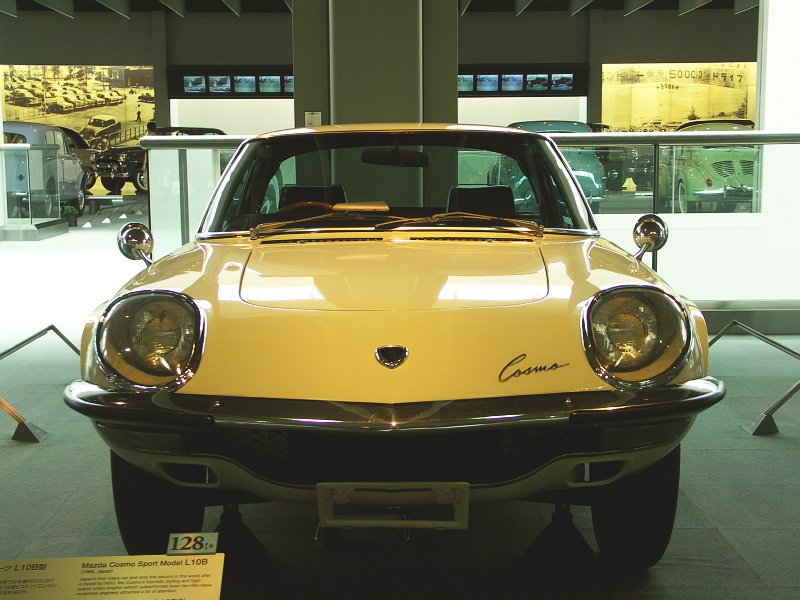
Styling remained almost untouched, which reflected how advanced the Cosmo Sport’s design had been from the beginning. The L10B carried over the sleek, low-slung profile with its long bonnet, compact cabin and short tail. The clean surfacing, slim pillars and flowing arches gave the car its timeless, space-age form. Subtle updates distinguished the L10B, including revised bumpers, slightly altered lamps and detail refinements, but the core shape remained one of the most elegant and distinctive designs to emerge from Japan in the 1960s. The Cosmo Sport’s proportions — crisp, compact and futuristic — allowed the L10B to feel both classic and modern even decades later.
Inside, the L10B offered a cabin designed around precision and driver engagement. A full suite of analogue instruments sat ahead of the driver, emphasising the car’s technical nature. The three-spoke steering wheel, slim gear lever and toggle switches created an aircraft-inspired ambience. The seats were supportive and stylish, and the general quality of materials reflected the car’s semi-hand-built construction. Although the Cosmo Sport was small inside, the attention to craftsmanship gave the L10B a sense of distinction that rivalled far more expensive European sports cars of the era.
On the road, the Cosmo Sport L10B delivered a more mature and capable driving experience than its predecessor. The stronger engine and five-speed gearbox made the car feel livelier across the rev range and more composed at high speed. The extended wheelbase improved straight-line stability, allowing the car to cruise more confidently on open roads. Steering remained crisp and direct, and the lightweight construction kept the car agile and responsive when cornering. The rotary engine encouraged drivers to use its rev range fully, and the smooth delivery made the car feel refined even when pushed hard.
The L10B became the more common of the two Cosmo Sport versions, though overall production remained extremely limited — around 1,176 units out of the total Cosmo run of approximately 1,500 cars. Each was assembled with significant manual craftsmanship, contributing to its quality and exclusivity. The L10B cemented the Cosmo Sport’s reputation not only as the world’s first twin-rotor production sports car but also as a genuinely accomplished GT machine.
Today the Mazda Cosmo Sport L10B is one of the most coveted Japanese classics, valued for its blend of beauty, rarity and historical significance. As the refined, more capable evolution of Mazda’s pioneering rotary sports car, it represents the essence of the Cosmo project. With its advanced engineering, elegant styling and unique rotary character, the L10B stands as a cornerstone of Mazda’s heritage and one of the most important sports cars ever produced in Japan.