Description
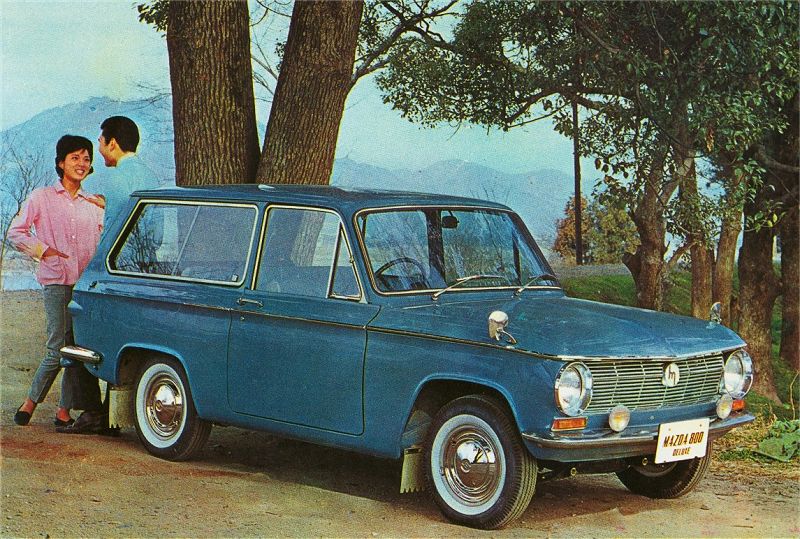
The Mazda Familia 800 Van was an early light-commercial derivative of the first-generation Mazda Familia range, introduced in the mid-1960s as Mazda expanded rapidly into both domestic and export markets. Built alongside the Familia 800 saloon and estate, the Van version offered a practical, durable and economical small commercial vehicle tailored for shopkeepers, delivery drivers and businesses needing a compact but capable workhorse. Although overshadowed today by later and more widely exported Familias, the 800 Van played a key role in Mazda’s emergence as a full-line manufacturer during a pivotal period in Japan’s motoring growth.
The Familia 800 Van was powered by Mazda’s 782 cc, water-cooled inline-four “SA-type” engine, an enlarged development of the company’s earlier small-car powerplants. Producing approximately 42 horsepower, it offered smooth, flexible performance thanks to its four-cylinder layout — a significant advantage over the two-cylinder and two-stroke engines still common in Japanese commercial vehicles of the era. Power was delivered to the rear wheels through a four-speed manual gearbox. For a light-commercial vehicle of its size, the engine provided a useful balance of economy and usable torque, making it well suited to city deliveries and short-distance transport.
The chassis used a conventional front-engine, rear-wheel-drive layout and was based on the passenger Familia platform but strengthened for commercial use. The front suspension employed independent coil springs for predictable handling and reasonable ride comfort, while the rear used a sturdy leaf-sprung live axle designed to carry heavier loads without excessive sag. The Van’s payload capacity made it a versatile tool for small businesses, and its compact dimensions allowed it to navigate Japan’s tight urban streets easily.
Styling of the Familia 800 Van was clean, simple and practical. While sharing the basic front design of the passenger models — including the modest grille and round headlamps — the Van adopted a high-roofed, long-roof body with flat side panels and a squared-off rear cargo area. Access to the load space was through a single rear door or twin opening panels depending on the market. The design prioritised utility and volume, with straight lines and upright proportions that maximised usable space.
Inside, the cabin was functional and robust, trimmed in durable vinyl and hard-wearing plastics. The dashboard was simple and clearly arranged, featuring only the essential instruments required for daily use. Visibility was excellent thanks to the upright windscreen and thin pillars, and the driving position was comfortable for long shifts of stop-start urban work. Behind the seats, the cargo compartment was flat-floored, wide and surprisingly spacious for a small van, accommodating boxes, tools, supplies or light freight with ease.
On the road, the Familia 800 Van delivered stable, predictable and economical performance. It was not fast, but the four-cylinder engine provided good drivability at low speeds, and the suspension was tuned to cope with both empty and loaded conditions. The compact wheelbase and rear-drive layout made the van easy to turn in narrow alleys and crowded districts, and operating costs were low — a major attraction for the small businesses that made up most of its customer base.
The Familia 800 Van proved successful in Japan and in selected export markets where small commercial vehicles were in demand. Its combination of refined four-cylinder power, practical load area and straightforward engineering helped broaden Mazda’s reputation beyond kei-class microcars and into the more competitive compact-commercial segments. It also laid groundwork for later, more advanced Familia vans and estates that would accompany Mazda’s expansion through the 1970s and 1980s.
Today, the Mazda Familia 800 Van is extremely rare, as most examples worked hard and were not preserved. Among enthusiasts of early Japanese commercial vehicles, however, it is regarded as an important milestone — a well-engineered, honest and practical light van that helped cement Mazda’s position as a serious and capable automotive manufacturer during its formative years.