
Description
The Mazda HR-X was one of Mazda’s most ambitious experimental concept cars, created at the beginning of the 1990s to showcase the company’s research into alternative-fuel rotary engines. Revealed in 1991 — the same year Mazda won Le Mans with the 787B — the HR-X represented a radically different direction for rotary development, demonstrating how the smooth, compact Wankel engine could be adapted for clean-burning fuels such as hydrogen. It was a bold exploration of future mobility at a time when environmental technology was still in its infancy.
The HR-X used a modified rotary engine engineered specifically to run on gaseous hydrogen. Rotary engines were particularly suitable for hydrogen combustion because they suffered far less from the pre-ignition and uneven burn issues that plagued piston engines running on hydrogen at the time. Mazda designed the HR-X’s rotary with special fuel injectors, reinforced seals and optimised chamber shapes to improve combustion stability. Although Mazda never released an official power figure, the hydrogen rotary was capable of smooth, usable performance suitable for everyday driving, free from vibration and with drastically reduced emissions.
The chassis and structure of the HR-X were created from lightweight, environmentally conscious materials — a design philosophy consistent with the clean-energy focus of the project. Mazda used aluminium, plastics and composite materials to keep weight low while maintaining rigidity. The vehicle rode on a platform designed for urban mobility, prioritising efficiency, low running resistance and aerodynamic smoothness. Suspension and handling were tuned for relaxed, safe driving rather than performance, supporting the HR-X’s role as a technology demonstrator.
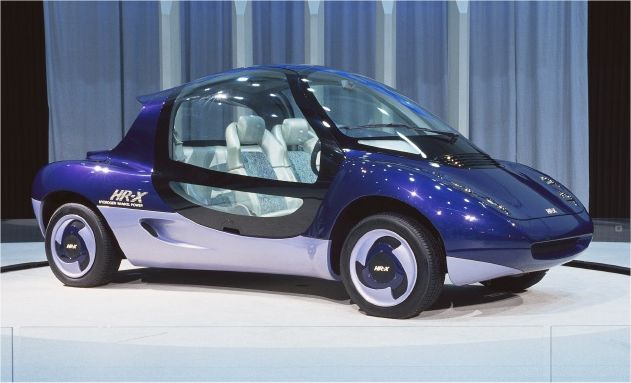
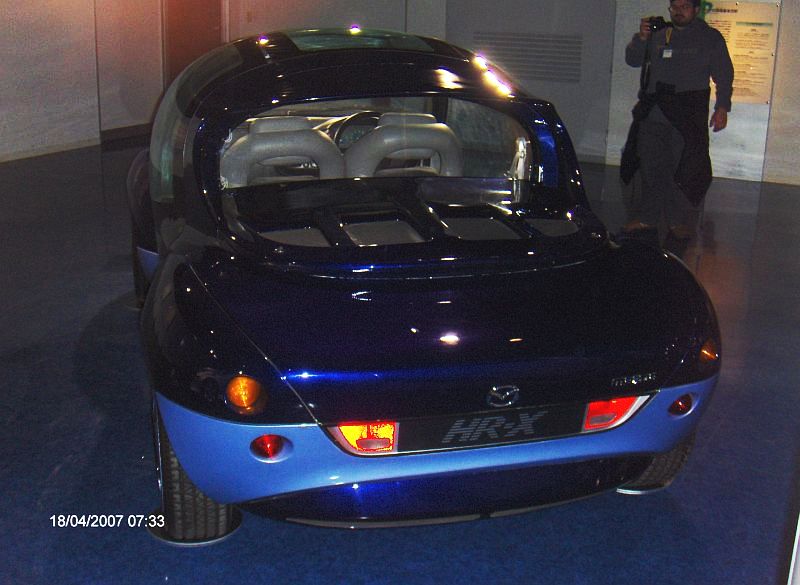
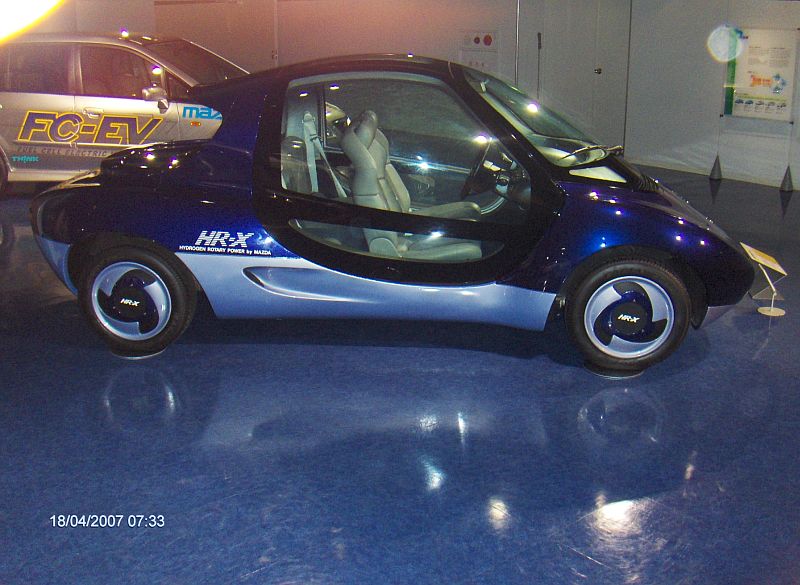
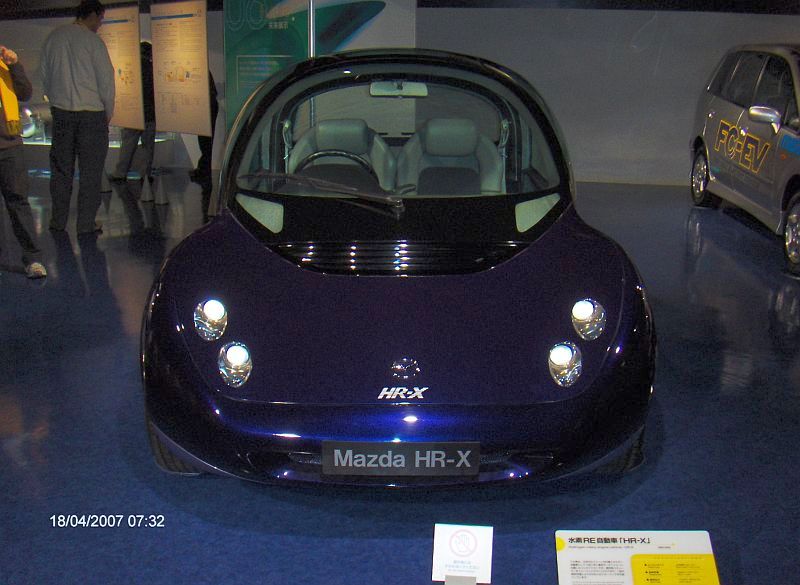
Styling was one of the HR-X’s most striking features. The design reflected early-1990s futurism, with flowing, aerodynamic shapes and a concept-car purity that stood apart from production vehicles of the period. The body was smooth, rounded and sleek, with a one-piece canopy-style windscreen and organically sculpted flanks that reduced drag. The front end carried minimal openings due to the rotary’s smaller cooling requirements compared with piston engines, and the entire exterior projected a sense of clean, efficient motion. Its form looked almost like a distillation of Mazda’s aerodynamic research from its Group C racing programme, translated into an eco-car aesthetic.
Inside, the HR-X continued the theme of futuristic minimalism. The cabin featured a wraparound dashboard, digital instrumentation and unusually sculpted seating. Controls were simplified, materials were lightweight, and the overall design emphasised visibility and driver ease. As a concept, the interior prioritised presentation of future design ideas over conventional practicality, highlighting Mazda’s vision for sustainable urban vehicles.
On the road, the HR-X’s hydrogen rotary was remarkably smooth and quiet. Hydrogen combustion in a rotary engine produced very low levels of NOx emissions, and Mazda’s engineers stated that the drivetrain performed reliably throughout their test programme. The car was not built for speed — its purpose was to prove the feasibility of a clean-fuel rotary — but the HR-X drove with the trademark linear delivery and refinement associated with Wankel engines.
The HR-X played an important role in Mazda’s long-term research into alternative fuels. It served as the foundation for later hydrogen-powered rotary prototypes, including the HR-X2, the hydrogen RX-8 RE, and the Premacy Hydrogen RE Hybrid. Each of these developments retained the same core idea first demonstrated in the HR-X: that the rotary engine’s combustion characteristics made it uniquely suitable for hydrogen fuel.
Today, the Mazda HR-X is remembered as a rare and forward-thinking concept from a company deeply committed to rotary innovation. While it never entered production, it stands as an important milestone in Mazda’s environmental research and a fascinating counterpart to the high-performance rotary icons of the same era. As one of Mazda’s earliest serious hydrogen-rotary vehicles, the HR-X represents the forward-looking engineering spirit that has defined the brand for decades.