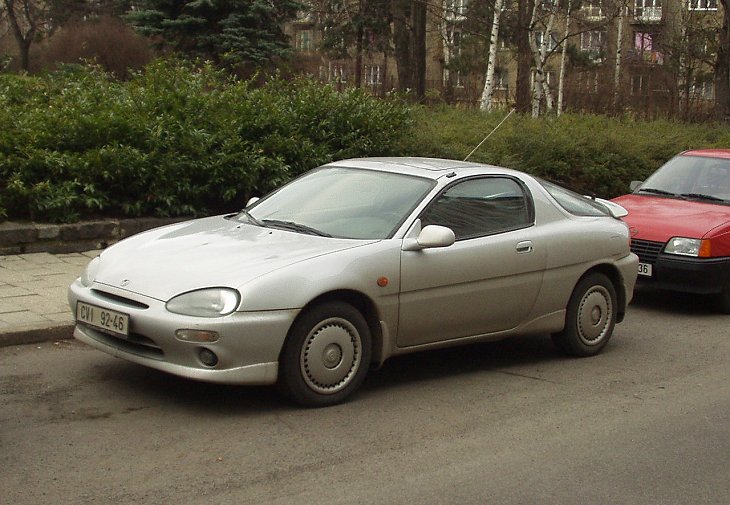
Description
The Mazda MX-3 V6 was the most distinctive and technically intriguing version of Mazda’s compact coupé of the early 1990s. Sold from 1991 through most global markets, it gained immediate attention for its unusual engine: the world’s smallest-production V6. Paired with the MX-3’s lightweight chassis and curvaceous styling, the 1.8-litre V6 created a refined, eager and genuinely unique small sports coupé that has since earned a loyal following among enthusiasts.
Power came from the K8-DE 1845 cc 24-valve V6, an engineering showcase that produced around 130 horsepower depending on market specification. Compact, smooth and beautifully free-revving, it was designed to demonstrate that a small-capacity V6 could deliver refinement and character far beyond what a four-cylinder of the same size could achieve. The K8 engine produced a distinctive, silky exhaust note and delivered crisp throttle response, strong mid-range pull and a willingness to rev right to its redline. Most MX-3 V6 models were paired with a five-speed manual gearbox that made the most of the engine’s character, though a four-speed automatic was available and offered relaxed, seamless progress for everyday use.
The MX-3’s chassis made full use of the V6’s refinement. Independent suspension all round — MacPherson struts at the front and a multi-link rear — gave the car superb balance and agility. The slightly heavier V6 engine actually improved high-speed stability while still keeping the nose light enough for quick turn-in and precise cornering. Steering was well weighted and communicative, and the suspension tuning struck an excellent compromise between comfort and driver engagement. The MX-3 V6 earned a reputation as one of the sweetest-handling small cars of its era, with excellent grip and a playful, confident feel on twisty roads.
Externally, the V6 shared the curvaceous, organic design that defined the MX-3 lineup. The smooth bonnet, swept-back headlights, rounded rear quarters and compact fastback profile gave the car a distinctive, almost futuristic appearance in the early 1990s. Subtle visual differences typically set the V6 apart from the 1.6 variant, including sportier alloy wheels, slightly deeper bumpers and discreet badges. The proportions remained compact and taut, giving the car an athletic stance without harsh or angular design elements.
Inside, the MX-3 V6 offered a well-designed and inviting cabin. The dashboard curved gently towards the driver and featured clear instrumentation, supportive bucket-style seats and well-placed controls. Materials were solid and durable, reflecting Mazda’s attention to quality during this period. Equipment varied by trim and market, but many V6 models included electric windows, central locking, a leather-trimmed steering wheel, air conditioning and higher-grade upholstery. Despite the car’s small size, the interior felt comfortable and well formed, with the rear seats suitable for occasional use.
On the road, the MX-3 V6 delivered a driving experience that combined refinement with youthful energy. The small V6 engine gave the car a polished, almost premium feel unusual for its class, while still offering enough performance to make backroad driving genuinely enjoyable. The smoothness of the power delivery and the sophisticated suspension tuning made it a comfortable commuter, yet its light weight and balance allowed it to be driven enthusiastically with confidence. It was not a straight-line performance machine, but instead a car that rewarded precision, rhythm and smooth inputs — very much in keeping with Mazda’s driver-focused philosophy.
The MX-3 V6 became an important part of Mazda’s early-1990s identity. It demonstrated the company’s willingness to develop unusual, technically interesting engines and to offer small coupés that were enjoyable and distinctive rather than simply economical. As a result, the MX-3 V6 gained a level of cult status, particularly for its unique engine and the way it blended refinement with agility.
Today the Mazda MX-3 V6 is increasingly appreciated as a rare and characterful compact coupé. Surviving examples are sought after for their unusual engineering, smooth V6 performance and excellent chassis balance. As one of the most refined and engaging small coupés of its era — and the only one with such a distinctive miniature V6 — the MX-3 V6 remains a memorable and appealing chapter in Mazda’s sporting history.