
Description
The Mazda MX-5 1.6 Cup was the stripped-back, competition-focused variant of the early NA-generation MX-5, created specifically for one-make racing series that emerged soon after the car’s 1989 launch. Built around the rev-happy 1.6-litre engine and the MX-5’s inherently well-balanced chassis, the Cup version distilled everything that made the standard car such a perfect low-power sports machine, then sharpened it for track use. It became the foundation of countless national MX-5 racing series — in Europe, Japan, New Zealand, Australia and North America — and helped transform the MX-5 into the most successful grassroots racing platform of its era.
At the heart of the MX-5 1.6 Cup was the same B6-ZE 1597 cc inline-four found in road-going NA models. Producing around 115 horsepower in its uncatalysed early form (slightly less in later years), the engine was left largely unmodified in most Cup regulations. This was deliberate. Racing organisers wanted tight parity and low running costs, so modifications were limited to reliability essentials such as improved cooling, uprated fluids or, in some series, a free-flowing exhaust within noise limits. What made the engine so effective in Cup racing was its character rather than its output: crisp throttle response, a willingness to rev cleanly, and a smooth, linear delivery that encouraged drivers to focus on technique. Paired with the MX-5’s superb five-speed manual gearbox, it created a drivetrain that rewarded precision and consistency over brute power.
The chassis formed the real foundation of the MX-5 1.6 Cup car. The NA’s double-wishbone suspension — front and rear — was remarkably advanced for such a small, affordable sports roadster. In Cup specification, suspension components were typically standard or lightly modified depending on the series. Most regulations allowed uprated dampers, firmer springs, performance brake pads, braided lines and better tyres, but the fundamental geometry remained untouched. This preserved the MX-5’s balance, agility and communicative steering, while increasing consistency and durability under race conditions. The car’s light weight made it responsive, predictable and forgiving — ideal attributes for a one-make series focused on driver ability.
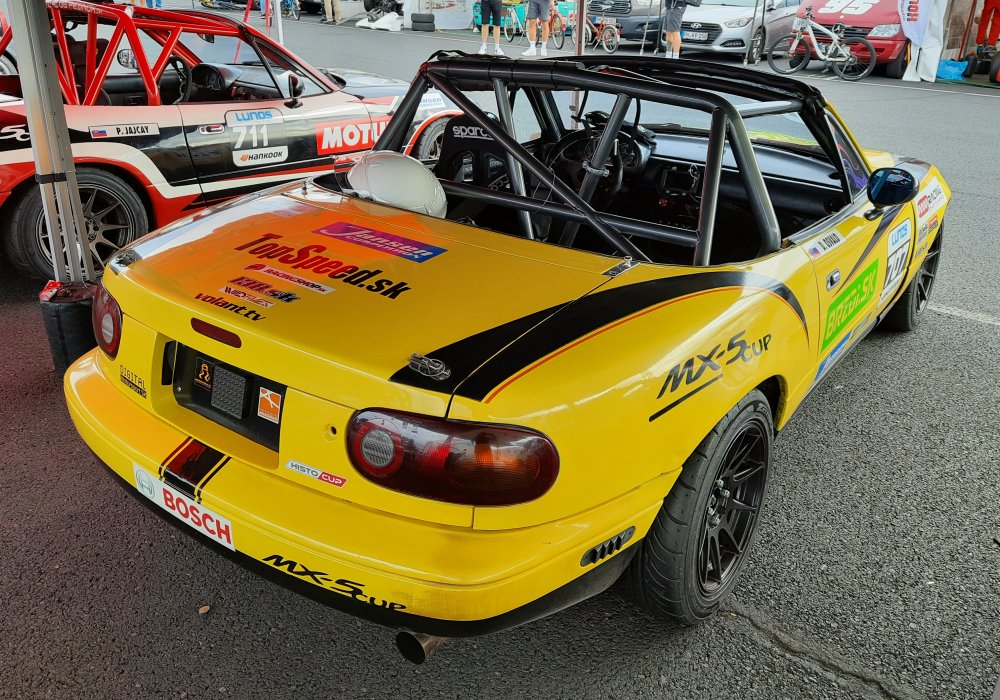
Styling remained close to the road car, because Cup rules generally mandated factory panels, standard bodywork and minimal aerodynamic additions. This maintained low costs and ensured the “spec” nature of the class. What set Cup cars apart visually were their liveries, roll-over protection, tow hooks and lightweight race wheels. The NA’s compact, rounded proportions — pop-up headlights, clean curves and short overhangs — made it instantly recognisable even in full race trim. Many Cup cars replaced the soft-top with a fibreglass hardtop for rigidity and safety, giving the MX-5 a more purposeful, coupe-like profile on track.
Inside, the MX-5 1.6 Cup was transformed into a proper racing environment. All non-essential interior components were removed, including carpets, trim panels, sound insulation and sometimes the passenger seat. A full roll cage was fitted to meet safety regulations and dramatically increase chassis rigidity. A bucket seat, race harness, fire extinguisher system and kill switch completed the setup. The dashboard structure typically remained, but with minimal instrumentation and race-specific additions such as rev lights or cut-off controls. The resulting cockpit was lightweight, focused and free of distractions, matching the Cup car’s raw driving purpose.
On the track, the MX-5 1.6 Cup delivered exactly the kind of racing experience organisers hoped for: close, competitive, driver-centric and hugely enjoyable. With modest power but exceptional balance, success depended on cornering speed, smooth inputs, slip-angle control and racecraft rather than horsepower. Drafting became an important tactic, and races often featured long trains of cars separated by tenths of a second. Drivers praised the Cup MX-5 for its benign handling, clear feedback and ability to recover gracefully from the limits. Tyre wear was low, running costs were minimal and the cars proved extremely reliable — all key ingredients in building the world’s most successful grassroots racing platform.
The importance of the MX-5 1.6 Cup to Mazda’s sporting identity is substantial. It helped cement the MX-5’s reputation not just as a fun roadster but as a serious driver’s car with exceptional track pedigree. It also introduced thousands of drivers to motorsport, thanks to its low cost, forgiving nature and tight performance parity. Entire generations of racers — amateur and professional — began their careers in MX-5 Cups.
Today, MX-5 1.6 Cup cars remain popular in club motorsport. Many continue to race in national and regional one-make series, while others find homes in track-day fleets or private collections. Their simplicity, mechanical purity and affordability make them some of the most appealing entry-level race cars available.
As a competition-honed version of one of the world’s greatest driver’s cars, the Mazda MX-5 1.6 Cup stands as a perfect embodiment of what makes the MX-5 formula so enduring: lightness, balance, honesty and the joy of driving at its purest.