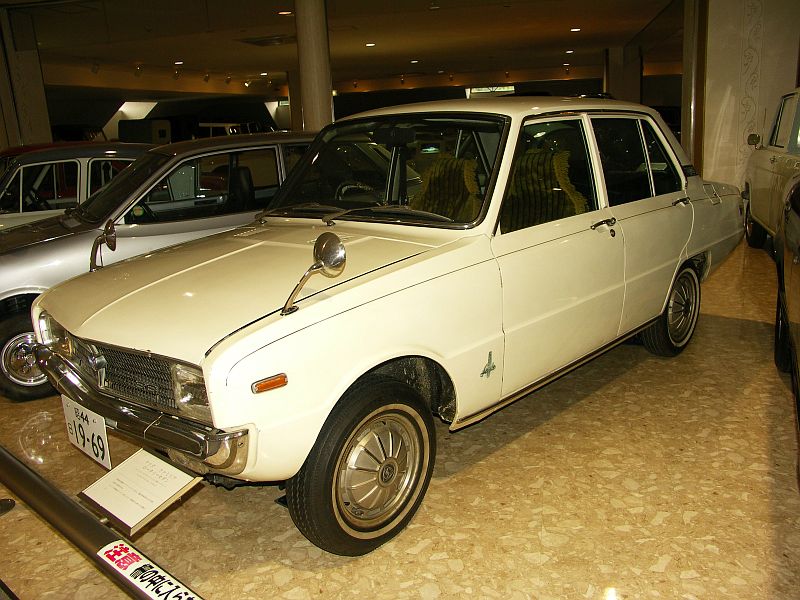
Description
The Mazda R100 Familia SS was one of Mazda’s most significant early performance cars and the very first Mazda to carry a rotary engine into full international production. Introduced in 1968 as part of the second-generation Familia range, the R100 served as the high-performance flagship of Mazda’s compact lineup and played a crucial role in establishing Mazda as the world’s leading rotary-engine manufacturer. Light, lively and technologically daring, it became a cult favourite among early Japanese performance enthusiasts and an important stepping stone toward Mazda’s later rotary icons.
At the heart of the R100 Familia SS was Mazda’s 10A twin-rotor engine, a compact 982 cc rotary unit producing around 100 horsepower in road trim. This was an extraordinary output for a small family car of the late 1960s. Smooth, rev-happy and unusually free from vibration, the rotary engine gave the R100 an eager, sophisticated character that immediately set it apart from its piston-engined competitors. Power delivery was linear and seamless, and the lightweight nature of the rotary kept the nose of the car unusually light, giving the R100 a distinctive handling balance. The engine was paired with a four-speed manual gearbox as standard, providing quick, satisfying shifts and excellent use of the rotary’s high-revving nature.
The chassis began with the basic architecture of the Familia sedan and coupé, but the SS specification received numerous upgrades to match its increased performance. A lightweight unibody structure kept overall mass low, helping the R100 achieve lively acceleration and nimble responses. The suspension used independent front coil springs and a leaf-sprung live axle at the rear, tuned more firmly than standard models to improve body control. Steering was sharp for its era, and the car’s compact dimensions made it feel alert and playful on winding roads. Drum brakes were fitted at all four corners in early versions, though later variants and export models gained front discs to cope with higher speeds.
Styling played a significant role in the R100’s appeal. Available as both a two-door sedan and coupé depending on market, it adopted clean, modern lines with subtle sporting cues. The front end featured quad round headlights, a crisp grille and a slightly more aggressive stance than the standard Familia. The coupé variant, especially, had a purposeful, tidy profile with a gently sloping roofline and neatly sculpted rear quarters. Mazda’s rotary badging was proudly displayed, marking the car as a technological pioneer. The R100’s understated style made it look more refined than many contemporary compact sports models, perfectly matching its character as a small but sophisticated performer.
Inside, the R100 Familia SS offered a focused but still practical cabin. The dashboard featured clear, round instruments, including a prominent tachometer emphasising the rotary’s love of revs. The seats were simple but supportive, and the overall layout felt more purposeful than the standard Familia versions. Although it remained a small family car at heart, the interior of the R100 carried the atmosphere of a compact sports machine, reflecting its higher performance and price point.
On the road, the R100 delivered a driving experience unlike anything else in its class during the late 1960s and early 1970s. The rotary engine gave it a smoothness and eagerness that piston engines struggled to match, and the car’s lightness made it feel quick, agile and responsive. It could rev freely to high engine speeds without the mechanical harshness common in small four-cylinders of the era. The handling was crisp and predictable, and the compact dimensions made the car delightful on twisting roads. Although fuel economy was modest and the early rotary required attentive maintenance, the rewards in character and performance were undeniable.
The R100 also gained international fame through motorsport. Mazda campaigned the model in touring-car racing, most famously at the 1969 Spa 24 Hours, where rotary-powered R100s astonished European audiences with their speed, smoothness and distinctive exhaust note. This motorsport success helped cement Mazda’s reputation as a serious rotary innovator.
The R100 Familia SS remained in production until 1972, after which it was succeeded by rotary versions of the RX-2, RX-3 and RX-4. Although later models offered more power and refinement, the R100 remains special as Mazda’s first true rotary road car and the machine that showcased the company’s ambition to the world.
Today, the Mazda R100 Familia SS is highly prized among collectors of early Japanese performance cars and rotary enthusiasts alike. Its clean styling, historic significance and light, rev-happy driving character give it a timeless appeal. As the car that marked Mazda’s bold entry into rotary performance, the R100 stands as a landmark in the company’s history — the compact, energetic pioneer that paved the way for every rotary Mazda that followed.