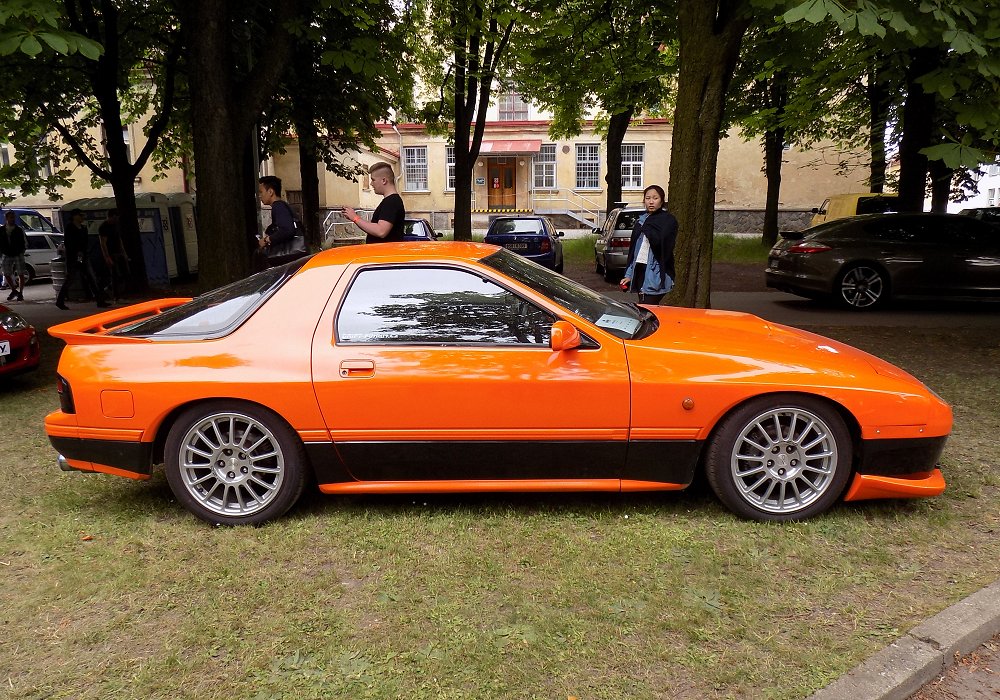
Description
Mazda RX-7 tuning has become one of the most diverse and distinctive branches of Japanese performance culture, shaped by the rotary engine’s unique strengths and challenges. Whether based on the SA22C/FB, FC or FD generations, tuning an RX-7 is always defined by the engine’s smooth, high-revving character, the car’s excellent weight distribution and the need for careful, respectful modifications that work with the rotary rather than against it. Over decades of development, tuners, workshops and enthusiasts have created a broad tuning philosophy centred on efficiency, cooling, balance and reliability.
The rotary engine responds to modifications differently from piston engines. It thrives on improved airflow, precise fuelling, proper cooling and careful ignition control. On naturally aspirated 12A and early 13B engines, traditional tuning begins with porting. Street ports increase breathing without sacrificing everyday drivability, bridge ports introduce a louder idle and stronger top-end punch, and peripheral ports create the highest power potential with a race-car personality. Intake upgrades, freer-flowing exhaust systems and optimised carburetion or injection complete the classic rotary blueprint, producing an engine that revs cleanly and delivers power with a light, turbine-like feel.
Turbocharged 13B engines, especially in the FC Turbo II and FD RX-7, offer far more tuning potential. The 13B-REW in the FD responds particularly well to improved intercooling, larger but efficient turbochargers, high-flow downpipes and modern engine management. The sequential turbo system, while ingenious, becomes complex as it ages, and many tuners choose a single-turbo conversion for simplicity, faster spool and reliable high-output tuning. Power levels beyond 300 horsepower are achievable with modest upgrades, while fully built engines with strengthened apex seals, modern turbos and upgraded fuel systems can comfortably exceed 500 horsepower. The key theme is balance; the rotary rewards smooth, efficient setups rather than oversized components.
Cooling is one of the most important aspects of RX-7 tuning. Rotary engines generate significant heat in the housing and exhaust, and managing temperature is critical for both performance and longevity. Upgraded aluminium radiators, improved oil coolers, high-flow fans and ducting modifications are considered essential even for mild tuning. FD models especially benefit from larger intercoolers, air-separation tanks and careful attention to coolant circulation. Tuners often describe cooling as the foundation upon which all reliable rotary power builds.
Handling improvements complement the RX-7’s inherently balanced chassis. Coilover suspension, uprated dampers, refreshed bushings and adjustable anti-roll bars sharpen the car’s responses without altering its natural neutrality. Lightweight wheels and performance tyres transform grip levels while maintaining the car’s agility. The FD, with its double-wishbone setup, rewards subtle tuning that enhances precision rather than brute stiffness. The FC benefits from improved dampers and bushings to bring its GT-influenced suspension into a more responsive state. Even early SA/FB models respond well to modern shocks, bracing and carefully chosen wheel sizes.
Braking upgrades are a necessary part of any performance build. The RX-7’s light weight helps, but modern pads, braided lines, high-temperature fluids and larger rotors significantly improve confidence during spirited driving. The FD’s factory brakes are strong, but many high-power builds adopt larger multi-piston calipers for endurance and fade resistance. Chassis bracing, particularly strut braces and under-body reinforcements, further improves stability and helps preserve the car’s sharp steering feel.
Aesthetically, RX-7 tuning has a rich and diverse history. The SA22C/FB often adopts period-correct modifications such as modest aero, JDM accessories and vintage wheels that enhance its 1980s silhouette. The FC embraces both classic 1980s angularity and the aggressive styles of Group A and drift culture. The FD, with its smooth, organic shape, is highly receptive to aero tuning. Subtle lip spoilers and functional ducts improve cooling and stability, while wider arches and smooth, flowing body kits have become icons in their own right. The FD’s design is so cohesive that even small aero changes can have a significant impact on visual and dynamic balance.
Interior tuning typically focuses on improving the driver’s relationship with the car. Supportive seats, precise short-shift kits, uprated steering wheels and modern gauges improve control and feedback. Many tuned RX-7s retain a minimalist feel, reflecting the car’s lightweight philosophy. Electronics also play a major role in modern builds, with standalone ECUs, wideband sensors and data logging forming the backbone of safe, repeatable performance.
Tuning an RX-7 has always been about understanding the rotary engine’s distinctive nature and working with it rather than forcing it into a piston-engine mould. The result is a tuning culture built on technical skill, mechanical sympathy and a deep appreciation for the lightweight, balanced spirit of Mazda’s most famous sports car. Whether a mild street build, a showpiece, a drift machine or a track-focused FD with modernised power and cooling, a tuned RX-7 remains one of the most rewarding driver’s cars ever created.