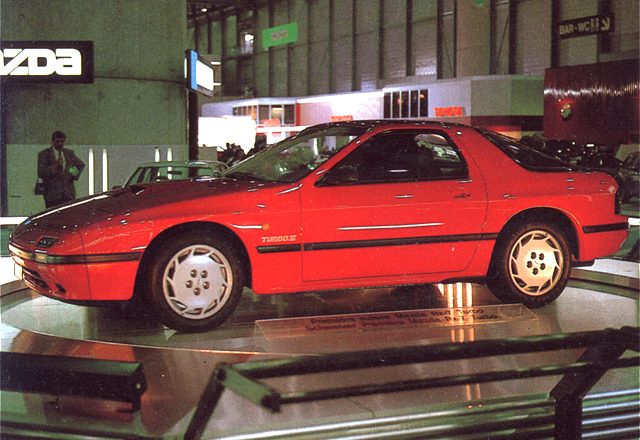
Description
The Mazda RX-7 Turbo was the high-performance evolution of Mazda’s rotary sports car, offering the smooth, high-revving character of the Wankel engine combined with the forceful mid-range thrust of turbocharging. Across the FC and FD generations in particular, the Turbo models became the definitive expression of Mazda’s rotary engineering — compact, lightweight, responsive and capable of remarkable performance when carefully tuned. Even today, the RX-7 Turbo stands as one of Japan’s most influential and admired sports-car formulas.
The first turbocharged RX-7 appeared with the second-generation FC model in 1985. Mazda fitted the 13B-T twin-rotor engine with a single turbocharger, delivering around 182–200 horsepower depending on market. The turbo transformed the rotary’s naturally smooth, linear power delivery into a broader, more muscular curve, giving the car strong mid-range acceleration and a deeper surge of torque. The FC Turbo II models remained refined and free of vibration thanks to the rotary’s inherent smoothness, and the engine responded eagerly at high revs, encouraging drivers to keep it spinning. Paired with a close-ratio five-speed manual gearbox, the FC Turbo delivered a blend of modern turbo thrust and classic rotary character that distinguished it from rival sports coupes of the era.
The third-generation FD took the RX-7 Turbo to a far more advanced level. Introduced in 1992, the 13B-REW engine became the world’s first mass-produced sequential twin-turbo rotary. In this setup, a small primary turbo provided immediate low-rpm boost, while a larger secondary turbo activated at higher revs, creating a smooth, continuous wave of acceleration. Official power outputs ranged from 255 to 280 horsepower depending on market regulations, but real-world performance was often stronger. The sequential system required meticulous engineering and remains one of the most distinctive features of the FD. Its compact layout, high-revving nature and uninterrupted delivery made the car feel light, responsive and deceptively quick.
The RX-7 Turbo chassis evolved to match the increased power. The FC model offered fully independent suspension with struts at the front and Mazda’s multi-link “IRS” rear setup, creating a stable and balanced platform with strong high-speed composure. The FD refined this further with double wishbones at all four corners and a lightweight aluminium-rich structure. The FD in particular became celebrated for its sharp turn-in, neutral balance and precise steering — qualities enhanced by careful weight distribution made possible by the compact rotary engine. Whether in FC or FD form, the RX-7 Turbo delivered a driving experience focused on agility, responsiveness and connection, more like a finely tuned lightweight sports car than a traditional turbocharged GT.
Styling mirrored the mechanical intent. Turbo versions of the FC featured deeper air dams, larger brakes, subtly wider wheels and functional vents that gave the car a more purposeful presence. The FD, however, reached a new stylistic peak. The smooth, low-slung shape, taut surfacing, long bonnet and tightly wrapped cabin created one of the most recognisable sports-car silhouettes of the 1990s. The clean design housed extensive cooling ductwork and carefully shaped aerodynamic elements that supported the demands of the sequential turbo system. Even today, the FD RX-7 Turbo is considered one of the most beautiful Japanese performance cars ever made.
Inside, the RX-7 Turbo maintained a driver-focused layout. The FC offered a modern, slightly angular cabin with clear instruments and supportive seats, while the FD created a cockpit that wrapped around the driver, highlighting its performance intent. The low seating position, well-placed controls and precise manual gearshift made the Turbo models feel purposeful before the engine was even started.
On the road, the RX-7 Turbo delivered an experience defined by smoothness, urgency and balance. The rotary engine’s rev-happy nature made it feel alive at the top of the rev range, while the turbocharging added the strength needed for fast, confident acceleration. The lightweight chassis allowed the car to change direction with remarkable agility, and the steering provided clear, delicate feedback. Particularly in FD form, the RX-7 Turbo achieved a level of dynamic purity that placed it alongside the era’s finest sports cars.
The RX-7 Turbo also played a major role in motorsport and tuning culture. The rotary’s tuning potential made it a favourite in touring cars, endurance racing, hill climbs and, later, drifting. Tuners discovered that the rotary responded exceptionally well to improved cooling, modern engine management and efficient turbo upgrades. As a result, many RX-7 Turbo models became high-performance machines capable of far exceeding their original output while retaining their lightweight, balanced feel.
Today, the Mazda RX-7 Turbo remains one of the most iconic Japanese performance cars. Its blend of rotary smoothness, turbo power and lightweight engineering gives it a character unlike any piston-engine rival. Whether in its refined FC Turbo II form or its world-class FD twin-turbo form, the RX-7 Turbo stands as one of Mazda’s greatest achievements — a sports car with unmistakable personality, rich engineering heritage and enduring enthusiast appeal.