Description
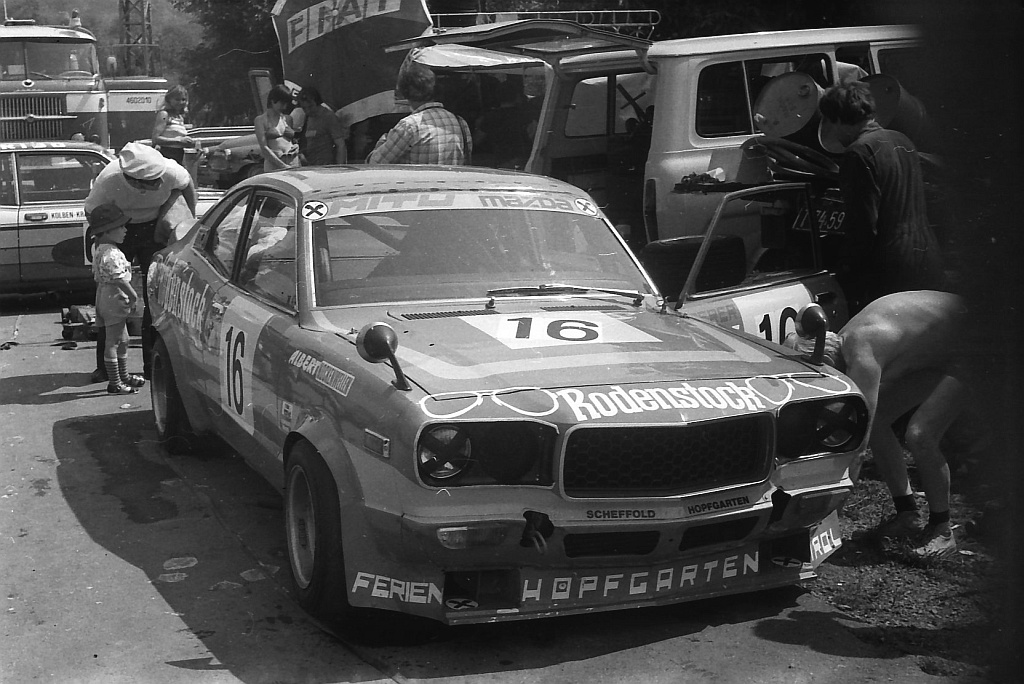
The Mazda RX-3 Racing models occupy a legendary place in rotary history, representing one of the most successful and surprising eras of Mazda’s motorsport achievements. From the early 1970s through to the late decade, RX-3s became feared competitors in touring-car championships around the world. Compact, lightweight and powered by high-revving rotary engines that punched far above their nominal displacement, the RX-3 transformed Mazda from a modest Japanese manufacturer into a serious international racing force. Its motorsport success was so significant that it helped secure the rotary engine’s future at Mazda long after other companies abandoned the technology.
Mazda first entered the RX-3 into racing shortly after the model’s introduction in 1971. The earliest competition cars used the 10A twin-rotor engine, a free-revving, smooth and unusually powerful unit for its size. Race-prepared versions produced far more power than the standard road car’s output, and the rotary’s compact size and low weight gave the RX-3 excellent balance. As development continued, Mazda upgraded the racing cars to the larger 12A rotary, which offered stronger torque and better durability under extreme conditions. The ability of the rotary engine to maintain high power at sustained high revs made it ideal for endurance events, and its smoothness reduced mechanical stress across the drivetrain.
The RX-3’s chassis proved exceptionally well suited to motorsport. Its light monocoque structure, compact dimensions and responsive steering gave it the agility needed for tight circuits, while the leaf-sprung rear axle — simple though it was — delivered predictable behaviour and impressive durability under race conditions. Mazda’s racing engineers strengthened suspension components, improved cooling and upgraded braking systems with larger discs and competition linings. The result was a car that handled hard cornering and long-distance racing with surprising sophistication. Despite not being a purpose-built racing chassis, the RX-3’s inherent balance and lightness allowed it to exceed expectations and outmanoeuvre much larger and more powerful rivals.
The RX-3’s breakthrough moment came in 1973 during the Fuji Grand Prix touring-car race in Japan’s top-level JTC series. For years, Nissan had dominated Japanese touring-car racing with their Skyline GT-Rs, building an almost unbeatable reputation. Mazda’s RX-3, still relatively new to competition, stunned the racing world by ending Nissan’s winning streak. The victory was dramatic, symbolic and widely celebrated: a small rotary-powered coupe defeating one of the most formidable racing machines of its time. This marked the beginning of the RX-3’s dominance in Japanese touring-car racing throughout the early and mid-1970s.
Mazda then took the RX-3 overseas, where it continued to build its legend. In Australia, the RX-3 became one of the standout competitors in the very popular touring-car scene. It raced fiercely against Ford Escorts, Holden Toranas and Datsun 1600s, often outperforming larger-engined competitors thanks to its combination of power, balance and reliability. In endurance races such as the Bathurst 1000, RX-3s consistently punched far above their weight, earning a reputation for toughness and speed that endeared them to Australian enthusiasts.
In the United States, the RX-3 competed in IMSA and SCCA events, where its rotary engine gave it a unique advantage in lower-displacement categories. American teams quickly recognised the rotary’s capability at high RPM, and RX-3s became known for their ability to run reliably at the limit. The sight — and sound — of an RX-3 howling down the straights at astonishing revs made it a crowd favourite in North American events. Even in endurance contests, the rotary proved remarkably durable, often outlasting piston competitors.
Mazda also fielded RX-3s internationally in endurance classics such as the Spa 24 Hours, where the car’s blend of speed, lightweight engineering and mechanical simplicity allowed it to compete effectively against European touring cars. Mazda’s factory-supported teams worked closely with privateers, ensuring that rotary expertise spread quickly through the racing community.
Visually, the RX-3 Racing models took on a distinctive and aggressive look. Wide arches, competition wheels, bold liveries and deep front spoilers gave the cars a muscular, purposeful stance. The rotary engine, with its high-revving nature, produced a sharp, unmistakable exhaust note that became one of the defining sounds of 1970s touring-car racing. The RX-3 looked every bit as fast as it felt and became an icon in motorsport paddocks worldwide.
By the time RX-3 racing programmes wound down toward the end of the 1970s, the car had secured dozens of victories across multiple continents and firmly established Mazda as a serious motorsport manufacturer. Its success directly influenced the development and acceptance of later rotary-powered competition platforms, including the RX-7, which would go on to become one of the most successful sports cars in racing history.
Today, surviving RX-3 racing cars are among the most coveted Mazda classics. Their motorsport heritage, dramatic styling and raw rotary performance give them huge appeal. As one of the key cars that proved the rotary engine’s legitimacy in world-class racing, the Mazda RX-3 Racing stands as a landmark achievement — the small, fierce, high-revving contender that helped define Mazda’s competitive spirit for decades to come.