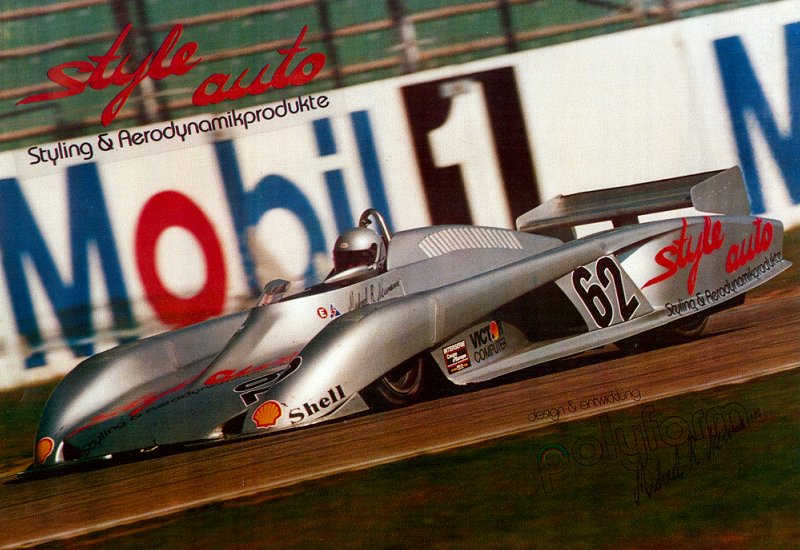
Description
The Mazda Start CA 871 Can-Am is one of the most obscure and unusual rotary-powered racing projects ever associated with Mazda — a little-documented experimental prototype developed during the late 1960s and early 1970s, when Mazda was aggressively exploring rotary applications in multiple forms of motorsport. Although far less well known than the RX-2, RX-3, RX-7 or the later Group C prototypes, the Start CA 871 was an ambitious attempt to adapt Mazda’s early rotary technology for the brutal, unrestricted world of Canadian-American Challenge Cup racing — the legendary Can-Am series famed for its enormous engines, extreme aerodynamics and absence of displacement limits.
Because the CA 871 never developed into a full works racing programme, much of its history is fragmentary, but the project reflects an early moment when Mazda was testing the limits of rotary performance beyond conventional touring and endurance categories.
The CA 871 programme centred on Mazda’s experimental multi-rotor engines. In this era, Mazda engineers were already testing the potential of three- and four-rotor designs, long before the later 13G, 13J and 26B units appeared in endurance racing. The Can-Am project explored using a high-output peripheral-port rotary, likely based on a three-rotor configuration, with power targets far exceeding anything Mazda had yet released publicly. These experimental engines aimed to take advantage of the rotary’s strengths — compactness, smoothness and high-rpm capability — in a category dominated by enormous V8 engines producing 600–900 horsepower. The rotary promised a compelling weight advantage and potentially higher sustained revs, though fuel consumption and thermal control posed formidable challenges.
The chassis referred to as CA 871 appears to have been constructed as a lightweight, open-cockpit sports prototype consistent with late-1960s and early-1970s Can-Am principles. Mazda did not yet have an in-house prototype programme, so the CA 871 most likely drew on external fabrication expertise similar to what Mazda later formalised with Mooncraft in the Group C era. The car likely utilised a tubular spaceframe or early aluminium monocoque, wrapped in a simple but aerodynamic body styled around the era’s Can-Am themes: a wide stance, open cockpit, large side intakes and a full-width rear aero section designed to manage the prodigious power expected from a multi-rotor engine.
Styling would have been purposeful and functional rather than decorative. Can-Am cars prioritised downforce and stability at massive speeds rather than beauty, and the CA 871 project appears to have mirrored that philosophy. The car was thought to be extremely low and wide, with large ducts to feed the rotary’s cooling system — a critical aspect of early Mazda competition engines. The bodywork likely included a short nose, smooth central tub sections and a sizeable rear wing or airfoil, standard for the escalating aero wars of the Can-Am period.
Inside, the cockpit would have been typical of experimental prototypes: a bare, functional racing interior with minimal instrumentation focused on monitoring oil temperature, coolant flow (where applicable) and — uniquely for Mazda — rotor housing temperatures, apex-seal condition and intake pressure. Driver ergonomics were secondary to engine test data, as the CA 871 existed primarily as a rotary development mule.
On the track, the Start CA 871 appears never to have reached sustained competitive use in North American Can-Am events. Instead, it served as part of Mazda’s internal research into high-output rotary performance, feeding lessons into later engines. The massive thermal loads, fuel consumption and durability demands of Can-Am racing were ultimately beyond the capabilities of Mazda’s early rotary units in this era. However, insights gained from the CA 871 project contributed to Mazda’s refinement of porting, cooling passages, housing materials and multi-rotor synchronisation — all foundational to the 1970s and 1980s racing rotaries and, eventually, the 1991 Le Mans-winning 26B.
The Mazda Start CA 871 Can-Am remains an extremely rare and little-known chapter in Mazda’s motorsport history: a bold, experimental prototype that pushed the boundaries of early rotary racing technology and demonstrated Mazda’s willingness to explore unconventional, ambitious avenues long before it became a fixture at Le Mans. Though it never achieved the fame of later prototypes, its significance lies in its role as an engineering stepping stone — one of the earliest serious attempts to unleash rotary power in one of the most extreme racing categories of all time.