Description
The Mazda T1500 was one of Mazda’s most important mid-sized three-wheeled trucks, introduced in the late 1950s and produced through the 1960s as Japan modernised and small businesses demanded stronger, more capable commercial vehicles. Sitting above Mazda’s tiny T-series microtrucks and below the larger four-wheeled models that would follow later, the T1500 became a staple of Japan’s delivery fleets, construction sites and rural industries. It offered dependable load-carrying ability, simple engineering and the manoeuvrability only a three-wheeler could provide.
Power came from Mazda’s 1.5-litre four-stroke inline-four engine, a significant step up from the small single- or twin-cylinder engines used in Mazda’s earlier three-wheelers. Producing around 60 horsepower depending on year, the engine delivered strong low-end torque and reliable performance even when the truck was fully laden. Designed for work rather than refinement, it was easy to maintain and durable under heavy use — crucial for business owners who relied on their vehicles daily. The engine was paired with a manual gearbox that gave the driver predictable control and gearing suited to hauling loads in both urban and rural conditions.
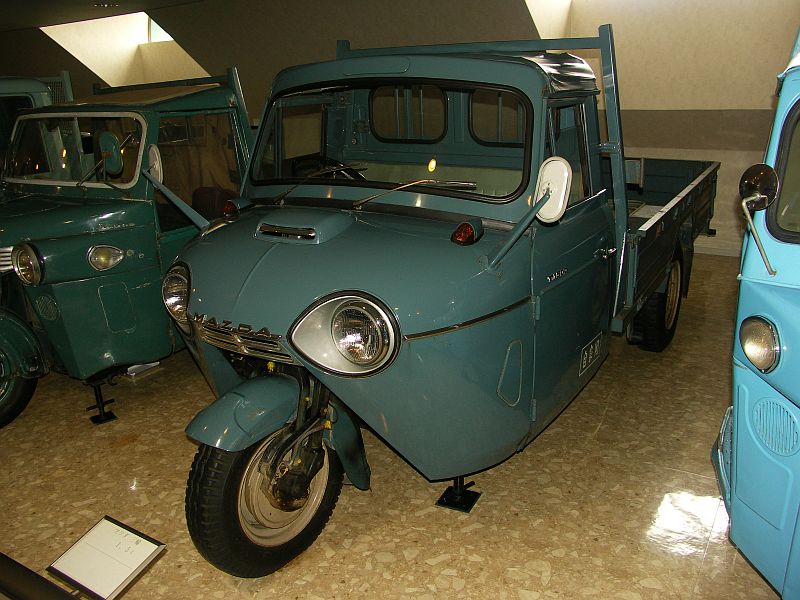
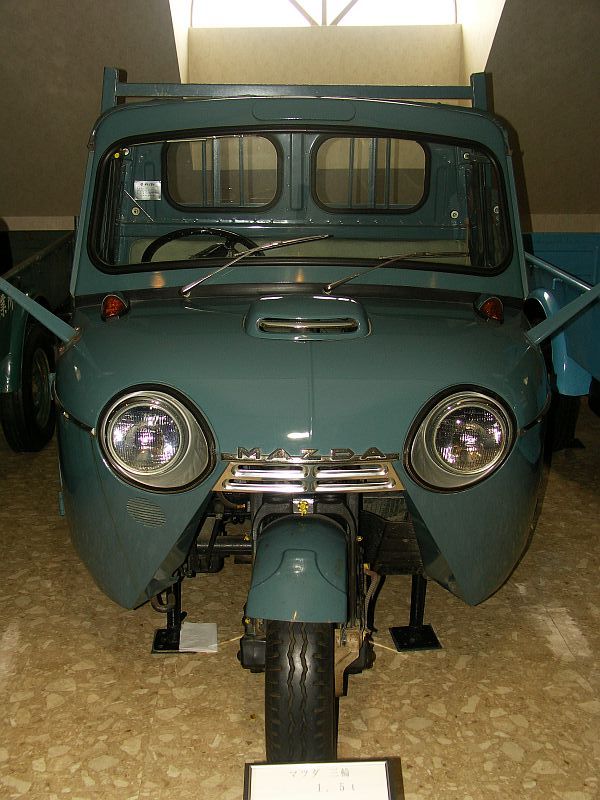
The chassis followed the traditional Japanese three-wheeler layout with two rear wheels carrying the load and a single, steerable front wheel at the nose. This configuration gave the T1500 remarkable manoeuvrability, allowing it to turn in tight spaces and navigate narrow alleys, crowded markets and rural lanes far more easily than larger four-wheeled trucks. The steel ladder frame was designed for strength and longevity, and the suspension — simple but rugged — absorbed rough surfaces well enough to keep the truck usable even on poor roads. The rear-wheel-drive setup ensured good traction when carrying weight, and the truck could manage significant payloads relative to its compact size.
Styling was straightforward and practical. The T1500 carried a rounded, functional cab design typical of Japanese three-wheelers of the period, with a small front cowl, curved wings and a compact, upright cabin. Its proportions were dictated entirely by utility — minimal front overhang, large windows for visibility and a wide, flat rear deck for cargo. The truck could be fitted with various bed styles, from open flatbeds to enclosed delivery boxes or customised bodies for trades and services. The look was purposeful rather than decorative, reflecting its role as a working machine.
Inside, the T1500 offered the basics needed for daily operation. The driving position was upright with clear forward visibility, and the dashboard housed only essential instruments. Seating was firm but adequate, designed with durability in mind. The interior had minimal insulation or comforts, but it was easy to clean and maintain, which mattered more to the businesses that purchased these vehicles. Controls were simple and mechanical, giving the driver a direct connection to the machine and making the truck feel robust and dependable.
On the road, the Mazda T1500 delivered a steady, predictable driving experience. The engine provided enough torque to move heavy loads without strain, and the truck performed well at the low speeds typical of urban distribution. While the three-wheel layout limited high-speed stability, it excelled in tight spaces, making the T1500 ideal for navigating dense city districts or working in compact job sites. Ride quality was basic but acceptable, and when driven within its limits the truck felt trustworthy and capable.
The T1500 played a vital role in Mazda’s commercial development. As Japan’s economy expanded and small businesses multiplied, the T1500 offered an affordable, reliable and versatile transport solution. It became a familiar sight in cities and villages across Japan, handling everything from parcel delivery and food distribution to building supplies and agricultural goods. Its popularity helped establish Mazda as a serious manufacturer of commercial vehicles and paved the way for Mazda’s later four-wheeled light trucks, including the B-series.
Today the Mazda T1500 is a rare and intriguing classic. Few examples survived once four-wheel trucks took over the market, but collectors now value the T1500 for its historical significance, its distinctive three-wheel configuration and its role in Japan’s post-war industrial growth. As one of Mazda’s most capable and widely used three-wheel commercial trucks, the T1500 stands as a key chapter in the company’s early history and a symbol of the era’s compact, hardworking innovation.