Description
The Mazda T2000 was one of Mazda’s most capable and widely used three-wheeled trucks, produced during the 1960s as Japan’s economy accelerated and demand grew for stronger, long-range commercial vehicles. Positioned above the smaller T600 and T1500 in Mazda’s three-wheeler hierarchy, the T2000 offered greater payload capacity, a more powerful engine and the durability needed for inter-city and regional transport. It became a dependable workhorse for construction firms, delivery companies and rural operators during a period when Japan relied heavily on compact, economical commercial vehicles.
Power came from Mazda’s 1,985 cc inline-four OHV engine, producing around 81 horsepower — a substantial figure for a three-wheeled truck of this era. The engine delivered strong low-rpm torque, giving the T2000 the muscle to carry large loads over hilly terrain or rough roads. It was engineered for reliability, ease of servicing and consistent performance under heavy use. A manual gearbox provided predictable control and rugged simplicity, with gearing optimised for hauling rather than speed. The powertrain was designed to withstand long hours of operation, making the T2000 a favourite among operators with demanding daily routes.
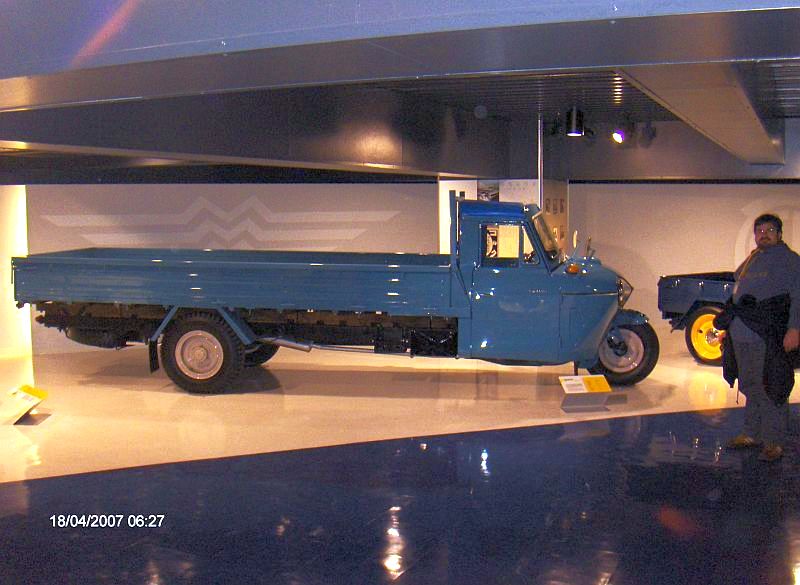
The chassis followed the established Japanese three-wheel layout: two rear wheels supporting the load and a single front steerable wheel that gave the truck its remarkable manoeuvrability. Mazda reinforced the ladder-frame to handle higher payloads than the smaller T-series models, and the suspension was built to tolerate rough, uneven surfaces. The T2000’s wide rear track and long wheelbase gave it impressive stability for a three-wheeler, while the lightweight front end allowed tight low-speed turning — a combination well suited to crowded urban districts and challenging rural roads. The rear-wheel-drive setup provided dependable traction, especially when the truck was fully loaded.
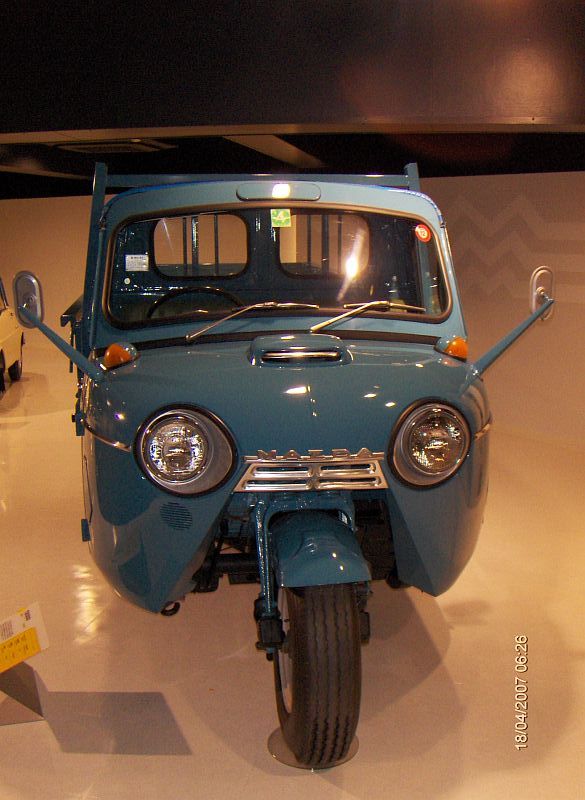
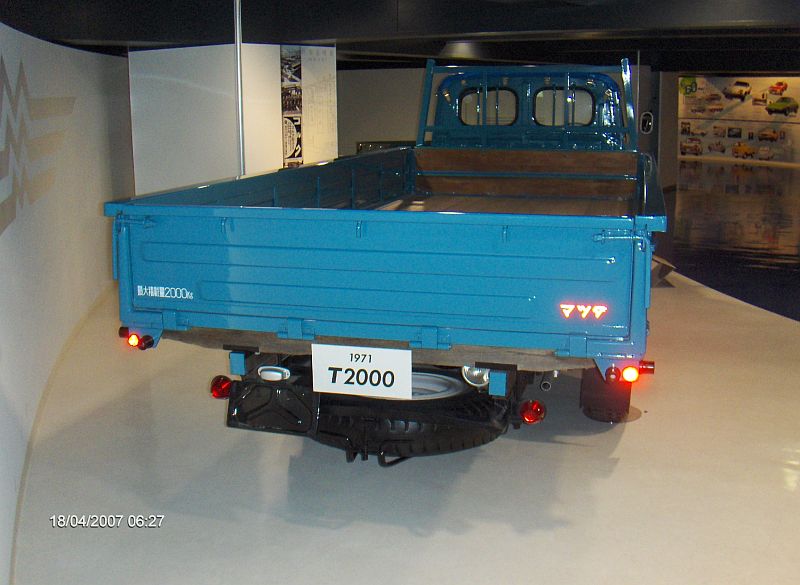
Styling remained simple, functional and focused entirely on utility. The T2000 featured a robust, rounded front cowl with large headlamps and a compact cabin mounted ahead of the load bed. Visibility was excellent thanks to the tall seating position and expansive windows, and the minimal front overhang helped the driver see the truck’s corners clearly — essential for navigating narrow streets. Depending on the operator’s needs, the truck could be fitted with flatbeds, wooden dropsides, enclosed cargo boxes or custom bodies for specific trades.
Inside, the cabin was basic but practical. The dashboard used straightforward metal panels with large, clear gauges and simple mechanical controls designed to withstand daily wear. Seating was firm but durable, and the upright driving position made long shifts manageable. Noise insulation was limited, but for commercial buyers the priorities were durability, easy maintenance and low operating costs — all areas where the T2000 excelled.
On the road, the T2000 delivered strong, steady performance for its class. The engine’s broad torque band made it capable of carrying heavy loads without strain, and the truck maintained good composure at the modest cruising speeds typical of three-wheel commercial vehicles. Manoeuvrability was excellent, especially in tight markets, alleyways and construction sites where larger four-wheel trucks struggled. The suspension and frame allowed the T2000 to handle rough rural roads reliably, making it suitable for agricultural transport as well as urban deliveries. While not intended for high-speed highway use, it provided dependable, predictable handling when driven within its design limits.
The Mazda T2000 played a major role in Mazda’s commercial-vehicle expansion. It helped bridge the gap between the era of small three-wheel utility vehicles and the rise of modern four-wheel trucks. As Japan’s transport demands grew more sophisticated, the T2000 provided the strength and versatility required by a wide range of industries. Its success contributed to Mazda’s evolution into a major manufacturer of commercial vehicles and influenced the development of later four-wheel Mazda trucks.
Today, surviving Mazda T2000s are rare and increasingly valued by collectors of early Japanese commercial vehicles. Their distinctive three-wheel configuration, robust engineering and historical importance make them fascinating examples of Japan’s post-war industrial mobility. As one of Mazda’s last and most capable three-wheel trucks, the T2000 stands as a significant milestone in the company’s commercial-vehicle heritage.