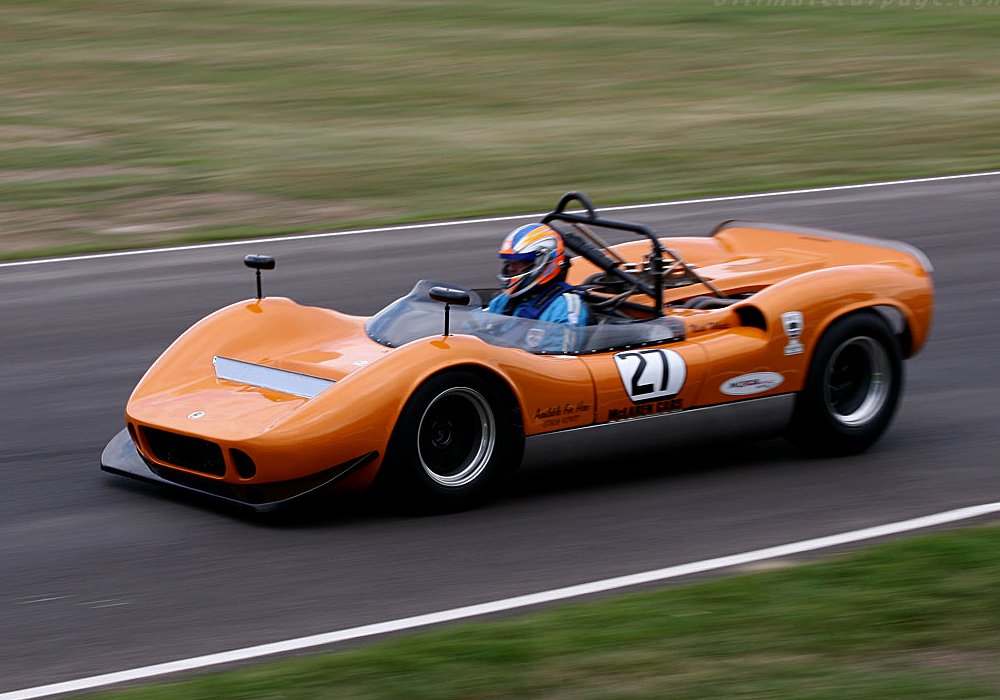
Description
The McLaren M1B Chevrolet was the second major evolution of McLaren’s early sports-racing programme and the car that firmly established the company as a serious contender in North American competition. Introduced for the 1965 season as the successor to the M1A, the M1B built on the strengths of the original design while adding more power, greater rigidity and improved aerodynamics. It became a popular choice for both works and privateer teams and served as the foundation for McLaren’s ascent to dominance in Can-Am racing.
The M1B typically ran with a Chevrolet small-block V8, most commonly in 5.0 to 5.7-litre form. These engines produced between 400 and 450 horsepower in period tune, giving the M1B a dramatic performance increase over the Oldsmobile-powered M1A. The Chevy V8 offered abundant torque, strong reliability and straightforward maintenance, making it ideal for long, demanding North American sports-car races. Its compact size and broad tuning potential also allowed teams to extract considerable performance while maintaining the lightweight philosophy central to the M1 platform. The V8 was paired with a robust manual transaxle, allowing strong acceleration and stability under racing loads.
The chassis of the M1B remained based on a tubular steel spaceframe, but it was strengthened and redesigned to accommodate the increased power and stress loads from the Chevrolet engine. McLaren and engineer Tyler Alexander used a mix of small- and large-diameter tubing to increase stiffness without excessive weight gain. Aluminium body panels remained the norm, shaped to improve cooling airflow and reduce drag. The M1B was slightly wider and more aggressive in stance than the M1A, giving it better stability at higher speeds.
Suspension was independent front and rear, using unequal-length wishbones paired with coil-spring dampers. The geometry was revised to improve grip and responsiveness, essential for managing the higher power output. Braking systems were upgraded as well, with larger discs and improved cooling to help the car endure the heavy braking zones typical of American road circuits. The combination of light weight, strong V8 power and predictable handling made the M1B a formidable racing machine.
Visually, the M1B refined the look of the M1A. The nose featured a more pronounced central intake and altered fender shapes to manage airflow more effectively. The bodywork remained sleek and uncluttered, reflecting a transitional era before large wings and complex aerodynamic devices became common. The rear section was shaped to enhance cooling for the V8 and provide stability at speed, while the car’s low profile and wide track gave it a planted, purposeful appearance. Although not yet a downforce-heavy design, the M1B was aerodynamically cleaner than its predecessor and offered improved high-speed behaviour.
Inside, the M1B was a straightforward competition cockpit, stripped of all unnecessary weight. A simple instrument cluster displayed vital engine data, and controls were positioned intuitively for the driver. Seating was basic but supportive, and the spaceframe structure was visible throughout the cabin, emphasising the car’s raw, mechanical character. The environment was tight, functional and built purely for racing efficiency.
On track, the McLaren M1B Chevrolet proved to be fast, balanced and durable, making it a strong early competitor in the emerging Can-Am series. The powerful Chevy small-block gave the car excellent acceleration and strong mid-range thrust, while the lightweight chassis allowed nimble handling and good feedback. Drivers found the M1B predictable at the limit, which contributed to its popularity among privateer teams. The car achieved several notable finishes and helped cement McLaren’s reputation as a constructor capable of producing competitive sports-racing machinery.
The M1B’s success also helped pave the way for the M1C and eventually the mighty M6 and M8 Can-Am cars that would dominate the series. It represented a key transitional step where McLaren moved from a promising newcomer to a genuine force in international sports-car racing.
Today, the McLaren M1B Chevrolet is a highly valued historic racing car. Its significance lies not only in its on-track achievements but in its role as a foundational McLaren model that demonstrated the company’s engineering direction. Surviving cars are prized by collectors and frequently appear in vintage racing events, where their combination of lightness, V8 power and 1960s sports-racer purity continues to impress.