
Description
The McLaren M1C was the third and final evolution of McLaren’s original M1 series of sports-racing cars, introduced for the 1967 season as a refinement of the M1A and M1B. It represented the ultimate development of McLaren’s early spaceframe sports cars before the company moved fully into monocoque construction with the M6. The M1C became a popular and successful choice for privateer racers, offering improved aerodynamics, rigidity and power handling while remaining accessible and easy to maintain.
Power for the M1C varied according to customer specification, but most cars were fitted with Chevrolet small-block V8 engines in the 5.0- to 6.0-litre range. These engines typically produced 450 to 500 horsepower in period race tune. The Chevy V8’s combination of reliability, abundant torque and broad tuning potential made it ideal for the demanding conditions of international sports-car racing. Some teams experimented with Ford or Oldsmobile engines, but the Chevrolet units quickly became the standard choice. Power was delivered through a robust manual transaxle capable of coping with the significantly increased output.
The chassis retained the tubular steel spaceframe layout of earlier M1 cars but was redesigned for greater stiffness, durability and ease of maintenance. McLaren refined the tube layout, strengthened critical nodes and incorporated lessons learned from the M1B’s competition use. The car used lightweight aluminium body panels and reinforced mounting points for suspension components. Although still a spaceframe rather than a monocoque, the M1C’s structure was strong and predictable, handling high-power V8 engines with confidence.
Suspension followed the familiar independent double-wishbone arrangement at all four corners, with coil-spring dampers and revised geometry for improved tyre contact and handling balance. The M1C was more stable and responsive at high speeds than its predecessors, with better control under heavy braking and sharper turn-in characteristics. Brakes were upgraded to cope with the increased engine power and weight transfer demands typical of Can-Am and international sports-car racing.
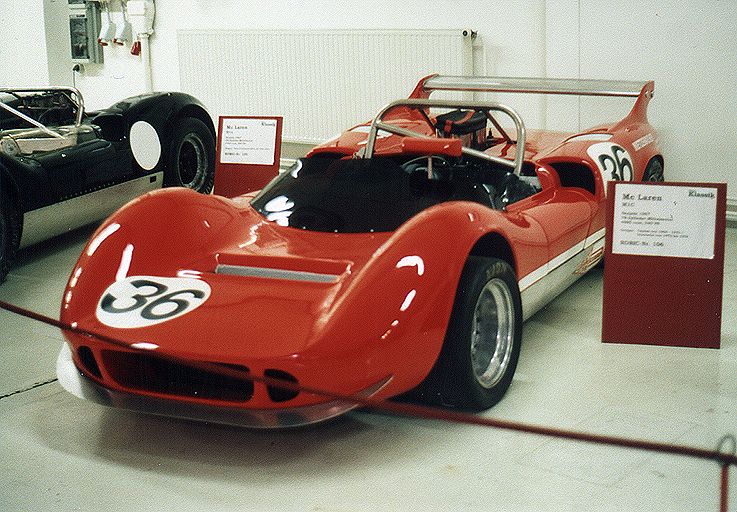
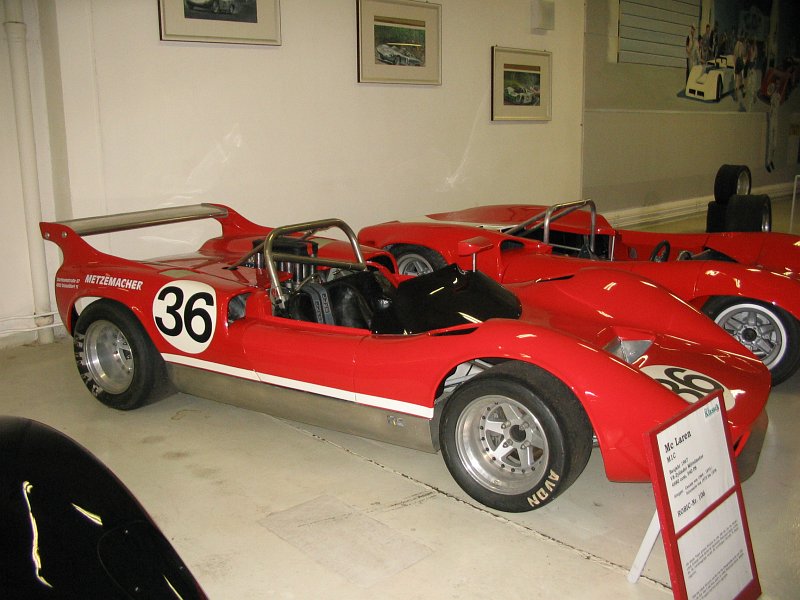
Visually, the M1C featured a more modern and efficient body shape than the M1A and M1B. The nose was lower and more sloped, with a wide central air intake and smoother airflow channels. The fenders were reshaped for better aerodynamic flow over the wheels, and the side panels were sculpted to reduce drag. The tail section was cleaner, more streamlined and slightly extended, offering better stability at high speed. While the car retained the open-top, mid-engined silhouette typical of mid-1960s sports prototypes, the M1C looked more aggressive and better resolved than earlier versions.
The cockpit remained true to McLaren’s lightweight, competition-focused philosophy. It was narrow and minimalist, housing only essential gauges and switchgear. Exposed frame sections and simple aluminium panels emphasised the car’s purpose-built character. The driving position was straightforward, giving the driver good control and visibility. Everything inside was aimed at function, making the M1C easy to operate during long races or in the heat of competition.
On the track, the M1C delivered strong, well-balanced performance that made it highly competitive in the hands of both professional and privateer drivers. Its lightweight construction and powerful V8 engines gave it rapid acceleration, while the refined suspension and chassis balance made it predictable and confidence-inspiring. The car excelled on fast, flowing circuits where its aerodynamic improvements and stability could be fully exploited. Although it did not achieve the headline dominance of later McLarens in Can-Am competition, the M1C was respected for its pace, durability and accessibility.
The M1C also played a key transitional role in McLaren’s development. It helped the company refine its engineering processes, customer support operations and understanding of high-power sports-racing design. The lessons learned directly influenced the move to monocoque construction and the development of the McLaren M6A, the car that would begin McLaren’s period of Can-Am dominance.
Today, the McLaren M1C is an important and desirable historic race car. Surviving examples are prized for their purity, mechanical simplicity and direct connection to the formative years of McLaren as a constructor. The M1C captures the essence of 1960s sports-racing design: lightweight, powerful, elegant in its simplicity and capable of delivering thrilling performance more than five decades after its debut.