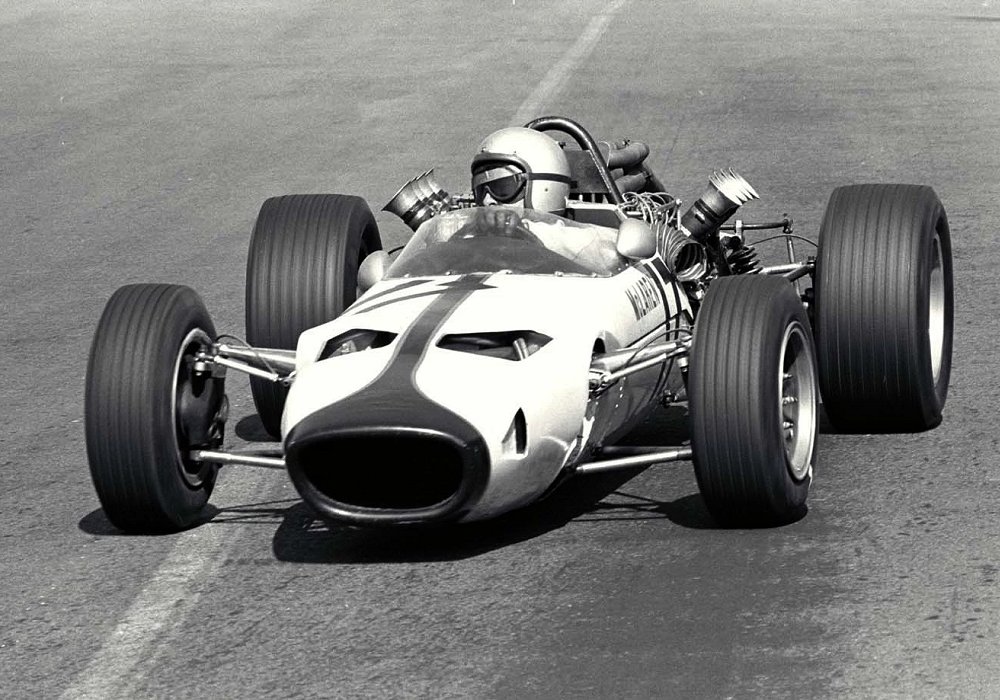
Description
The McLaren M2B Ford was the first Formula One car ever built by Bruce McLaren’s team, marking McLaren’s official debut as a constructor in the 1966 Formula One World Championship. It was the beginning of a lineage that would eventually produce world championship–winning cars, but the M2B itself was very much a transitional, experimental machine. Built with limited resources and during a time of rapid regulation changes, it served as Bruce McLaren’s early test bed for engineering ideas that would shape the team’s future direction.
The M2B was designed around the new 3-litre engine formula introduced for 1966. Initially, McLaren intended to use a Ford Indy-based V8 that was modified by Traco to suit F1. This unit produced around 300 horsepower but proved heavy, thirsty and difficult to adapt to the lighter requirements of Grand Prix racing. Its fragile oil system and cooling demands created persistent reliability issues. As a result, McLaren later experimented with a Serenissima V8 producing around 260 horsepower, but this lacked the power needed to compete at the front. The team’s engine situation remained the M2B’s greatest limitation, overshadowing the chassis’ considerable promise.
The chassis itself was innovative for its time. The M2B used a monocoque built from Mallite, a composite material combining balsa wood sandwiched between aluminium sheets. This created a structure that was exceptionally stiff for its weight and represented advanced thinking in F1 design. The car’s side panels and bulkheads were neatly integrated into the monocoque, and the compact structure provided a solid platform for the suspension and drivetrain. Mallite proved difficult to work with in practice, but the lessons learned would influence later McLaren chassis designs.
Suspension used traditional double wishbones at the front and a reversed lower wishbone with twin radius arms at the rear, paired with coil-spring dampers. The geometry was designed for predictable handling and manageable tyre wear, and Bruce McLaren praised the car’s balance when engine troubles did not intervene. Brakes were outboard discs at all four corners, giving the car strong stopping power for its weight. With a competitive engine, the M2B would likely have been far more successful.
Visually, the M2B was sleek and neatly proportioned, with a low, narrow nose and cleanly sculpted side panels. It carried a white and green livery inspired by McLaren’s partnership with the film studio Paramount Pictures, who briefly sponsored the car. The design was uncluttered and elegant, reflecting McLaren’s preference for simplicity and functional aerodynamics. At a time when wings and complex airflow devices had not yet arrived in F1, the M2B relied entirely on mechanical grip and a tidy body shape.
Inside, the cockpit was typical of mid-1960s Formula One: tight, spartan and shaped directly by the monocoque’s structure. The steering wheel, pedals and gauges were all positioned with driver comfort and clarity in mind, and Bruce McLaren himself spent long hours fine-tuning the ergonomics. The exposed metal surfaces and visible chassis elements gave the interior a purposeful, hand-built appearance.
On the track, the M2B showed flashes of real potential. Bruce McLaren drove the car to sixth place in its debut at the 1966 Monaco Grand Prix, earning McLaren’s first constructors’ points. The chassis handled well and responded faithfully to driver input. Unfortunately, persistent engine failures and the underwhelming performance of the Serenissima unit meant that the car rarely finished races. The M2B became known as a chassis held back by its engines, rather than one inherently lacking in competitiveness.
Despite its modest results, the M2B represented an essential foundation for everything McLaren would achieve. It established the engineering culture that Bruce McLaren believed in: innovation, precision, simplicity and careful evolution. The challenges the team faced with engines, materials and construction directly informed the design of the much more successful M4 and M7 series that followed.
Today, the McLaren M2B Ford is remembered as the starting point of one of Formula One’s greatest constructors. Although not a race-winner, it was the first step in what would become decades of McLaren innovation and success. The M2B stands as an important artefact in F1 history, representing both the ambition of Bruce McLaren and the beginning of a legacy that continues to this day.