Description
The McLaren M6 GT was Bruce McLaren’s bold attempt to take his Can-Am–winning engineering into the world of road-legal supercars. Conceived in 1968 and developed through 1969, the M6 GT was intended to be both a limited-production road car and the basis for a Group 4 endurance-racing programme. Although only a handful of prototypes were completed before the project was abandoned, the M6 GT became a deeply important car in McLaren history: the company’s first road-car project, the spiritual ancestor of the later McLaren F1 and a rare glimpse into Bruce McLaren’s long-term ambitions.
The M6 GT was powered by a mid-mounted Chevrolet small-block V8, similar to the engines used in the dominant M6A and M6B Can-Am cars. In road-going specification the lightweight, high-compression V8 produced around 370 to 400 horsepower, giving the car exceptional performance for its era. Strong, flexible torque and a wide power band made the GT tractable on the road despite its racing heritage. The engine was paired with a robust manual transaxle, and the combination of modest weight and plentiful power gave the M6 GT supercar-level acceleration long before the term existed.
The chassis was derived directly from the M6 Can-Am cars, using a lightweight aluminium monocoque centre section bonded and riveted for rigidity. Tubular steel subframes were attached to carry the engine, suspension and running gear. This hybrid structure provided excellent stiffness and kept weight low—one of Bruce McLaren’s core objectives. The suspension layout mirrored the race car’s double-wishbone arrangement at all four corners, with geometry tuned for more compliant road manners. Even so, the M6 GT retained the sharp responses and direct handling feel of a competition machine.
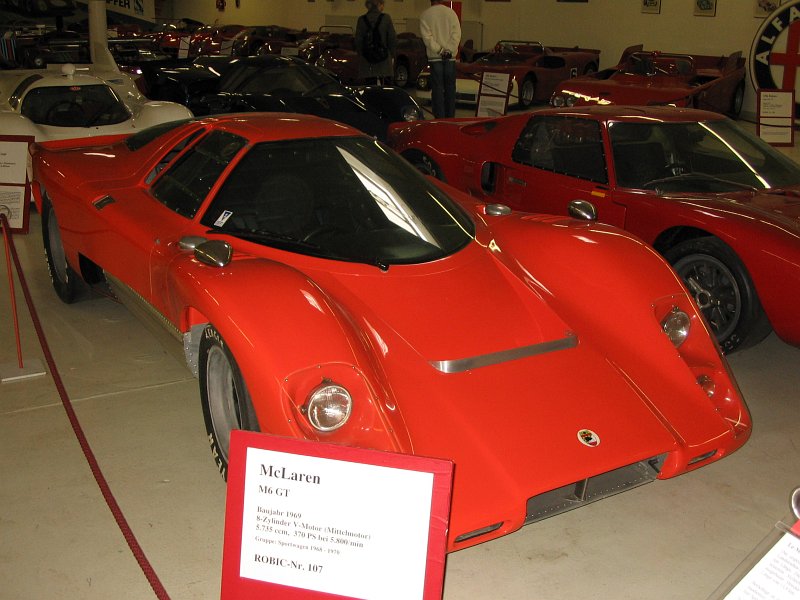
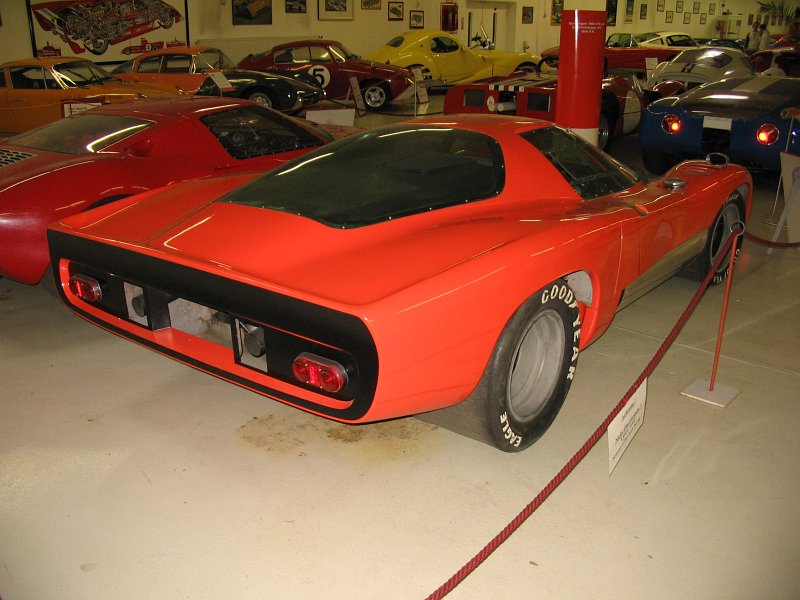
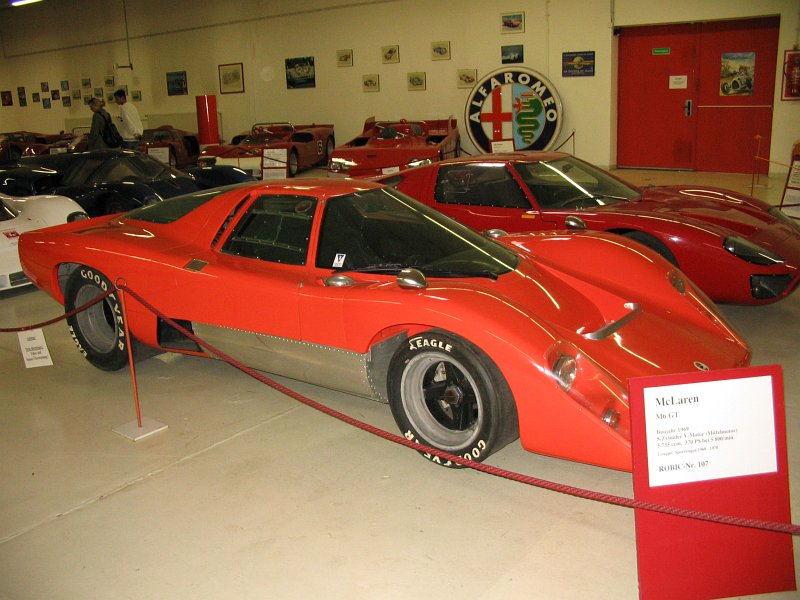
Aerodynamics and bodywork were central to the M6 GT’s character. The car wore a fully enclosed fibreglass coupé body designed by Tony Hilder, with a long, low profile and flowing curves that distinguished it from the open-cockpit M6 racers. The GT’s shape reduced drag and improved high-speed stability, while the canopy-style windscreen and integrated rear buttresses created a futuristic silhouette. Large side air intakes fed the mid-mounted V8, and the rear section lifted for access to the drivetrain. The body achieved a balance between race-inspired efficiency and road-car usability, with proportions that were dramatic but not impractical.
Inside, the M6 GT was far more refined than the racing M6 models but still focused on simplicity. Bruce McLaren intended it to be a usable road car, so it featured carpeting, interior trim, basic sound insulation and fixed seating with harnesses. The driving position was low and purposeful, with a clear view over the sloping bonnet. Instrumentation was straightforward, giving the driver essential information without distraction. The cabin remained sparse by road-car standards, but compared with contemporary prototypes it was impressively civilised.
On the road, the M6 GT offered an experience unlike anything else available at the time. Its combination of light weight, mid-engine layout and wide-track stance gave it superb balance and agility. The Chevrolet V8 provided effortless acceleration, and the car delivered a sense of precision more commonly associated with racing machinery. The M6 GT was quick, responsive and unusually composed at speed, offering a blend of performance and control that foreshadowed the supercars of the 1970s and 1980s.
The project ultimately faltered due to regulatory and timing challenges. New FIA rules for Group 4 homologation required a production run of 50 cars—a figure McLaren, then a small racing operation, could not realistically meet. Without a viable racing class for the car and facing the financial and logistical burden of large-scale production, Bruce McLaren reluctantly cancelled the programme after producing only a few prototypes. The decision was influenced further by the team’s intense focus on Can-Am racing, where McLaren was then achieving overwhelming success.
Today, the McLaren M6 GT is regarded as one of the most important “what-if” cars in motorsport history. Only two or three complete examples exist, including the personal road car Bruce McLaren used on public roads in England. Its significance lies not only in its rarity but in its role as the first true McLaren road car—a concept decades ahead of its time. The core ideas of the M6 GT—light weight, driver focus, mid-engine balance and uncompromised engineering—would reappear in the McLaren F1 and every McLaren road car that followed.
The M6 GT remains a symbol of Bruce McLaren’s vision for a company that would build both race-winning machines and world-class performance road cars. Even in prototype form, it stands as a landmark in McLaren’s evolution and one of the most fascinating sports-racing designs of the late 1960s.