
Description
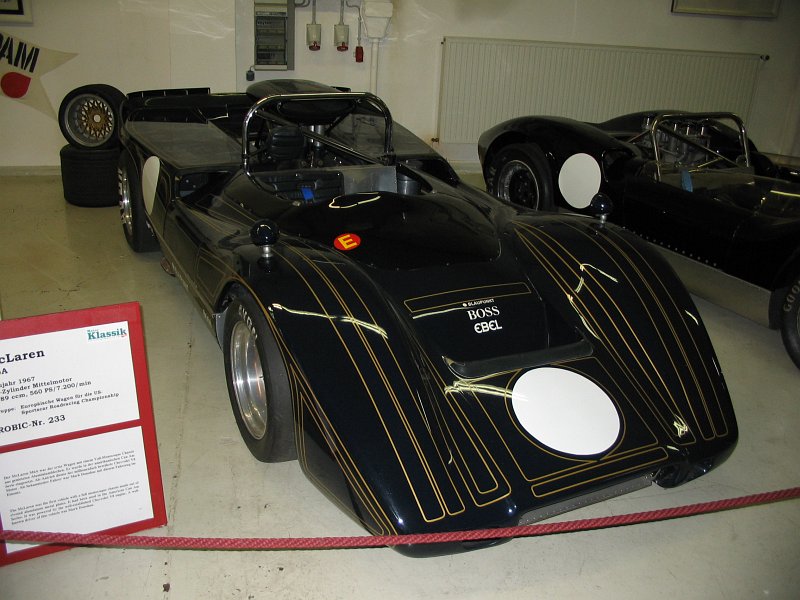
The McLaren M6A was one of the most important racing cars in McLaren’s history and the machine that launched the team into its era of dominance in the Can-Am series. Introduced for the 1967 season, the M6A marked McLaren’s transition from tubular spaceframe construction to full monocoque engineering and became the first McLaren designed entirely around the demands of unrestricted Group 7 racing. With its combination of lightweight construction, efficient aerodynamics, immense V8 power and outstanding reliability, the M6A set a new standard in sports-racing design and firmly established McLaren as the team to beat.
Power for the M6A came from Chevrolet’s small-block V8, usually in a 5.9- or 6.0-litre configuration and producing around 525 horsepower in race tune. The Chevy V8 was chosen for its superb torque delivery, robust reliability and generous tuning potential. Its relatively compact size and good weight characteristics made it ideal for the mid-engined layout. McLaren’s meticulous installation and cooling system management ensured consistent performance even under the heavy strain of long Can-Am races. The engine was paired with a strong manual transaxle, capable of handling the V8’s output and providing the precise control drivers needed on demanding circuits.
The chassis of the M6A represented a major leap forward for McLaren. Instead of the earlier steel spaceframe approach, the M6A used a bonded and riveted aluminium monocoque with stiff, load-bearing side structures. This significantly increased torsional rigidity while keeping weight exceptionally low. The advanced construction method provided a much stronger platform for suspension tuning and engine mounting, improving handling predictability and chassis response. The monocoque design also improved safety and durability, making the M6A one of the most structurally sophisticated cars in Group 7 competition at the time.
Suspension was via double wishbones front and rear with coil-spring dampers, tuned to match the stiffer chassis and immense power of the Chevrolet engine. The setup provided excellent stability at high speed and gave the M6A precise turn-in characteristics. Braking was handled by large ventilated discs that offered consistent stopping power throughout long race distances. The combination of stiff chassis, well-balanced suspension and strong brakes gave the M6A exceptional road-holding, allowing drivers to fully exploit its power advantage.
The bodywork of the M6A was shaped with aerodynamic intent, reflecting the growing importance of airflow management in late-1960s sports-racing design. The car featured a low, wide front profile with broad fenders and a neatly integrated front intake system. The sides were smooth and uninterrupted, helping reduce drag, while the rear bodywork tapered cleanly toward the suspension and exhaust area. The M6A’s shape was simple but highly effective, offering a balanced mix of low drag and good stability. It was also the first McLaren to wear the company’s now-famous papaya orange livery, which became an immediate visual signature for the team.
Inside, the M6A followed McLaren’s philosophy of simplicity and functionality. The cockpit housed only essential controls and instrumentation, with seating positioned to optimise driver control and visibility. The monocoque structure meant that cockpit walls doubled as load-bearing components, giving the interior a tight, purposeful feel. As with all successful racing machines of the period, weight saving dominated every design choice, resulting in a sparse but efficient environment.
On track, the M6A proved outstanding. Its combination of V8 power, low weight, stiff chassis and clean aerodynamics made it faster, more stable and more predictable than its rivals. Bruce McLaren and Denny Hulme used the car to devastating effect, winning five of six races in the 1967 Can-Am season and securing the championship. The M6A’s dominance began a period known as the “Bruce and Denny Show,” where McLaren became the undisputed force in Can-Am racing for several years. The car’s reliability was also exceptional; it finished every race that season without significant mechanical failure, a remarkable achievement in such a demanding category.
The M6A’s success paved the way for a lineage of even more advanced designs, including the M6B customer cars and the mighty M8 series that followed. However, the M6A remains one of the most significant cars McLaren ever built. It marked the beginning of McLaren’s golden era in Can-Am and established the engineering principles that would guide the team through decades of competition.
Today, the McLaren M6A is celebrated as a landmark in sports-racing history. Its pioneering monocoque design, its performance dominance and its connection to Bruce McLaren himself make it one of the most historically important McLaren racing cars. Surviving examples are extremely rare and treasured by collectors and racing historians alike, representing the moment when McLaren emerged as a world-class constructor.