Description
The McLaren M8B was the second major evolution of the M8 series and one of the most dominant cars in Can-Am history. Introduced for the 1969 season, it was an aggressive development of the already formidable M8A, engineered to extract even greater aerodynamic grip, more efficient power delivery and improved chassis performance. The M8B delivered one of the most overwhelming displays of superiority ever seen in sports-car racing, forming the core of McLaren’s continued Can-Am dominance.
The M8B retained the Chevrolet big-block V8, now further refined for reliability and power. Displacement typically remained around 7.0 litres, producing close to 680 horsepower in race-specification trim, with enormous torque available from very low rpm. This engine philosophy suited the Can-Am format, where acceleration out of fast corners and long straight-line speed were paramount. McLaren’s engine preparation focused on cooling, lubrication and durability, allowing drivers to run the big V8 at sustained high loads throughout an entire race without fear of failure. The result was relentless, dependable power in every session.
The chassis of the M8B was based on the aluminium monocoque structure pioneered by the M6A and refined for the M8A, but strengthened further to handle the extreme aerodynamic loads generated by the B-spec aerodynamic package. The monocoque was stiff and surprisingly light for its size, giving the M8B a strong foundation for predictable handling at very high speeds. The chassis design also helped centralise mass, making the car more responsive in transient manoeuvres and better balanced in long, sweeping corners. Suspension remained double wishbones front and rear, with geometry tailored to complement the increased downforce.
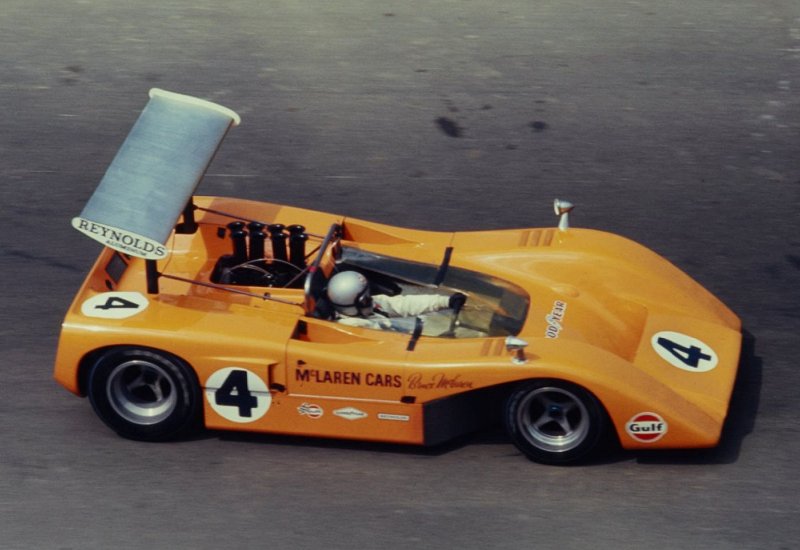
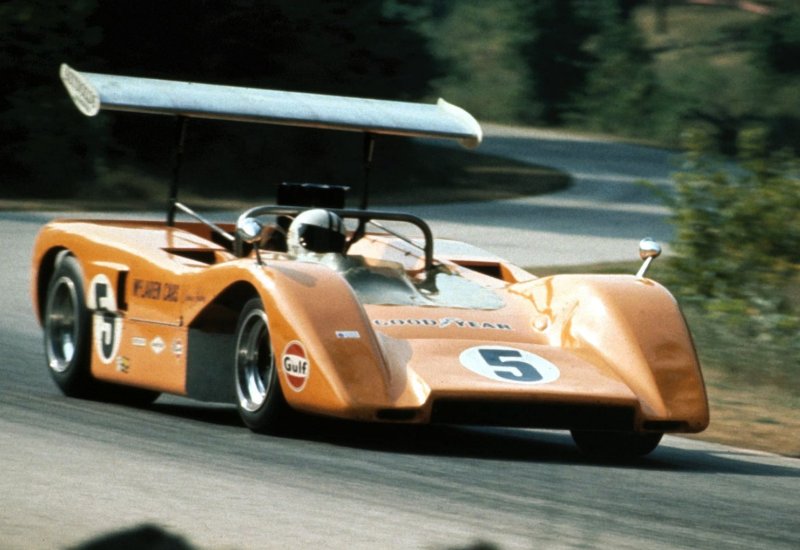
The defining innovation of the M8B was its aerodynamics. McLaren replaced the M8A’s conventional high-mounted wings with full-width wings mounted directly to the suspension uprights. This meant the downforce acted directly on the wheels rather than the chassis, improving grip without stressing the monocoque. The wings produced enormous downforce by the standards of the time, dramatically improving cornering speed and braking stability. The system was complex and required careful tuning, but when balanced correctly it gave the M8B far more grip than any rival.
The bodywork was updated as well, featuring cleaner surfaces, broader side sponsons and improved airflow management around the radiators. The M8B’s distinctive high rear wing — tall, wide and supported by the uprights — became one of the most recognisable Can-Am silhouettes of the late 1960s. The car retained the papaya orange livery that had become McLaren’s trademark, making it instantly identifiable.
Inside, the M8B remained focused on function. The cockpit was minimal, with essential gauges and controls positioned for rapid use during long races. The low seating position and tight monocoque sides created an intense racing environment that enhanced driver feedback. As with all McLaren Can-Am cars, simplicity, clarity and weight reduction guided every design choice.
On the track, the M8B was devastating. With its improved downforce, immense V8 power and refined chassis, it offered grip and acceleration unmatched by any competitor. Drivers Bruce McLaren and Denny Hulme used the M8B to overwhelm the 1969 Can-Am field, winning every single race that season. McLaren took six victories and Hulme three, securing the championship in one of the most dominant performances in the history of the series. The reliability was equally impressive — the M8B rarely suffered mechanical issues, a testament to McLaren’s focus on endurance as well as outright speed.
The success of the M8B cemented McLaren’s reputation as the team to beat in Can-Am competition and demonstrated the effectiveness of advanced aerodynamic concepts long before they became common in other categories. The B-spec car directly influenced later designs, including the M8D, which carried McLaren’s Can-Am success into the early 1970s.
Today, the McLaren M8B is remembered as a landmark racing machine. Its perfect season in 1969 stands as a testament to McLaren’s engineering brilliance and Bruce McLaren’s leadership. Rare, powerful and historically pivotal, the M8B remains one of the most revered sports-racing cars of its era — a high point in the story of unrestricted, no-limits motorsport.