Description
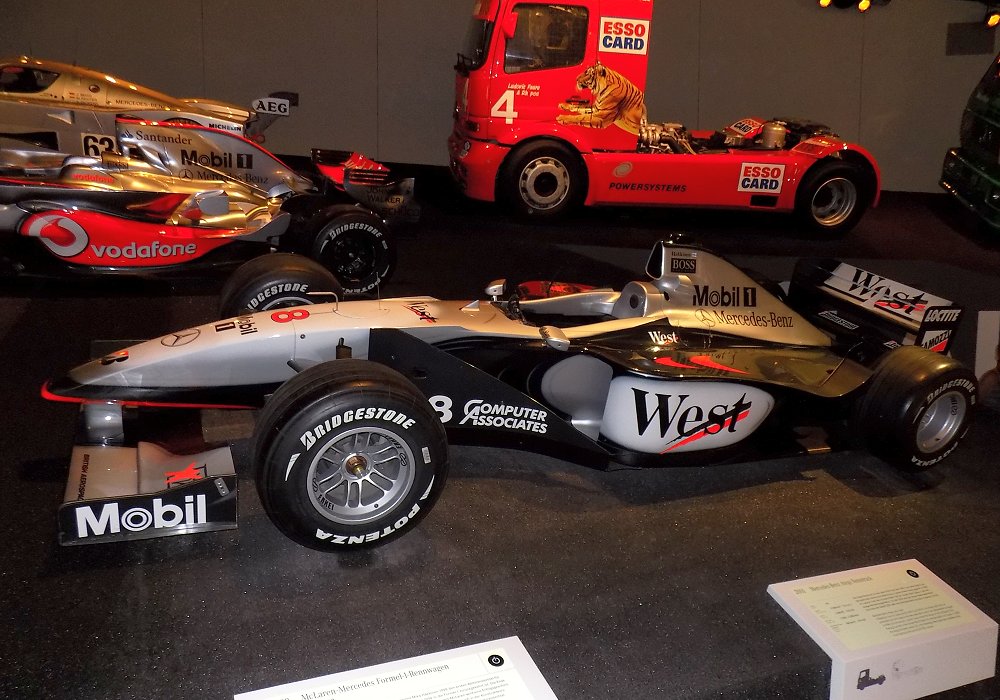
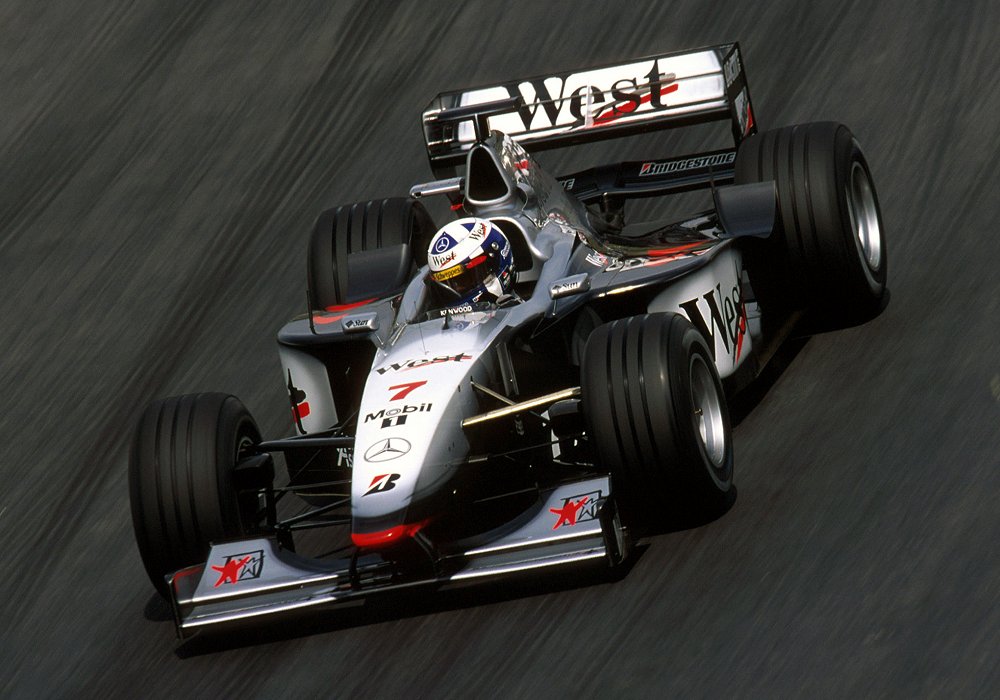
The McLaren MP4-13 Mercedes was one of the defining Formula One cars of the late 1990s and a landmark machine in McLaren’s modern era. Raced in 1998, it marked the return of McLaren to championship-winning form, securing both the Drivers’ and Constructors’ Championships with Mika Häkkinen and David Coulthard. The MP4-13 combined advanced aerodynamics, cutting-edge electronics, superb chassis balance and a powerful Mercedes V10, creating a package that was exceptionally competitive under the radically changed 1998 regulations.
Power came from Mercedes-Benz’s FO110G 3.0-litre V10 engine, a highly developed and extremely compact unit produced by Ilmor Engineering. This naturally aspirated V10 generated around 770 horsepower at peak revs and delivered its power smoothly across a wide operating range. It was light, responsive and reliable, giving McLaren a strong advantage under the new aerodynamic and tyre rules. The engine’s compact dimensions allowed McLaren to design tighter rear-end packaging, improving airflow efficiency and reducing drag.
The chassis was a carbon-fibre monocoque developed under the leadership of Adrian Newey, who had joined McLaren in 1997 and immediately began reshaping the team’s design philosophy. The MP4-13 was his first full McLaren car, and it reflected Newey’s trademark focus on aerodynamic detail, packaging efficiency and centre-of-gravity optimisation. The car featured a narrow, low body profile and tightly sculpted sidepods, allowing exceptionally clean airflow to the diffuser and rear wing. The long wheelbase contributed to stability at high speeds, especially in fast corners.
Aerodynamics were a major strength. The MP4-13 was designed around the new 1998 requirement for narrower cars and grooved tyres, which reduced mechanical grip. McLaren responded by maximising aerodynamic downforce through a redesigned front wing, undertray and diffuser. The sidepod inlets were compact and positioned to optimise cooling without disturbing airflow. The rear wing was highly efficient, and the car featured clever detailing such as bargeboards, turning vanes and finely shaped wing profiles that gave it excellent balance and efficiency. The car’s aero platform was stable, making it predictable at the limit.
Suspension used double wishbones and pushrod-operated dampers front and rear, refined to match the aerodynamic platform and tyre characteristics. The shift to narrower track-widths required significant retuning of suspension geometry to maintain grip and ride control. McLaren’s system provided superb stability, allowing Häkkinen in particular to exploit the car’s precision. Bridgestone tyres, which McLaren had exclusive access to among top teams early in the season, also formed a critical part of the performance package.
The gearbox was a McLaren-designed seven-speed seamless-shift unit, electro-hydraulically operated and extremely compact. McLaren’s electronics were among the most advanced in the field. Although driver aids such as traction control and launch control were temporarily banned in 1998, McLaren’s engine mapping, clutch control and data systems provided exceptional drivability and strategic insight.
Inside, the cockpit was clean and driver-focused, with a digital multifunction steering wheel and ergonomic controls. The chassis accommodated Häkkinen’s and Coulthard’s preferred seating positions, allowing fine control and excellent visibility over the slim nosecone.
On the track, the MP4-13 proved immediately dominant. At the season-opening Australian Grand Prix, Häkkinen and Coulthard famously lapped the entire field—an extraordinary demonstration of the car’s speed. Throughout the year the MP4-13 remained the benchmark, particularly at medium- and high-speed circuits. Häkkinen used the car’s sharp turn-in, stability and consistency to secure eight victories and the Drivers’ Championship, while Coulthard added several podiums to secure the Constructors’ title for McLaren.
The main competitive threat came from Ferrari’s resurgent F300 and Michael Schumacher’s relentless pressure, but McLaren’s aerodynamic advantage, superior tyre performance and consistent reliability allowed the team to stay ahead. The championship was closely fought until Suzuka, where Häkkinen drove a flawless race to secure the title.
Today, the McLaren MP4-13 is remembered as one of the greatest cars of the late 1990s and a masterpiece of Adrian Newey’s early work with the team. It marked McLaren’s re-emergence as a championship contender and established the technological direction the team would follow into the 2000s. With its blend of power, agility, efficiency and iconic silver-and-black West livery, it remains one of the most celebrated cars in McLaren’s history.