
Description
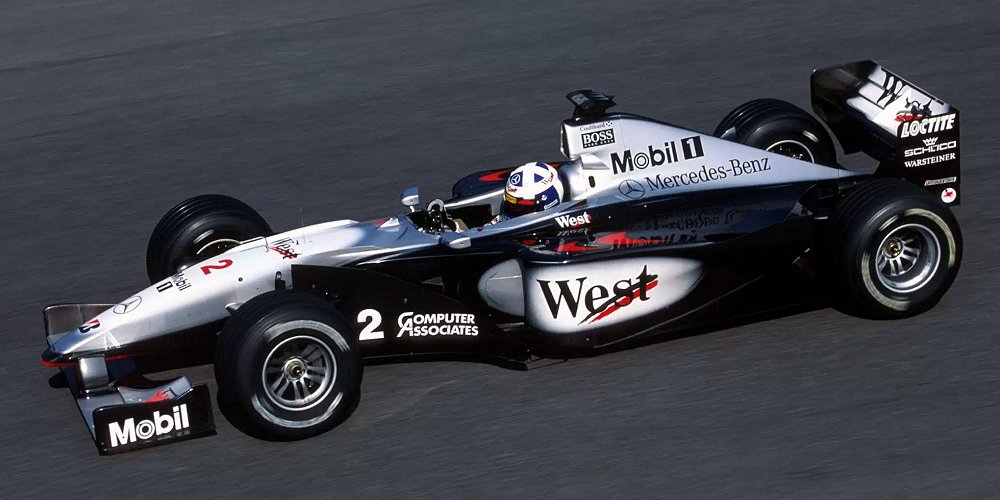
The McLaren MP4-14 Mercedes was McLaren’s 1999 Formula One challenger and the direct successor to the title-winning MP4-13. It carried forward many of the same design philosophies but introduced significant refinements in aerodynamics, weight distribution, cooling layout and electronic systems. In performance terms it was one of the fastest cars of its era, often the outright quickest on the grid, yet persistent reliability problems prevented McLaren from repeating the dominance of the previous season. Even so, the MP4-14 secured the 1999 Constructors’ Championship and delivered Mika Häkkinen his second Drivers’ World Championship.
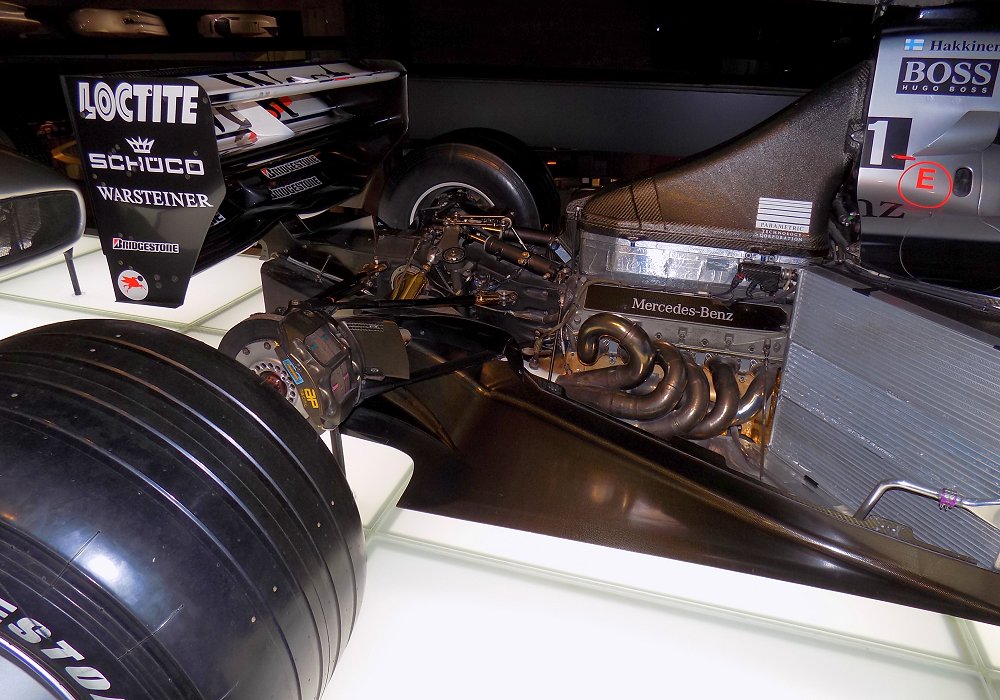
Power came from the Mercedes-Benz FO110H 3.0-litre V10, developed by Ilmor as the next evolution of the FO110G used in the MP4-13. The new unit produced around 785 horsepower at peak revs, making it one of the most powerful engines on the grid. It was lighter, more responsive and more compact, designed to improve rear-end packaging and lower the centre of gravity. Although the engine was extremely fast, it was also highly stressed and contributed to several of the mechanical failures that affected McLaren’s season. When running reliably, however, it provided exceptional acceleration and top-end performance.
The chassis was a carbon-fibre monocoque shaped under the technical direction of Adrian Newey. It represented a further step forward in aerodynamic refinement, with an exceptionally tight coke-bottle rear end, slimmer sidepods and more efficient air management around the car’s centre section. New underfloor sculpting, revised bargeboards and a more intricate front-wing profile provided higher and more consistent downforce than the previous year’s car. The MP4-14 was particularly strong at high-speed circuits, where its aerodynamic stability and engine power combined to produce a formidable performance advantage.
Because of the 1999 regulation changes, including reduced side-impact structures and altered bargeboard positioning rules, the MP4-14 required significant repackaging of its internal systems. Cooling pathways were redesigned to suit the more compact Mercedes engine, the radiators were reshaped and the overall weight distribution improved. The car’s aerodynamic platform was more sensitive than that of the MP4-13, but when dialled in it allowed Häkkinen to deliver some of the most precise and aggressive drives of his career.
Suspension used double wishbones and pushrod-operated dampers front and rear, tuned to work with both the car’s narrow 1998-spec track width and the newly refined aerodynamic platform. The MP4-14’s mechanical balance was excellent, and its steering response was sharp and predictable. It was particularly strong in medium-speed corners, where the combination of downforce and chassis rigidity made it the class of the field. The gearbox was a seven-speed semi-automatic McLaren unit, lighter and quicker-shifting than the previous year’s design.
Electronics continued to advance. While traction control was still banned, McLaren developed sophisticated engine mapping, clutch-control strategies and data-acquisition systems. These electronic refinements improved tyre usage, throttle response and overall drivability, giving Häkkinen and David Coulthard a smoother car over race distance than many rivals.
Inside the cockpit, the layout remained minimalist and driver-focused, with a digital multifunction steering wheel and deeply reclined seating position. Ergonomics were tuned for precise control, with pedal feel and steering weight shaped to Häkkinen’s preferences. The MP4-14 required intense concentration to extract its maximum performance, rewarding smooth inputs and punishing over-driving.
On the track, the MP4-14 was often the fastest car in the field. Häkkinen took multiple pole positions and delivered exceptionally strong race pace, particularly early in the season. However, McLaren suffered a series of mechanical failures, electrical issues and operational mistakes that allowed Ferrari and Eddie Irvine to remain in close championship contention. Despite the speed advantage, McLaren lost several potential victories to engine failures, gearbox issues and pit-stop errors.
The season ultimately came down to consistency versus speed. Ferrari’s F399 was slower but more reliable, while McLaren’s MP4-14 was faster but less robust. Häkkinen’s decisive victory at Suzuka secured his second World Championship, and McLaren claimed the Constructors’ title through a combination of outright speed and Coulthard’s steady points scoring.
Today, the McLaren MP4-14 Mercedes is remembered as one of the quickest cars of the late 1990s and a prime example of Adrian Newey’s aerodynamic mastery. Its blend of power, agility and efficiency placed it at the forefront of its generation, even if reliability prevented it from achieving the same legendary status as its predecessor. As the car that carried Häkkinen to his second title, it remains an iconic machine in McLaren’s modern history.