

Description
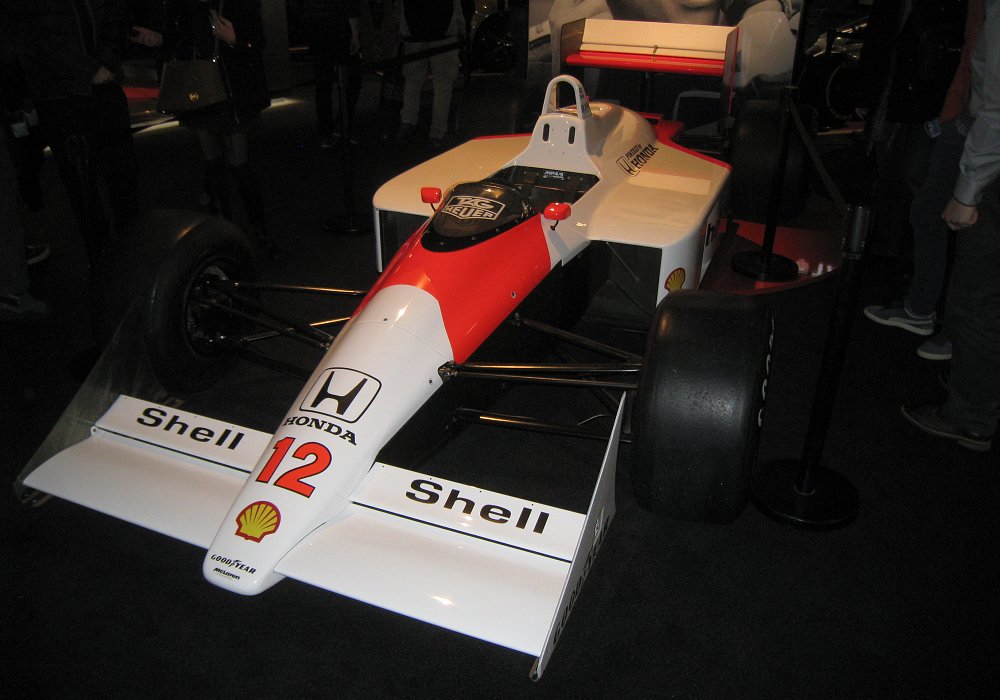
The McLaren MP4/4 Honda was one of the most dominant and technically refined Formula One cars ever built. Raced in the 1988 season, it achieved a level of superiority rarely seen in Grand Prix history, winning 15 of 16 races and securing both the Drivers’ and Constructors’ Championships. Driven by Ayrton Senna and Alain Prost, and powered by Honda’s final-generation turbo V6 engine, the MP4/4 became the defining machine of the last turbo era before new atmospheric regulations reshaped the sport. Its low-profile design, uncompromising engineering and extraordinary efficiency made it a milestone in F1 car development.
The MP4/4 was powered by Honda’s RA168E 1.5-litre turbocharged V6, a compact, highly efficient unit delivering around 650 to 700 horsepower in race specification and significantly more in qualifying trims. Although regulations limited turbo boost to 2.5 bar and fuel capacity to 150 litres, Honda managed to produce an engine with exceptional fuel economy, throttle response and durability. It was light, tightly packaged and perfectly integrated into the MP4/4’s chassis design. The combination of Honda’s engineering excellence and McLaren’s aerodynamic philosophy gave the car unmatched performance over a race distance.
The chassis was designed under the technical leadership of Gordon Murray and Steve Nichols. Murray had arrived from Brabham and brought with him the low-line concept he had used on the BT55, which had been fundamentally flawed but conceptually advanced. McLaren refined and perfected this idea with the MP4/4. The chassis was built around an extremely low driver position, allowing the bodywork to adopt a lower centre of gravity and reducing frontal area. This layout not only improved aerodynamic efficiency but also allowed cleaner underbody airflow, critical at a time before full ground-effects were reintroduced in later decades.
The carbon-fibre monocoque was narrow, rigid and light, forming a strong central structure around which the suspension and engine were mounted. The low-line layout required significant rethinking of internal packaging, especially regarding fuel cell placement, steering rack height and gearbox orientation. The result was a chassis that was exceptionally stable under braking, balanced in high-speed corners and predictable at the limit—qualities Senna exploited with extraordinary precision.
Aerodynamics were carefully integrated with the chassis geometry. The MP4/4’s bodywork was smooth, tightly shaped and free of unnecessary surface disruptions. The low nose reduced drag, while the sidepods were minimised to channel clean airflow along the car’s length. The diffuser and rear wing worked in harmony to generate downforce without imposing excessive drag. The car achieved remarkable efficiency, which was essential under the strict fuel limits of the time. McLaren’s wind-tunnel research produced a package that was both stable and efficient on every type of circuit.
Suspension used conventional double-wishbone arrangements front and rear, but geometry was refined to work with the car’s extreme low-line layout. Ride, pitch and roll characteristics were optimised to maintain aerodynamic stability. The gearbox, developed in-house, offered fast, reliable shifts and aided in packaging the rear of the car. Brakes were carbon-carbon, offering powerful and consistent stopping performance without excessive wear.
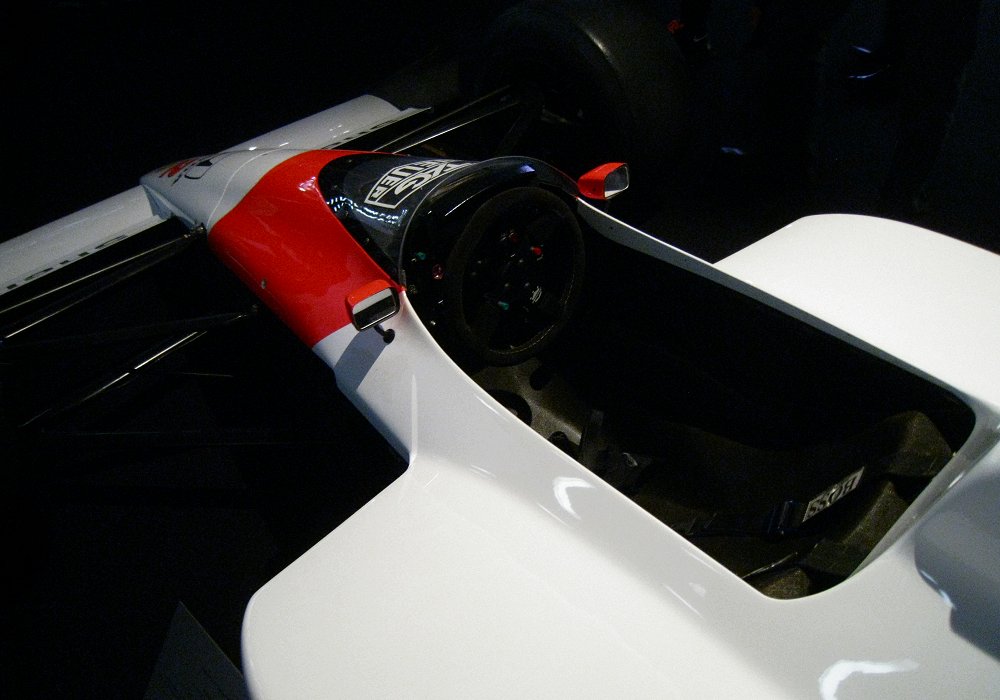
Inside the cockpit, the low reclined driving position was one of the car’s most distinctive features. The driver sat further back and much lower than in earlier McLarens, giving the MP4/4 its striking flat silhouette. Despite the unusual ergonomics, both Prost and Senna adapted quickly. The interior was sparse and focused on clarity—essential gauges, switches and the Honda boost-control interface allowed drivers to manage fuel consumption and power delivery throughout a race.
On the track, the MP4/4 was breathtakingly effective. It was fast in qualifying but even more impressive in race conditions, where fuel strategy and consistent performance mattered most. The car produced stable aerodynamic behaviour, responsive handling and seamless power delivery from the Honda engine. Senna and Prost used these qualities differently—Senna extracting aggressive single-lap speed and Prost maximising strategic precision—but the car suited both styles.
The 1988 season became a showcase of domination. Senna won eight races and secured the Drivers’ Championship; Prost won seven. The team lost only one race, at Monza, after a rare engine issue. The MP4/4 delivered a level of superiority seldom replicated in F1 history.
Today, the McLaren MP4/4 Honda is regarded as one of the greatest Formula One cars ever created. Its technical innovation, its consistent dominance and its association with two of the sport’s finest drivers give it legendary status. It remains a benchmark in F1 engineering—a car that combined visionary design, flawless execution and perfect driver-machine harmony.