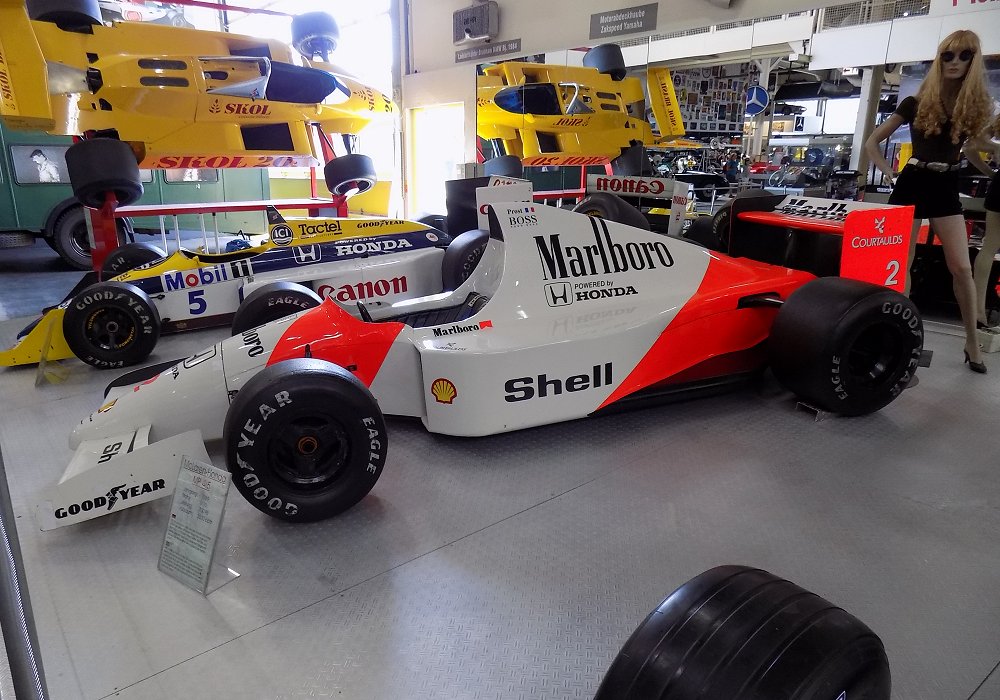
Description
The McLaren MP4/5 Honda was the car that carried McLaren’s momentum from the turbo era into the new normally aspirated Formula One regulations introduced for 1989. It followed the legendary MP4/4 and faced the challenge of replacing what was arguably the most dominant F1 car ever built. Remarkably, it succeeded. The MP4/5 became one of the defining cars of the late 1980s, securing the Constructors’ Championship and delivering Ayrton Senna and Alain Prost another season of fierce, historic rivalry.
The MP4/5 was powered by Honda’s RA109E 3.5-litre naturally aspirated V10 engine, developed specifically for the new post-turbo ruleset. Producing around 675 to 690 horsepower at extremely high revs, the RA109E was light, compact and exceptionally advanced. It made use of cutting-edge materials, precise electronic management and Honda’s expertise in high-revving architecture. Although the switch from turbocharged power to atmospheric induction reduced outright torque, the V10 offered superb throttle response, immediate delivery and a broad usable power band. In qualifying trim, revs exceeded 13,000 rpm, and the RA109E quickly became one of the most admired engines of the era.
The chassis continued McLaren’s carbon-fibre monocoque philosophy, building on the low-line approach established with the MP4/4 but adapted for the new engine architecture. Gordon Murray had stepped back into an overseeing role, with Steve Nichols and Neil Oatley handling much of the detailed design. The MP4/5’s monocoque was stiff, strong and engineered around optimal weight distribution. With the larger V10 replacing the compact turbo V6, McLaren spent considerable effort refining packaging, cooling channels and the shape of the sidepods to achieve maximum aerodynamic efficiency.
Aerodynamics represented an evolution rather than a revolution. Wings were revised for the naturally aspirated era, which required different downforce profiles to maintain cornering performance without the benefit of turbo torque on exit. The nose was slim, low and aerodynamically clean, while the sidepods featured sculpted upper surfaces to guide airflow toward the rear wing. Cooling intakes were larger than on the MP4/4, necessary for the higher thermal loads from the big V10. The diffuser was refined to increase underbody downforce, and overall the car achieved a very stable aerodynamic balance.
Suspension used conventional double wishbones front and rear, with geometry tuned to maintain tyre contact across a range of load conditions. The shift to non-turbo powertrains changed the dynamic behaviour of the car, requiring recalibration of anti-dive and anti-squat characteristics. The MP4/5 maintained McLaren’s reputation for predictable handling and stable braking behaviour. Carbon brakes offered powerful stopping performance, and the gearbox—developed by McLaren—was refined to withstand the high-revving, sharp-delivery nature of the Honda V10.
The cockpit remained tight and functional, with the reclined seating position carried over from the MP4/4. Controls were simple and tactile, with updated electronics to manage the new engine. Drivers had excellent visibility and balance, and the overall ergonomics were tailored for long, demanding race stints.
On the track, the MP4/5 demonstrated immediate competitiveness. It secured wins early in the season and remained fast throughout the year, though reliability challenges and a more competitive field made the 1989 campaign more complex than 1988. The car won 10 of 16 races. Prost, in his final year with McLaren, used his smooth, precise driving style to extract remarkable consistency from the V10, securing the 1989 Drivers’ World Championship. Senna won six races but suffered several mechanical failures and famously collided with Prost at Suzuka, a defining moment in their rivalry.
Despite increasing pressure from Williams-Renault and Ferrari, the MP4/5 finished the season as the most successful chassis on the grid, giving McLaren the Constructors’ Championship by a significant margin. The car’s performance laid the foundation for the updated MP4/5B in 1990, which would go on to secure another Drivers’ Championship for Senna.
Today, the McLaren MP4/5 Honda is remembered as one of the finest examples of late-1980s Formula One engineering. It successfully bridged the gap between the turbo and atmospheric eras, proved competitive in the hands of two of the greatest drivers in the sport’s history and continued McLaren’s run of championship-winning form. Its combination of advanced aerodynamics, a superb high-revving Honda V10 and McLaren’s meticulous design philosophy make it a landmark car in the evolution of F1 technology.