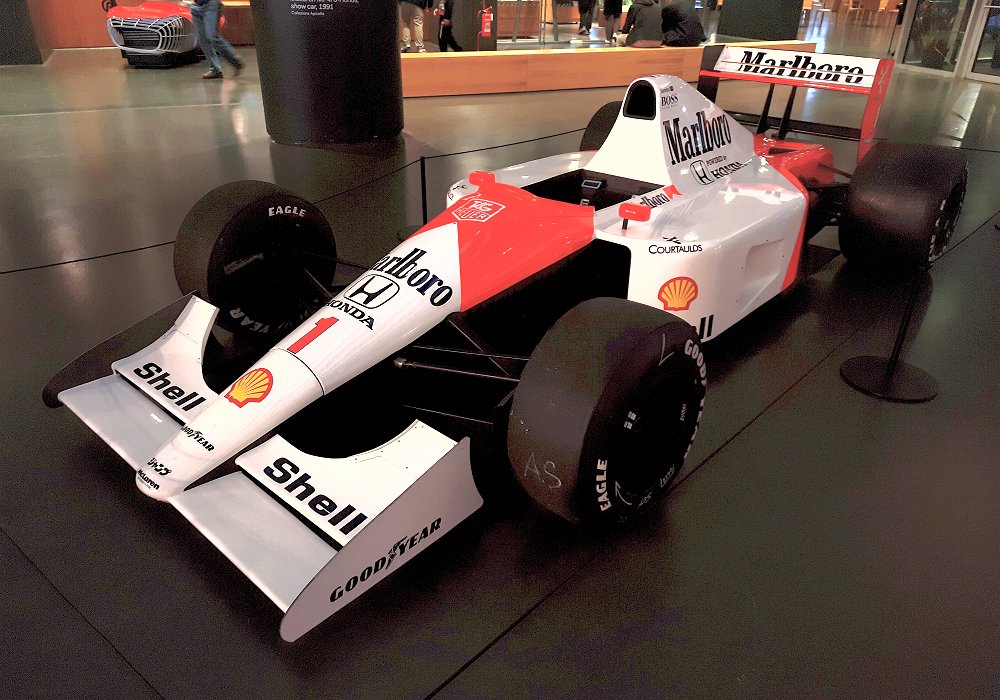
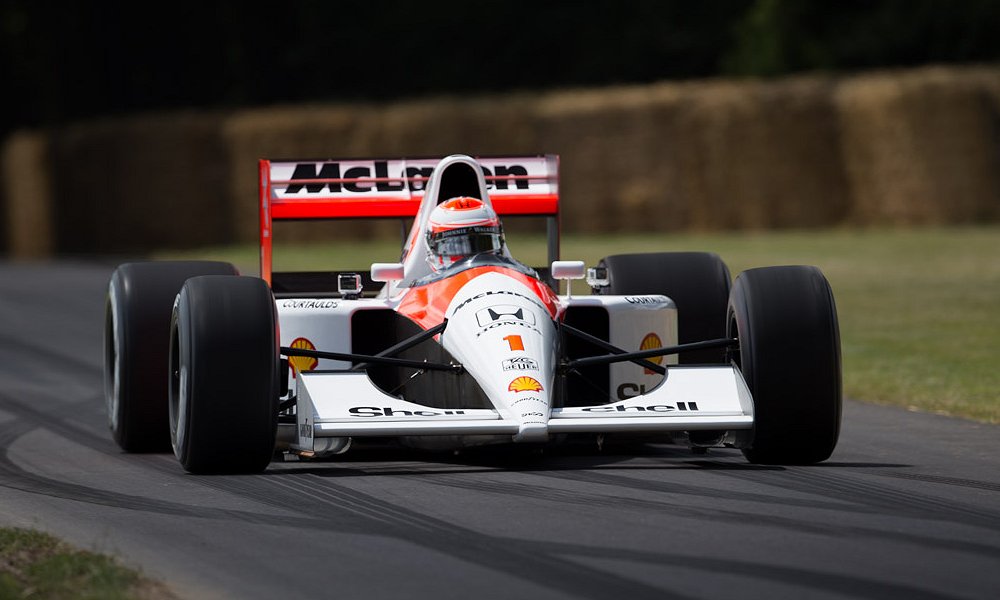
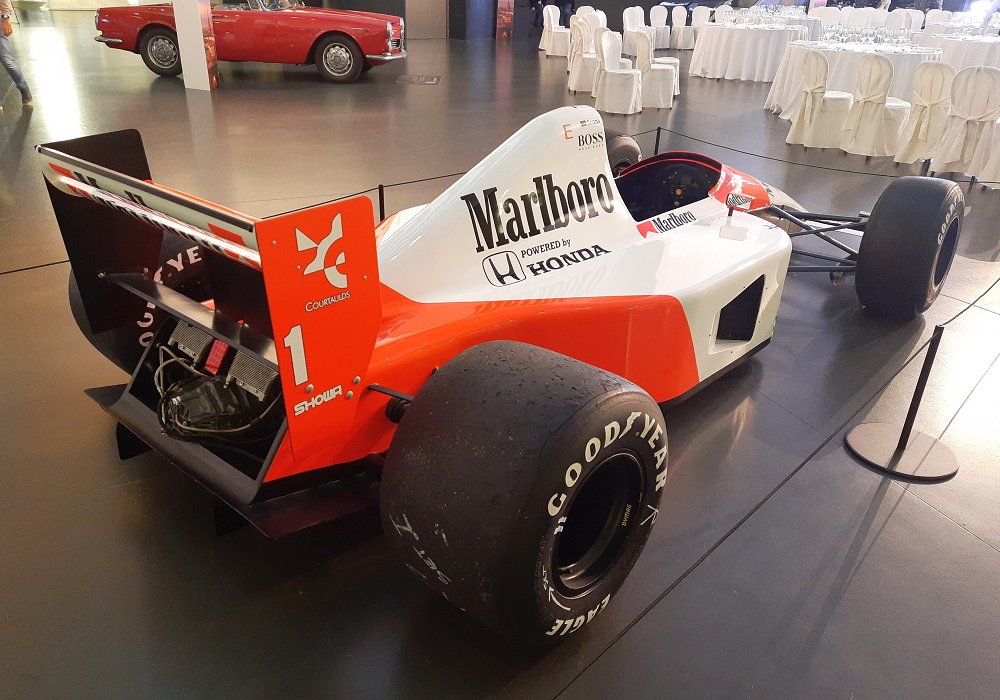
Description
The McLaren MP4/6 Honda was the car that carried Ayrton Senna to his third and final Formula One World Championship and the machine that marked the end of McLaren’s dominant partnership with Honda. Raced during the 1991 season, the MP4/6 combined traditional McLaren chassis refinement with Honda’s first V12-era F1 engine, delivering strong reliability, smooth power and competitive performance through a year of rapidly advancing technology. Although it lacked the overwhelming superiority of earlier McLarens, it was consistently effective and perfectly suited to Senna’s relentless precision.
The MP4/6 was powered by Honda’s RA121E 3.5-litre naturally aspirated V12, a highly complex, high-revving unit capable of producing around 710 horsepower in race trim and more in qualifying specification. The move to a V12 configuration was part of Honda’s strategy to maximise top-end power, smoothness and throttle response in a field where Ferrari and Lamborghini were already exploiting multi-cylinder engines. The RA121E was wide, acoustically ferocious and mechanically sophisticated, with exceptional reliability once early-season cooling issues were resolved. Its power delivery suited Senna’s driving style, offering a fluid, linear response that was ideal for difficult traction zones.
The chassis continued McLaren’s carbon-fibre monocoque design, refined under the direction of Neil Oatley. The structure was stiff, light and engineered to work harmoniously with the V12’s mass and cooling requirements. Compared with the MP4/5 series, the MP4/6 required larger radiators, wider sidepods and re-sculpted airflow pathways to manage the extra heat output from the V12. The overall body profile was slightly bulkier than the previous year’s car, but McLaren worked extensively on airflow management to preserve aerodynamic efficiency.
Aerodynamics were conventional for the era but extremely well developed. The MP4/6 used a clean, slim nose, broad sidepods and a well-balanced rear wing and diffuser combination. The car produced strong overall downforce without excessive drag, and its stability under braking was a major strength. Throughout the season McLaren refined the wings, bargeboards and brake-cooling ducts to maintain competitiveness against the fast-advancing Williams FW14, which featured semi-active suspension and more advanced aerodynamics.
Suspension was fully mechanical—pushrod-operated double wishbones front and rear—reflecting a transitional period before electronic systems began influencing chassis control. The MP4/6 relied on careful geometry tuning, spring selection and damper development to maintain predictable handling. The chassis excelled at slow- and medium-speed cornering, though it lacked the high-speed stability of the increasingly sophisticated Williams. The gearbox was a McLaren-designed manual six-speed unit, operated via a traditional gear lever rather than the new electro-hydraulic paddle-shift systems that would emerge soon afterward.
Inside, the cockpit retained McLaren’s clean, driver-focused layout. The reclined seating position, compact steering wheel, analogue gauges and simple switchgear were typical of the pre-electronics F1 era. Senna’s ergonomics were finely tuned; he preferred precise pedal feel and minimal steering resistance. The car required significant physical input compared with the semi-active or traction-assisted designs that would follow a few years later.
On the track, the MP4/6 was a strong all-rounder. It began the season extremely competitively, with Senna winning the first four races through a combination of outright pace, strategic nous and unshakable consistency. As the year progressed, Williams made rapid gains, particularly with the FW14’s aerodynamics and performance potential, but McLaren’s reliability and Senna’s racecraft kept the team at the front. The RA121E V12 proved both durable and powerful, allowing McLaren to maintain strong race-day performance even when Williams held a qualifying advantage.
Senna’s 1991 World Championship was defined by his performances in this car—his defensive masterclass in Barcelona, strategic brilliance in Brazil and decisive drive at Suzuka all highlighted the MP4/6’s versatility. Gerhard Berger also delivered important results, contributing to McLaren’s Constructors’ Championship victory.
The MP4/6’s legacy lies in its position as the last championship-winning V12 in Formula One and the final title McLaren achieved with Honda before the manufacturer withdrew from F1 at the end of 1992. It also represents the last world title of Senna’s career, adding emotional and historical weight to its significance.
Today, the McLaren MP4/6 Honda is remembered as a classic of the early-1990s F1 era: powerful, beautifully engineered and driven by one of the greatest drivers in history. It stands as a symbol of the final years of pure mechanical Grand Prix cars before the rise of advanced electronics and active systems.