Description
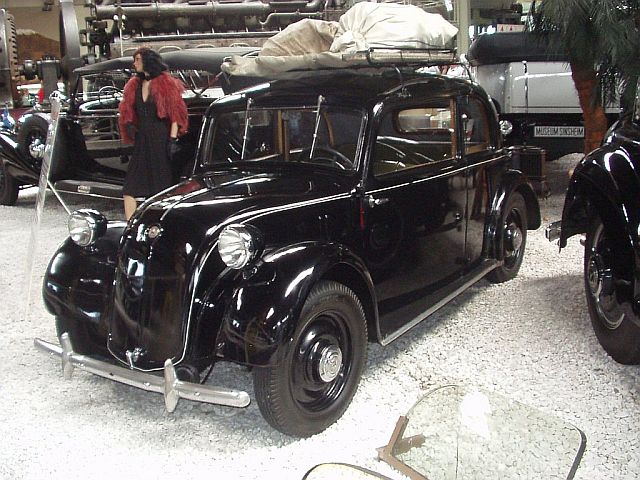
The Mercedes-Benz 130, introduced in 1934, was one of the most unusual and technically bold cars of its era. Known internally as the W23, it represented Mercedes-Benz’s early exploration of the rear-engined concept many years before it became widely associated with the Volkswagen Beetle and later the Porsche line. Compact, innovative and mechanically unconventional, the 130 was intended to offer a modern small car for urban and family motoring while showcasing new ideas in weight distribution, packaging and chassis design.
Its defining feature was the placement of the engine behind the rear axle. The powerplant was a 1.3-litre inline-four, producing around 26 horsepower. While modest, this output was sufficient for the car’s size and purpose. The engine drove the rear wheels through a four-speed manual gearbox, and the mechanical layout provided excellent traction on poor roads. The rear-mounted engine also allowed Mercedes to build a compact passenger compartment with a relatively spacious cabin for the size of the car. Though the car’s performance was limited to a top speed of roughly 90 km/h, it was intended more for efficient everyday driving than for long-distance touring.
The chassis layout followed the rear-engine architecture, with the car’s ladder frame designed to accommodate the unique weight distribution. To counter the heavy rear bias, Mercedes engineers tuned the suspension carefully. The front used a transverse leaf spring with double wishbones, and the rear employed swing axles, a layout that would later become common on several German cars. The handling was distinctive: stable in normal driving but requiring care at higher speeds due to the tendency of early swing-axle suspension to induce oversteer when abruptly unloaded. For everyday city and suburban use, however, the 130 remained predictable and comfortable.
The styling of the Mercedes-Benz 130 was modern and aerodynamic for its time. Its short bonnet—made possible by the lack of a front engine—gave the car an unusual appearance compared with traditional front-engined saloons. The body had clean, rounded contours, with flowing wings and a gently sloped roofline. The compact proportions gave the car an approachable, almost friendly character, while still retaining a level of Mercedes refinement in its detailing. It was available as a two-door saloon, a cabrio-limousine and several practical variants suited for light commercial use.
Inside, the 130 offered more space than traditional small cars of the period. With no engine intruding into the front compartment, the cabin felt relatively open, with upright seating and simple but well-finished controls. The dashboard carried clear gauges and switches, arranged for practicality rather than luxury. Upholstery was durable but comfortable, reflecting the car’s intended role as an everyday family vehicle. Though far less opulent than larger Mercedes models, it maintained the brand’s emphasis on neat craftsmanship and structural solidity.
On the road, the 130 delivered a unique driving experience. The rear-mounted engine provided good traction and quiet running, as much of the noise was behind the passengers. The car accelerated modestly but smoothly, and its compact size made it easy to manoeuvre in crowded streets or tight rural lanes. The suspension tuned for comfort gave the car a soft, compliant ride, especially compared with stiffer, more traditional designs of the early 1930s. Its unusual handling traits were rarely an issue at the speeds for which the 130 was intended.
Although innovative, the Mercedes-Benz 130 was not a major commercial success. Its unconventional layout was unfamiliar to many buyers, and the driving characteristics differed markedly from what most motorists expected. Mercedes refined the concept further with the later 150 and 170 H models, but rear-engined cars remained a niche for the company. Nevertheless, the 130 was a critical step in the evolution of German rear-engine engineering, influencing both contemporary and later designs in subtle ways.
Today, the Mercedes-Benz 130 is appreciated for its historical significance and its distinctive engineering. Surviving examples are rare, and their uniqueness makes them highly interesting to collectors, historians and enthusiasts of early automotive innovation. Though not a high-performance car or a luxury model, the 130 remains an important chapter in the story of Mercedes-Benz experimentation, representing a period when the company explored unconventional solutions to the challenges of compact car design.