Description
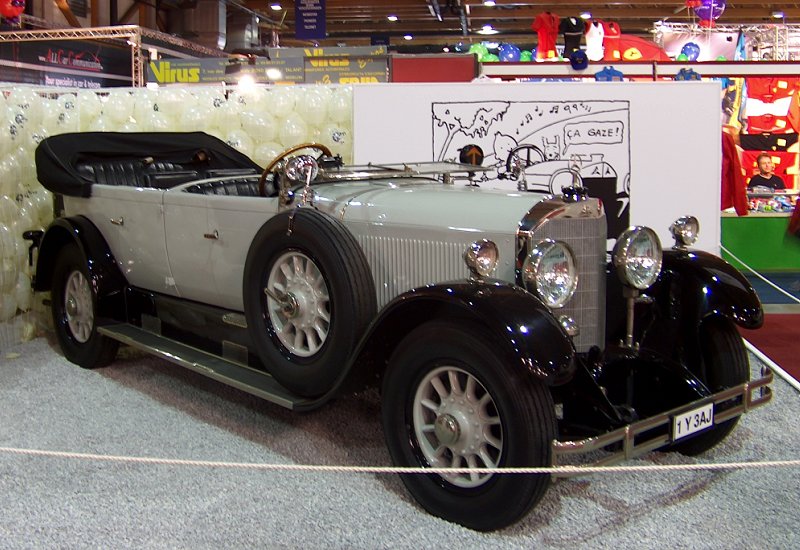
The Mercedes-Benz 15/70/100 PS was one of the key transitional models in the evolution of Daimler and Benz designs during the mid-1920s. Introduced in 1924, it combined the long-established engineering principles of pre-war German luxury cars with the new forced-induction technology that would soon define Mercedes performance. The naming convention follows the German system used at the time: 15 indicated the taxable horsepower classification, 70 the engine’s normal output in brake horsepower, and 100 the power when the supercharger was engaged. That triple-rating format became a trademark of the early supercharged Mercedes models and set the tone for the later S, SS and SSK giants that arrived a few years later.
At its heart, the car used a straight-six engine of 3.9 litres, a robust cast-iron unit driven through a four-speed gearbox, rear-wheel drive and a substantial ladder frame chassis. In normal use, the engine produced around 70 hp, entirely adequate for touring in the 1920s, but the driver could engage the supercharger mechanically via the throttle, at which point the output jumped dramatically to roughly 100 hp. Mercedes used a Roots-type blower, and when activated it produced a very characteristic whine that became familiar in later racing cars. This early version of the system still required careful handling, as prolonged use could stress the engine, but in short bursts it transformed the car’s performance, helping it reach speeds approaching 120 km/h, impressive for its era.
The chassis was conventional by German standards of the time, with rigid axles front and rear and semi-elliptic leaf springs. Steering was heavy at low speeds but stable at higher cruising velocities. Brakes were mechanical and operated on all four wheels, a relatively advanced feature at a time when some manufacturers still used rear-only systems. Bodywork varied widely because customers typically bought the chassis and commissioned coachbuilders such as Sindelfingen, Erdmann & Rossi, or smaller artisans to create open tourers, cabriolets, limousines or sporting two-seaters. The long wheelbase and tall proportions gave the car a dignified presence, and many examples were finished with luxurious interiors featuring polished wood, thick leather and custom luggage fittings.
The 15/70/100 PS occupies an important place in Mercedes history because it marks the early phase of the firm’s supercharged development programme. Engineers were already experimenting with smaller displacement engines boosted to match and exceed the power of larger competitors, a strategy that would culminate in the legendary K-, S- and SS-series performance machines. The dual-output rating system embodied this concept: an efficient touring engine for everyday driving and a powerful forced-induction mode for overtaking or spirited travel. It also helped Mercedes re-establish its technological prestige after the economic difficulties that followed the First World War.
Production numbers were modest, and by 1926 the model evolved into the 24/100/140 PS, with a larger engine and stronger performance. Surviving examples of the 15/70/100 PS are rare today, often preserved in museum collections or high-end private collections. They represent not only a technical milestone but also the aesthetic of 1920s German luxury motoring, combining craftsmanship with innovation. For collectors, the car sits at the beginning of the great Mercedes supercharged lineage and is one of the foundational models that eventually led to some of the most celebrated performance cars of the pre-war period.