Description
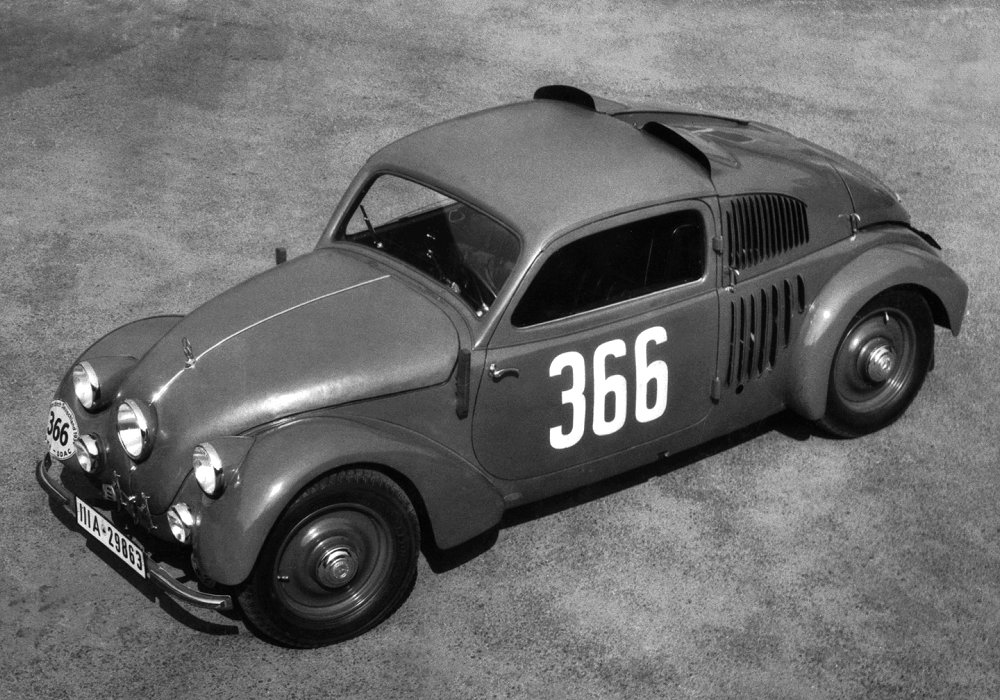
The Mercedes-Benz 150 Sport-Limousine was one of the most unusual and technically progressive compact cars produced by Mercedes-Benz in the 1930s. Introduced in 1934 alongside the 150 Sport-Roadster, it belonged to the small family of rear-engined Mercedes models that represented the company’s brief but bold exploration of radically modern engineering concepts. Known internally as the W30, the Sport-Limousine combined the streamlined silhouette of an aerodynamic fastback with the unconventional mechanical layout of a rear-mounted engine, resulting in a car far ahead of its time both stylistically and technically.
At the centre of the 150 Sport-Limousine was its rear-mounted 1.5-litre inline-four engine. This compact unit produced around 40–45 horsepower depending on carburetion and tuning—modest by Mercedes standards, but strong for a lightweight compact car of the period. The rear-engine configuration freed up interior space and provided good traction, especially on challenging or slippery surfaces. The engine drove the rear wheels through a four-speed manual transmission mounted ahead of the axle, contributing to better weight distribution than many other early rear-engined designs. The car could reach speeds of roughly 110–115 km/h, giving it lively performance for a small family-focused machine.
The chassis was built around a tubular backbone frame, chosen for its ability to support the unusual mechanical arrangement with minimal weight. Independent front suspension with a transverse leaf spring gave the car a smooth ride and good directional stability, while the rear used swing axles, a layout typical of early rear-engined vehicles. This provided comfort and traction but required care during aggressive cornering, as the suspension geometry could induce oversteer when pushed beyond its intended limits. For everyday driving, however, the car offered a level of ride compliance and handling precision that was advanced for the early 1930s.
The body of the 150 Sport-Limousine was one of its most distinctive elements. Instead of adopting the upright saloon styling common in small cars of the era, Mercedes created a streamlined fastback silhouette that appeared strikingly modern. The short bonnet, flowing roofline and tapering tail followed aerodynamic principles that were only beginning to influence European automotive design. The cabin was placed far forward, thanks to the rear-mounted engine, giving the car a unique stance and excellent visibility for the driver. With its clean curves, low stance and compact proportions, the Sport-Limousine looked like a preview of automotive shapes that would not become mainstream until decades later.
Inside, the car offered a practical but attractively arranged cabin. The forward seating position created more legroom than one might expect from such a compact vehicle. The dashboard carried clear, functional instruments arranged around a simple, well-crafted panel. Materials were chosen for durability and lightness rather than luxury, but the build quality reflected the Mercedes ethos. The seating accommodated four passengers, making the Sport-Limousine a more versatile and family-oriented counterpart to the two-seat Sport-Roadster.
On the road, the 150 Sport-Limousine delivered a driving experience unlike any other contemporary Mercedes. The rear-mounted engine produced a distinct sound character, and the car’s compact size made it agile in urban settings. Acceleration was brisk for its class, and the lightweight body allowed the engine’s modest power to be used effectively. The combination of independent suspension and aerodynamic bodywork made the car stable and comfortable at speed, though its rear-engine handling traits meant it rewarded smooth and deliberate driving.
The Sport-Limousine was produced only in very small numbers. Its engineering was advanced, but it arrived at a time when the market for innovative compact cars was limited. Mercedes-Benz was experimenting with new design philosophies rather than establishing a new mass-production direction. The model’s unusual concept, higher price and unfamiliar handling characteristics meant it remained a niche offering. Mercedes later refined the rear-engine idea with the 170 H, but ultimately the company shifted its compact-car development back to more conventional front-engine layouts.
Today, the Mercedes-Benz 150 Sport-Limousine is an exceptionally rare and historically important automobile. Its streamlined styling, rear-engine architecture and modern chassis design place it among the most forward-thinking cars of the early 1930s. Collectors and historians value it not only for its scarcity but for its role in Mercedes-Benz’s experimental engineering phase—a period when the company explored radical solutions to small-car design and produced some of the most intriguing minor models in its pre-war history.