Description
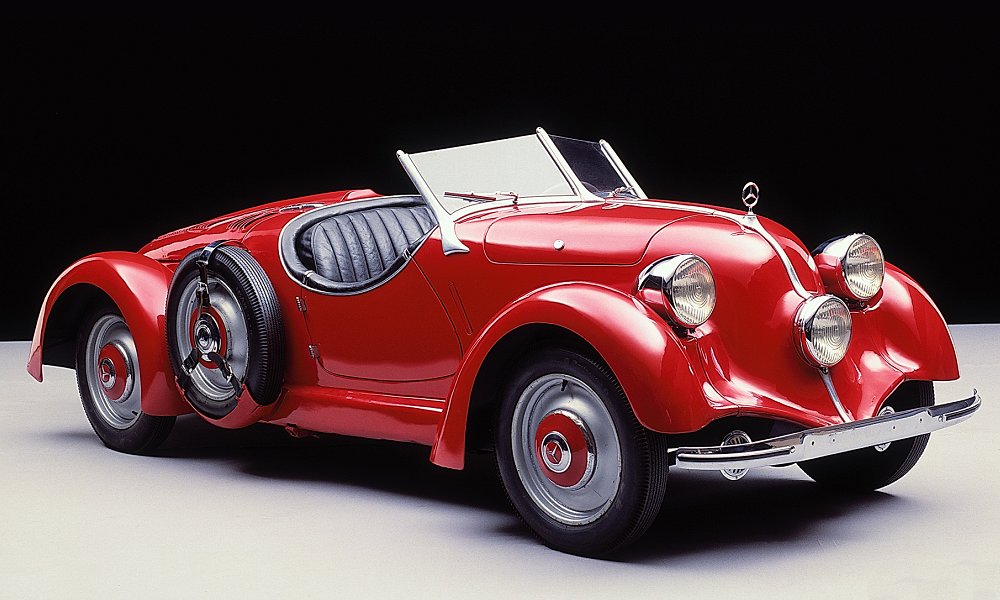
The Mercedes-Benz 150 Sport-Roadster was one of the most striking and technically adventurous small performance cars of the mid-1930s. Introduced in 1934 as part of Mercedes’ brief but fascinating experiment with rear-engined passenger cars, the 150 (internal designation W30) combined a compact layout with a lightweight sporting body and a level of engineering that placed it well ahead of typical small sports machines of its era. It was produced in very small numbers, making it one of the rarest and most unusual pre-war Mercedes models.
The defining feature of the 150 Sport-Roadster was its rear-mounted engine. Mercedes engineers developed a 1.5-litre inline-four fitted with a twin-carburettor setup, producing roughly 55 horsepower. This was a substantial output for such a small displacement in the early 1930s, giving the Roadster lively performance and a top speed in the region of 125 km/h. The rear-engine layout provided excellent traction and allowed Mercedes to package the cockpit far forward, creating distinctive proportions and freeing up space compared with traditional front-engined cars. The drivetrain used a four-speed manual gearbox mounted ahead of the rear axle, helping to balance the weight distribution.
The chassis employed a tubular backbone frame, a design chosen to handle the unusual mechanical layout while keeping weight low. The suspension used independent swing axles at the rear and a transverse leaf spring with wishbones at the front. This setup provided good ride quality and responsive handling at moderate speeds, though—as with many early swing-axle cars—drivers needed to be mindful of rear-end behaviour during very hard cornering. For the car’s intended sporting road use, the combination offered agility, stability and a unique driving character.
The bodywork of the 150 Sport-Roadster was among the most stylish ever fitted to a Mercedes compact model. The two-seat open body featured a low, sleek silhouette with flowing wings and a gently sloped rear deck that concealed the engine compartment beneath gracefully shaped panels. The short, rounded nose—made possible by the absence of a front-mounted engine—gave the car an aerodynamic, modern appearance. The folding soft top was neatly integrated, and the overall design conveyed a sense of youthful speed and technical modernity that contrasted with the more formal styling of larger Mercedes models.
The interior was simple but sophisticated. Two well-shaped bucket seats, a clean dashboard with clear instruments and purposeful switchgear reflected the car’s sporting intent. Weight savings were evident throughout, though the car still carried the careful craftsmanship expected of Mercedes-Benz. Visibility was excellent, and the forward-set cabin made the car feel airy despite its compact dimensions. The driving position was low and purposeful, giving a direct connection to the road and to the car’s unusual mechanical layout behind the driver.
On the road, the 150 Sport-Roadster delivered a distinctive and engaging experience. The engine’s sound and vibration came from behind, providing a sensation more associated with much later Porsche and Volkswagen designs. Acceleration was brisk for the era, and the car’s light weight allowed it to respond eagerly to throttle input. The steering was precise, and the suspension provided a compliant yet controlled ride. The rear-engine balance gave the car excellent traction, especially on steep or loose surfaces, while the overall chassis tuning kept the Roadster predictable when driven with skill.
The 150 Sport-Roadster was built in extremely limited numbers, primarily as a showcase for Mercedes’ rear-engine engineering rather than as a mass-market product. Though technically advanced and visually appealing, the model did not find widespread commercial success. Rear-engined layouts remained a small niche within Mercedes’ portfolio, and the company eventually shifted its compact-car strategy toward more conventional designs. Nevertheless, this brief chapter of experimentation remains an important part of the company’s technological history.
Today, the Mercedes-Benz 150 Sport-Roadster is one of the rarest and most fascinating pre-war Mercedes models. Surviving examples are coveted by collectors for their striking design, innovative engineering and position as one of the earliest sporty rear-engine roadsters built by any manufacturer. It stands as a symbol of Mercedes-Benz’s willingness to explore unconventional solutions and as a vivid reminder of an era when the company combined adventurous engineering with elegant, handcrafted bodywork.